Is this police force professional and capable of handling violen...
/ 2026-10-16 18:54:07Focus


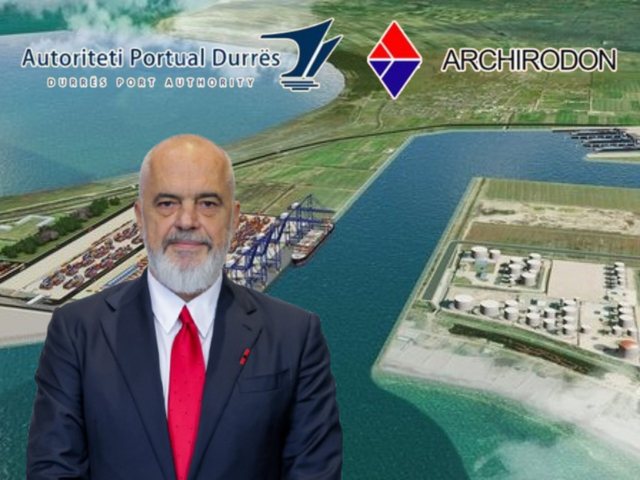
The government claims it is building a superport in Porto Romano that will handle up to 2 million TEUs (containers).
According to the American Chamber of Commerce USA-Albania, the container pier will be only 400 m long, and this is also evident from the project.

Container processing at a port is dependent on three main factors:
1) the length of the quay, i.e. the number of ships and their size in processing,
2) the technology used (automation) or the speed of the container's passage from the ship's hull to the land and vice versa, as well as
3) storage space on the ground, if it is smaller than the quantity processed.
Today, at the global level, the average annual processing per 100 m of quay is 80-120 thousand TEU and the maximum is 150-180 thousand per year.
So with 400 m of quays in Porto Romano, no more than 500 thousand TEUs can be processed per year.
Where did the Government get the figure of 2 million TEU per year?
At least 2000 m of quays are needed for TEU processing to achieve the processing of 2 million TEUs per year at Porto Romano.
Let's compare it to Gioia Tauro in Italy. It has a quay length of 5100 m and processes around 4.5 million TEU per year.
So the yield is 90 thousand TEU per 100 m of quay per year.
For the Government to achieve processing of 2 million TEU per year with 400 m quays, it must break a global record.
For every 100 m of quay, it must process 500 TEU miles per year, 5 times higher than the average of container ports globally.
Meanwhile, the dry ports in Skopje and Pristina have no impact on the TEU processing efficiency in Porto Romano, but on the accommodation capacities on land.