Is this police force professional and capable of handling violen...
/ 2026-10-16 18:54:07Focus


By Séamas O'Reilly – The New Statesman
Amid the fear and confusion that America and Israel have caused with Iran, horror abounds. The death toll on the ground among Iranian civilians is high and continues to rise, while the aerial bombing of a girls' school in Minab, where 150 children were killed, serves as the clearest and most frightening example. The conflict has already spread to fourteen countries, may push Gulf countries to reassess their relations with America, which seems incapable of protecting them from Iranian missiles and risks driving the global price of oil to $150 a barrel. All this while Trump and his friends insist on calling it both a war and not a war, while refusing to provide any consistent justification for starting the conflict, or what their intentions are, either to Congress or to the American public. In short, war is a black hole of irrationality and fear, from which no ray of light can escape. This may be why so many people try to extract even a glimmer of light from the rubble.
For almost everyone, a specific target of perverse pleasure has arisen, perhaps best described by the statement that the Financial Times managed to obtain from “the head of a major global investment fund with a presence in Dubai.” I quote: “it’s very scary – this will have consequences for some of my clients… The idea was that, by being in Dubai, you were not exposed to geopolitics.”
It was a godsend for those who were following the one aspect of this tangled mess that seemed to unite the entire internet: the reactions of wealthy Westerners and influencers in Dubai and other wealthy Gulf states as they tried to post their journey through a war. Richard Keys, a Doha-based presenter, tweeted that he hoped future broadcasts of football matches could serve as a distraction from the violence. Journalist Isabel Oakeshott, based in Dubai, praised the disabled teacher who braved air strikes to teach her daughter, prompting thousands of critical responses. (One particularly bitter response serves as a practical summary of the form and tone of these comments: “My favorite thing about living in a tax-free petrostate built on a mass slave cemetery is when disabled teachers defy Iranian bombs.”) Ian Miles Cheong released a series of surprisingly cool promotional videos for the city-state he has relocated to. Andrew Tate danced into the Dubai sunset and boasted about his plans to move from Saudi Arabia to Dubai, only to be stopped by Saudi authorities. All this amid a trend where wealthy Westerners and influencers showcased the carefree luxury of their lives, under the caption: “Living in Dubai – aren’t you scared?”
Dubai has long been the object of ire for many. It is, inevitably, a tax haven for the super-rich, with an extraordinary concentration of oligarchs, criminals, cartel members and shady characters. It is an oil-rich city-state ruled by an autocracy notorious for human rights abuses, where the death penalty is permitted for both adultery and homosexuality, and where low-wage migrant workers must contend with the Kafala system, which, according to the Global Slavery Index, forces an estimated 132,000 people into conditions akin to modern slavery.
But in the imagination of the world public, Dubai has managed to represent something else, seemingly less political: a kind of shiny trinket, of dubious taste, inhabited by empty people.
Some – mainly Dubai residents – interpret these reactions as a sign of envy. Given that the reaction has been so strong and so widespread, it is difficult to completely deny the argument. In fact, it is not the numerous media articles about crime, politics or finance that shape people’s common image of the city. In a way, those who deride Dubai as a cultureless wasteland that contributes nothing to the world are mistaken. They forget its greatest export today: a target that can be hit without guilt, a symbol of excessive decadence. A Mediterranean New York for billionaires, now a Florence of pleasure in the misfortune of others.
Most people who have seen a glimpse behind the scenes of this city have done so through social media, where posts about the aspired luxury of influencers living in Dubai have become commonplace. Perhaps this is why many find it difficult to systematically criticize Dubai's many problems without falling into contempt, a kind of contempt that would be unimaginable for any other city facing aerial bombardment – often with a clear class subtext.
The anger is directed not so much at the oligarchs or cartel bosses in their skyscraper offices as at Dubai's self-made influencer class. They are attacked in a manner reminiscent of 18th-century pamphlets against the arrondissement aristocrats: disgusting upstarts living in undeserved luxury in a golden Instagramopolis. Some even openly express delight at the idea that these people could be destroyed by bombing – without reflecting that, in all likelihood, the first to disappear would be, so to speak, the modern slaves who work there.
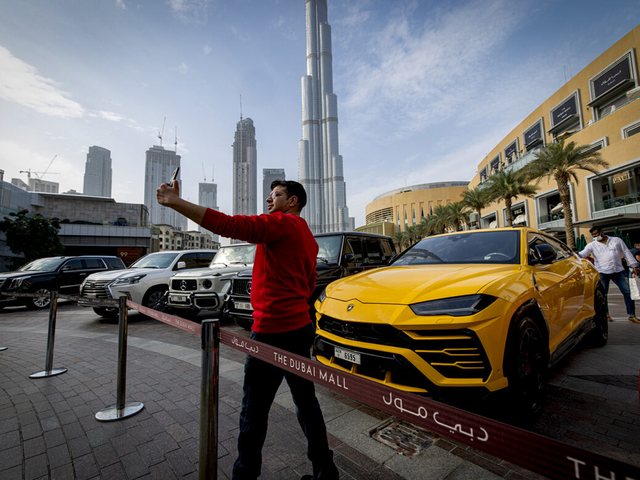
In a way, the internet's envy of the rich and beautiful has reached its peak precisely in Dubai, fueled by endless photos of sterile suites, palm-fringed penthouses and Lamborghini-lined sidewalks. An endless web of sponsored ads, teeth-straightened smiles in Turkey and video tours of glacier-melting indoor ski slopes.
All of this has created perhaps the least sympathetic victims on the planet: those who absorb the blame for the broader horrors of capitalism. A country that does not claim to embody Western values, but in fact encapsulates them in its entirety. A country populated by the characters we can’t stop following every day with our clicks. A country fueled by the energy we consume, praised by the leaders we elect – and now in danger of being leveled by the nations those same leaders bomb.