Is this police force professional and capable of handling violen...
/ 2026-10-16 18:54:07Focus


Federico Rampini – Corriere della Sera
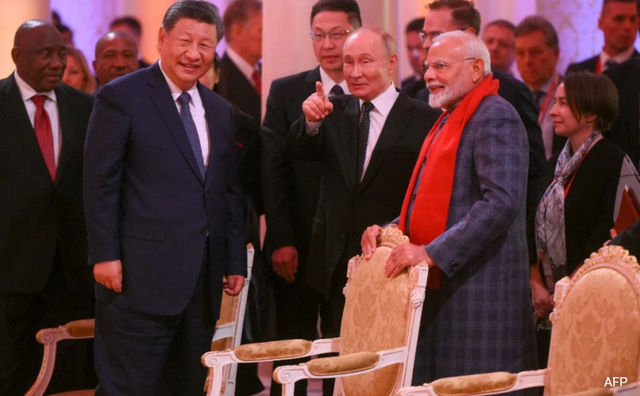
"The rest of the world" has arrived in Beijing these hours, at Xi Jinping's court, to honor him in a series of activities with which the Asian superpower aims to consolidate its geopolitical center. "The rest of the world", that is, everyone, except Westerners.
The gathering of leaders arriving is extraordinary. And it is quite significant to delve into the narrative that the communist regime makes of its doctrine of the new world order, destined to replace the one created by the West. “The Great Global South is no longer the silent majority,” declared the Chinese Foreign Minister, welcoming the many leaders arriving from developing countries.
The culmination of these activities will be the Victory Parade, on September 3. Exactly 80 years since the day of Japan's formal surrender, at the end of World War II. The propaganda of the Chinese communist regime has prepared the celebration with an offensive of historical revisionism. The manuals "rewritten" by Beijing minimize the role of the Americans in that war, accuse the US of not properly telling the truth, namely that Japan was defeated thanks to the heroic resistance of the Chinese.
Even the name changes: That conflict is now called the Great War of Resistance of the Chinese People against the Japanese. Of course, it is a distortion: the Chinese guerrillas would never have defeated the Japanese army alone. Moreover, Beijing hides the fact that those who fought the most against the Japanese invaders were Chiang Kai-shek's nationalist troops, who also fought against Mao Zedong's communists, lost in 1949 and took refuge in Taiwan. Moscow also enters this Chinese revisionist narrative, which "overlooks" the ambiguities of Stalin, who for a long time did not know whether to support Chiang or Mao.
But the Victory Parade on September 3 is not the only event, and perhaps not even the most important. Before it, Xi Jinping will chair the 25th Summit of the Council of Heads of State of the Shanghai Cooperation Organization (SCO) 2025. This summit will be held in Tianjin, the closest port to Beijing, in northern China, on August 31 and September 1. It will be one of the most important diplomatic meetings of the year between heads of state and government. The SCO (founded in 2001) is one of the organizations with which the People's Republic builds its alliances and designs a new world order centered on China. It is accompanied by the Global Security Initiative (GSI), the BRICS and the Belt and Road Initiative, to name just the best known. Unlike the BRICS, the SCO and the GSI are still more strongly influenced by Chinese hegemony.
“Xi wants to advance the ‘Shanghai spirit, take on the mission of our times and respond to the people’s expectations,’” a spokesman said. Xi will announce new ways to “constructively safeguard the post-war international order and improve the global governance system.”
The Tianjin summit will be attended by leaders from over 20 countries and 10 international organizations. The list is impressive and shows the countries that currently want to be “in China’s grace.” Among them: Belarusian President Alexander Lukashenko, Indian Prime Minister Narendra Modi, Iranian President Masoud Pezeshkian, Pakistani Prime Minister Shahbaz Sharif, Russian President Vladimir Putin, Turkish President Recep Tayyip Erdogan, Egyptian Prime Minister Mostafa Madbouly.
Then come the leaders of all the former Soviet republics of Central Asia, all the countries of Southeast Asia, including Indonesia and Vietnam, although closer to the US. Plus dozens of others. As well as the heads of almost all the world's multilateral organizations, from the UN Secretary-General, Antonio Guterres, on down.
"Xi will use this summit as an opportunity to illustrate a post-American international order and to show that the White House's efforts to counter China, Iran, Russia and now India have not had the expected effect," said Eric Olander, director of the China-Global South Project.
To understand Xi’s thinking and the message he will convey to “the rest of the world” at this summit, the main reference is the Communist Party organ, the People’s Daily. In particular, an article by Liu Xuelian, from Jilin University, entitled: “Xi’s New Security Theory.” He explains that the GSI is not just a political proposal, but a real theory, challenging Western doctrines of international relations, such as realism and liberalism. According to him, the rise of China will be quite different from the hegemons of the past.
Xi’s doctrine “goes beyond the Western realist theory that sees security as antagonistic and zero-sum; instead, it affirms the principle of the indivisibility of security.” He emphasizes that unlike the West, which relies on military power and exclusive alliances that foster division and arms races, the Chinese vision strives to see security comprehensively, as shared by all of humanity.
However, despite the new language, this doctrine is a continuation of previous Chinese communist propaganda and is not a specific response to Donald Trump. Since the early 2000s, during the Bush and Obama presidencies, the Communist Party has spread among the BRICS and SCO the idea that China is a peaceful power that has never practiced colonialism, while accusing America of returning to the spirit of the Cold War.
But China’s neighbors know that the reality is different. In the recent communist past, China has participated in aggression against South Korea (1950-53), attacked India (1962), invaded Vietnam (1979), used the army against its own civilians (Beijing 1989), violently suppressed ethnic uprisings in Tibet and Xinjiang (2008-2009), and violated commitments to Hong Kong’s autonomy (2019-2021). Moreover, it exerts constant pressure on all neighbors with whom it has territorial disputes. Former Foreign Minister Yang Jiechi openly expressed this mentality at a summit in Singapore in 2010, when he said: “China is a big country, others are small, this is a truth.”
This language is linked to a thousand-year-old tradition. Imperial China also followed the hierarchical logic of international relations: small neighbors had nothing to fear, they just had to behave like vassals, pay taxes and accept Chinese superiority. But history does not matter. What is happening today is the willingness of the “Great Global South” to legitimize Xi’s narrative. Two European leaders will also participate in the Victory Parade, from Serbia and Slovakia, countries once in Russia’s orbit, today beneficiaries of large Chinese investments.