Protests, violence, curfews: From France to Albania, why Europe'...
/ 2026-10-20 23:47:20Focus


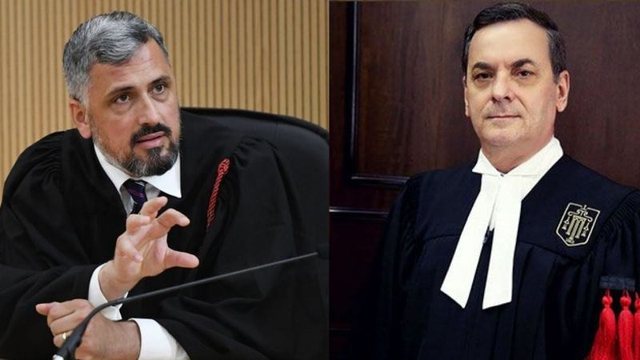
The competition for the vacant seat on the Constitutional Court turns out to have been a formally open, but in reality predetermined process.
Official documents analyzed by Top Channel show that the Judicial Appointments Council and the Supreme Court followed a procedure with repeated violations of the law, which ultimately led to the name of judge Asim Vokshi. At the head of both institutions, as President of the Judicial Appointments Council and the Supreme Court, Sokol Sadushi played a key role in the process that, according to the documents, has circumvented the basic rules of transparency and equality in competition.
After the Supreme Court opened the call for applications, the list of candidates was forwarded to the Judicial Appointments Council for verification of legal criteria. It is at this stage that the first violation occurs.
Asim Vokshi has been notified twice about the withdrawal of his candidacy forms, a practice prohibited by KED regulations, which only allow for one notification within three days of publication. He was initially informed in writing and electronically on January 17, 2025. However, according to documents, KED sent a second notification on January 20 to a different email address declared by the candidate, after the first notification failed. On that very day, Asim Vokshi withdrew the forms and authorized verification.
This administrative intervention raises the fundamental question: how was the second address obtained? Did the Council communicate privately with the candidate, giving him the opportunity not to miss the legal deadline for expressing interest?
In the second phase, during the integrity verification, the Judicial Appointments Council received official information from the National Authority for Classified Information Security (AKSIK), which contained data that, according to the law, constitutes a prohibitive criterion for candidacy.
AKSIK informed the KED that candidate Asim Vokshi appears with indications of collaboration or contacts with intelligence services. But instead of treating this fact as a legal obstacle, the Council considered it "limited information" and continued the evaluation procedure.
On this point, the law is clear. In cases where information comes that may compromise national security, in case of uncertainty, it is the security institution itself that must determine whether these elements constitute a risk or not. The Judicial Appointments Council has no legal authority to decide on its own which elements compromise national security or not.
The KED decision states that “additional verifications with law enforcement institutions” have been carried out, but there is no data indicating that the information has been fully assessed. Contrary to the Council’s own methodology, which stipulates that in case of indicators of integrity deficiencies the candidate should receive 0 points, the KED has given Asim Vokshi the maximum 30 points in the “moral merits” criterion.
Among the signatories of this assessment are two current members of the Constitutional Court, Miriana Semini and Ilir Toska, the latter one of the members who had previously approved Vokshi's candidacy in the vetting process.
The violations continue even in the final phase, during the special meeting of the Supreme Court judges for the voting process. The minutes obtained by Top Channel show that a vote in favor of the candidacy of Naureda Llagami, who had secured 9 votes, the required majority of 3/5 of the 15-judge panel, was declared invalid. With the annulment of this vote, Asim Vokshi was declared the winner with only 6 votes in favor.
In the audio recording of the meeting, judges can be heard objecting to the invalidity of the ballot, but the intervention of President Sokol Sadushi interrupts the debates, leaving the final decision-making to the court secretaries.
Audio recording:
Chancellor Anisa Kulo: "One of the causes of invalidity is any mark other than the voting mark. The Commission considers this ballot paper invalid."
Judges: "Valid, it's a sign at number 2."
Sokol Sadushi: "The commission has the paper in hand. None of the members has the right to be consulted. The commission decides."
The minutes do not reflect the full discussion and lack an integral transcription of the audio, raising suspicions of deliberate concealment of the debate.
From the admission of candidacy to the final vote, every step of this process contains elements that undermine transparency, equality, and legality. In the end, the winner turns out to be the one who, according to the documents, was predetermined to be.
Top Channel, as a national media outlet, has no intention of harming individuals or institutions. Our duty is to inform the public about processes that have an impact on the justice system and trust in constitutional institutions. This reporting is not an act of confrontation, but a natural exercise of democratic control, a form of checks and balances that serves the future of the rule of law in Albania. / TCH