How Belinda Balluku is fabricating the rumor about Top Channel's...
/ 2026-10-19 16:19:00Focus


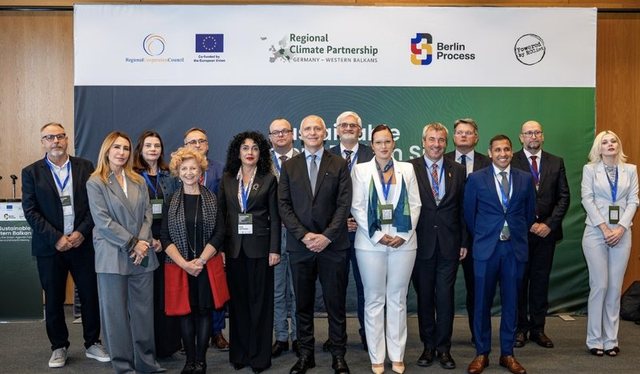
The Western Balkans are moving from promises to action.
The ministers of environment and sustainable development from the six countries of the region adopted today the Dubrovnik Declaration, within the framework of the Second Ministerial Meeting on the Green Agenda for the Western Balkans, organized by the Regional Cooperation Council (RCC) with the support of the German BMZ, the European Commission, the Croatian Government and the United Kingdom within the framework of the Berlin Process 2025.

The declaration marks an important step towards implementing the European Green Deal, setting concrete objectives for nature protection, pollution reduction and climate change adaptation.
Four documents that set the course of the decade:
The region's ministers approved four important documents that concretize the Green Agenda 2025–2030:
• Revised Green Agenda Action Plan, aligning the region with EU policies by concentrating actions from 58 to 41;
• The Climate Adaptation Roadmap, which envisages a Regional Strategy until 2026;
• Regional Plan against Plastic Pollution, which aims to reduce marine and river pollution by 80% by 2028;
• Biodiversity Strategy for the Western Balkans, which aims to protect 30% of land and seas by 2030.
“The Dubrovnik Declaration is not just a political document. It is a commitment to action,” said Amer Kapetanović, Secretary General of the RCC.
“ The Green Agenda is our shared promise to make this region greener, fairer and more resilient ,” he added.
In a region where temperatures have risen by over 2°C, almost double the global average, the need for action is more urgent than ever. In 2024 alone, 11 of the 13 largest fires in Europe occurred in the Western Balkans.
Experts estimate that the region will need $37 billion in investment in the next decade, but sustainable benefits could reach $74 billion by mid-century.
Jan Dusik, from the European Commission (DG CLIMA), stressed that the Western Balkans are an integral part of Europe's green transition, while Johann Saathoff, State Secretary at the BMZ, announced the preparation of an additional financial package of 250 million euros by the end of the year.
The British Ambassador to Croatia, Javed Patel , underlined that “regional cooperation and shared responsibility are the heart of the Green Agenda”, while Croatian Minister Marija Vučković highlighted the success of the Berlin Process as a model of cooperation for the region.
During the meeting, the new Green Agenda Observatory Digital Platform, developed by RCC, was presented, which will monitor the region's progress and increase transparency in the implementation of environmental policies.