Is this police force professional and capable of handling violen...
/ 2026-10-16 18:54:07Focus


Prime Minister Edi Rama's repeated statements over the years that the majority "will not become an obstacle to the investigation of MPs and senior officials", that "we are not anyone's law firm" and that "whoever has problems with justice should face it themselves", are now back in focus in light of recent developments, where Belinda Balluku's immunity is under discussion.
The Institute of Political Studies has compared the publicly articulated positions of Prime Minister Edi Rama for years and it seems to have changed in 2023–2024, when Parliament faced the issue of the incompatibility of the mandate of former Minister Olta Xhaçka.
"The Xhaçka case was archived, but more than that, the parliament has entered a new phase, where the previous rhetoric about respecting the law has shifted to anti-SPAK rhetoric about refusing investigations. The most flagrant case is that of Deputy Prime Minister Balluku, a process that, after the consumption of the principled decision-making in the Constitutional Court, continued for months in parliament," writes ISP.
In the Balluku case, the majority still does not have a decision, but it has indirectly announced the rejection of SPAK's request.
In 5 cases, the Assembly has voted to lift the immunity of legislators, specifically for Tom Doshi, Mark Frroku, Armando Prenga, Arben Ahmetaj, and Sali Berisha.
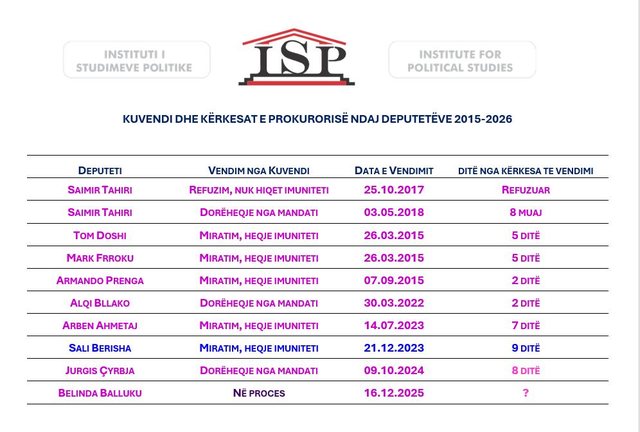
So far, the only case of rejection by the Assembly is for Saimir Tahiri in 2017, when the Serious Crimes Prosecution requested authorization to lift immunity, but the majority considered the accusation's request unfounded in facts and evidence. A few months later, in May 2018, Tahiri resigned from his mandate as an MP.
The Institute for Political Studies' reaction:
“We will not become an obstacle to the investigation of MPs and senior officials accused by the judiciary”, “we are not anyone's law firm”, “whoever has problems with the judiciary should face it themselves”, “the party does not defend the accused”. These are some of the statements made over the years by Prime Minister Edi Rama regarding flagrant cases of officials accused by the judiciary. However, he changed his position in 2023 and 2024 when the Assembly had to decide on the incompatibility of the mandate for former Minister O.Xh., an MP also in the current legislature. When the Constitutional Court asked the Assembly to implement the Constitution, the Prime Minister refused, “The Constitutional Court cannot order how MPs vote, it is impossible. It is theoretically and technically impossible. Because the vote of each MP is sovereign”. His decision was also the decision of the parliamentary majority.
The Xhaçka case was archived, but more than that, the parliament has entered a new phase, where the previous rhetoric about respecting the law has shifted to anti-SPAK rhetoric about refusing investigations. The most flagrant case is that of Deputy Prime Minister Balluku, a process that, after the consumption of the principled decision-making in the Constitutional Court, continued for months in the parliament.
The table illustrates the most well-known cases of lifting immunity - in procedural and political terms, the Tahiri case seems to resemble the Balluku case, the majority took him into its defense a few months before the charges escalated and he resigned to end up sentenced to prison.
In the Balluku case, the majority still has not reached a decision, but the rejection of SPAK's request has been indirectly announced. Without entering into interpretations regarding the guilt or innocence of Ms. Balluku, the main concern is related to the role and approach of parliament and political parties towards immunity and their officials accused of corruption or abuse of office.
If in a democracy, MPs refuse to be investigated, especially if the refusal comes from the governing majorities, the message that citizens receive is that the concept of equality before the law does not apply and that the most powerful are immune to investigations. The Institute of Political Studies (ISP) is monitoring the progress of the investigation process and institutional decision-making, as part of its commitment to implementing the principles of decriminalization and integrity in politics, for clean officials and clean politics.
The initiative is supported by the National Endowment for Democracy (NED). In this role, the ISP recommends that the Albanian Parliament apply the standards of EU countries, including those of the European Parliament, where every official under indictment faces justice, without benefiting from political protection and parliamentary immunity. If the accused official is found guilty, he faces the law, if he is found innocent, he gains credibility and in both cases democracy becomes more reliable, more functional.
The a priori rejection of investigation, equality before the law, and the standard of accountability constitutes a serious deviation from the concepts of the rule of law, and an act undermining faith in democracy.