Is this police force professional and capable of handling violen...
/ 2026-10-16 18:54:07Focus


With two plenary sessions within the same day, the Albanian Parliament approved with 74 votes of the majority the loan agreement of 302 million dollars between Albania and the United States of America, within the framework of the Foreign Military Financing (FMF) program for the modernization of the army.
During the first session, the opposition stated that it supports the agreement in principle, but opposed the manner in which it was reviewed, accusing the majority of violating the Constitution and the Rules of Procedure of the Assembly.

Initially, the Assembly approved the introduction of the agreement through an accelerated procedure. The debate then focused on the fact that MPs were asked to sign a confidentiality declaration in order to have access to the full text of the document. Later, MPs gathered for a second session with closed discussions, which the Democratic Party MPs boycotted.
Secret agreement
At the start of the first session, the Speaker of the Assembly, Niko Peleshi, announced that it was a direct loan from the US Defense Security Cooperation Agency (DSCA) worth 302 million dollars, intended for the modernization of the Armed Forces.
Peleshi explained that MPs could only be made aware of the content of the agreement after signing a confidentiality statement.
On behalf of the majority, the leader of the Socialist Parliamentary Group, Taulant Balla, called the agreement a "historic step" for national security and relations with the US.
"This is a historic agreement for Albania... Albania supports NATO's new 5% target. The funding will be used exclusively for the modernization of the Armed Forces according to the highest NATO standards," Balla declared.
According to him, the funds will be disbursed gradually according to the needs of the Ministry of Defense. Albania will have 48 months to activate them, while the loan provides for a repayment period of up to 12 years.
Opposition in favor of the agreement, against the procedure
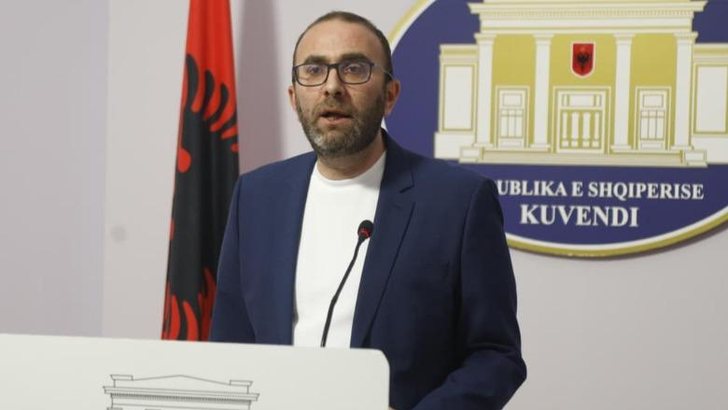
The head of the Democratic Party Parliamentary Group, Gazment Bardhi, stated that the opposition would support the agreement, but opposed the way the government sought to approve it.
"We are in favor of the agreement that increases investments in security and fulfills obligations to NATO. But we are against the unconstitutional way in which Edi Rama seeks to approve it within a day in Parliament," declared Bardhi.
The leader of the DP group accused the majority that the text of the agreement had not been made available to the deputies and that the procedure followed violated the Constitution and the Rules of Procedure of the Assembly.
He also recalled that Albania has not met NATO's defense spending target for years. After the procedural debate, opposition MPs walked out of the second plenary session.
"The plenary session scheduled for today, at 3:00 PM, has been called in violation of the Constitution, which clearly stipulates that the Assembly cannot vote on a law earlier than one week from the moment of the start of its consideration," Bardhi explained an hour before the voting session.
An agreement after NATO pressure
The approval of the loan comes just a few weeks after Albania was placed at the center of discussions within NATO for failing to meet the minimum target of 2% of GDP for defense.
Last month, Reuters reported that hosting the next NATO summit in Albania was under question due to the level of military spending.
In a response to Faktoje, an Alliance spokesperson confirmed Secretary General Mark Rutte's statement that Albania, the Czech Republic and Slovenia had not reached the 2% target by 2025, although the difference was considered relatively small in relation to the Alliance's total budget.
A week before the NATO summit in Ankara, Faktoje asked whether a final decision had been made about the planned summit in Albania.
The Alliance's response was brief: "We do not comment on ongoing discussions between Allies."
Budget increase a few days before the summit
A few days before the Ankara summit, on June 30, 2026, the government approved a normative act that amended the State Budget.
Prime Minister Edi Rama himself linked this decision to commitments to NATO, stating that Albania would provide the necessary funding to increase defense spending.
As a result, the Ministry of Defense budget for 2026 increased from 58.9 billion lek to 69.2 billion lek, an increase of over 10.2 billion lek, or 17.5% more than the initial plan.
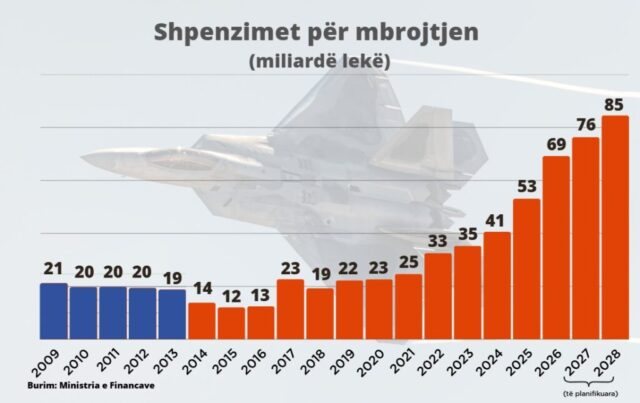
At the end of the summit in Ankara, Mark Rutte confirmed that the next NATO summit will take place in Albania, while the date remains to be determined.
2% target history
The political debate over the loan also brought back the discussion about meeting the NATO objective. Data over the years show that neither during the government of Sali Berisha nor during most of the government of Edi Rama, Albania did not reach the threshold of 2% of GDP for defense.
In 2009–2013, expenditures fluctuated around 1.2–1.4% of GDP, while after 2013 they gradually increased, especially after the Russian invasion of Ukraine in 2022.
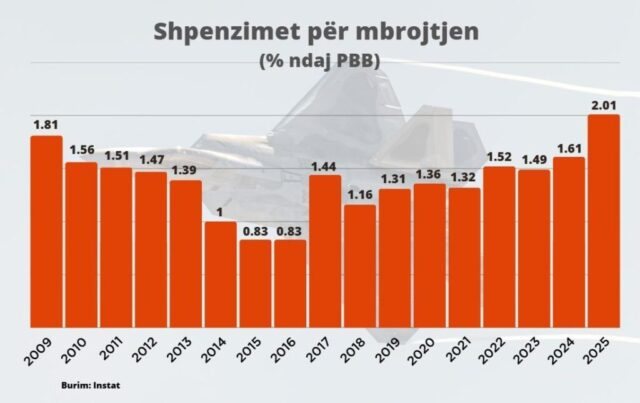
However, according to NATO's assessment, Albania remained below the target even in 2025.
Calculations based solely on the national budget give a somewhat different result, putting the year 2025 at just over 2%.
According to experts, this discrepancy is explained by the methodology. NATO does not only calculate the budget of the Ministry of Defense, but uses a broader definition of "defense spending", which also includes other categories such as military pensions and contributions to international operations.
A loan for military modernization
The $302 million loan is the largest defense financing of this type that Albania has received under the US FMF program.
According to the government, the funds will be used to modernize the Armed Forces according to NATO standards, while any disbursement will be approved by the relevant American authorities.
However, the way the agreement was approved, with an accelerated procedure, two sessions within a day, and limited access to documentation, dominated the political debate more than its content itself. For the opposition, the problem was not the agreement with the US, but the way the majority chose to pass it in the Assembly./Faktoje.al