Protests, violence, curfews: From France to Albania, why Europe'...
/ 2026-10-20 23:47:20Focus


The solar system is a planetary system made up of various celestial bodies that are held in orbit by the gravitational force of our star, the Sun.
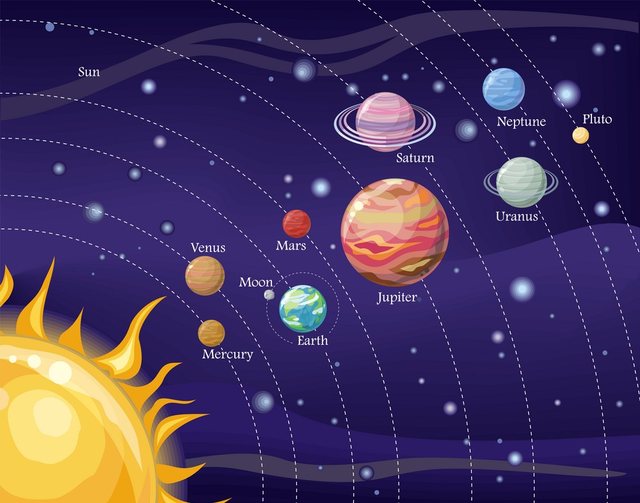
It is composed of nine planets (and their 166 moons), three dwarf planets (Ceres, Pluto, Eris and their four moons), and billions of small bodies. These include Kuiper Belt bodies, several tens of thousands of asteroids, an undetermined but probably very large number of comets, meteorites, and interstellar dust.
The planets of the solar system in order of distance from the sun are: Mercury, Venus (Venus), Earth, Mars, Jupiter, Saturn, Uranus, Neptune and Pluto.
Of these eight planets, six of them have natural satellites commonly named "moons" after Earth's Moon, and each of the outer planets is surrounded by planetary rings of dust and other particles. All planets, except Earth, are named after gods and goddesses of Greco-Roman mythology.
Mercury is the closest planet to the Sun and also the smallest planet in the Solar System. Mercury orbits the Sun once every 87,969 days, completing three revolutions on its axis every two orbits. Mercury is technically a very bright object, but it is difficult to see because the Sun blocks much of its light from being seen clearly.
Venus is the second closest planet to the Sun and the fifth largest. After the Sun and the Moon, Venus is the brightest object in space from Earth's perspective. Venus has been described as the inferior planet when viewed through a telescope from Earth.
Earth (lat: Terra) is the third planet of our solar system. Earth is about 4.55 billion years old and the only planet in our Solar System where life has developed. Earth has only one natural satellite: the Moon. It is assumed that the creation of the Earth came about as a result of the events that followed the Big Bang.
Mars is the fourth planet from the Sun and the seventh in size. Its rotation around itself lasts 24 hours and 39 minutes, while the rotation around the Sun takes 687 days. Mars has two Moons or as they are called Small Satellites that revolve around it. Mars (Greek: Ares) is the God of war. The planet probably got this name because of its red color, which is why Mars has been referred to several times as the Red Planet.
Jupiter is the fifth planet from the Sun and the largest of all the others in the Milky Way galaxy. Jupiter is more than twice the size of the other planets and 318 times the size of Earth. Jupiter has 63 Moons or as they are called Satellites that revolve around it. Most of them are very small compared to some of the larger Moons. Jupiter (Zeus to the Greeks) was the king of the Gods, the prince of Olympus and the protector of the Roman state.
Saturn is a planet of the Solar System. It is the sixth planet from the Sun. It was named after the Roman god Saturnus, called Kronos in Greek mythology. Saturn's symbol is ♄, which is the symbol of Saturn's sickle.
Uranus is the 7th planet from the Sun and the 3rd largest (diameter). Uranus is larger in diameter but smaller in weight than Neptune. Uranus is the ancient Greek God of the heavens. Uranus was the son and companion of Gaia, the father of Cronus (Saturn), the Cyclopes and the Titans (ancestors of the Great Gods). Uranus had been seen many times before, but simply ignored as another star.
Neptune is the eighth planet in the Solar System. It is named after Neptune who was the God of seas and running water.
Neptune is the eighth planet from the Sun in our Solar System. It is the fourth largest planet by diameter and the third largest by mass. Neptune weighs 17 times the mass of Earth.
'Pluto' orbits beyond the orbit of Neptune. It is much smaller than any official planet and is now classified as a Dwarf Planet. Pluto is the smallest of the seven Moons of the Solar System (Io, Europa, Ganymede, Callisto, Titan and Triton). Pluto (Greek-hell) is Lord of the underworld.