How Belinda Balluku is fabricating the rumor about Top Channel's...
/ 2026-10-19 16:19:00Focus


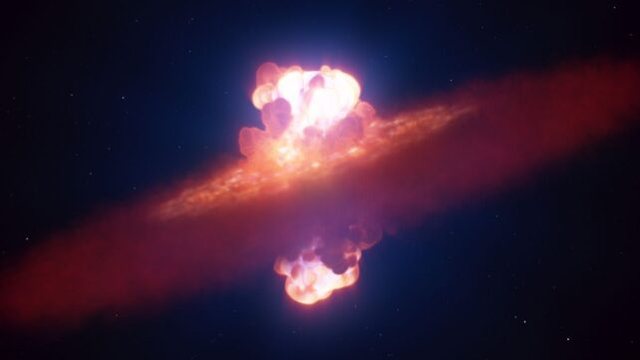
For the first time, scientists have determined the shape of a supernova explosion that penetrated the surface of a dead star.
Supernova SN 2024ggi exploded in April 2024 about 23.6 million light-years away and displayed an olive-like shape before the front part collided with surrounding matter.
These details would not have been apparent if the event had been recorded a day later, highlighting the scientific value of an early observation, the agility to mobilize equipment, and the validity of different observation techniques.
The death of a massive star is a complex process driven by the depletion of fuel in its core.
Stars have a delicate balance. They fuse atoms in their cores to create heavier elements.
Since the resulting matter has less mass, the remaining matter is converted into energy that supplies the external pressure to maintain the stability of the star.
For stars past a certain mass, eons of fusing lighter elements into heavier ones end up filling their cores with iron. This is the end point of fusion.
Since the formation of elements heavier than iron would consume more energy than it releases, the core can no longer generate the outward pressure that keeps the star in a stable state. This is where a supernova is triggered.
Everything that follows happens very quickly. The star begins to explode, producing a wave that travels toward the core, turns around, and explodes outward, piercing the outer surface of the star.
There is a very short period of time before this impact collides with the slower-moving gas, which the star "drags" along over the centuries before it dies out.