Protests, violence, curfews: From France to Albania, why Europe'...
/ 2026-10-20 23:47:20Focus


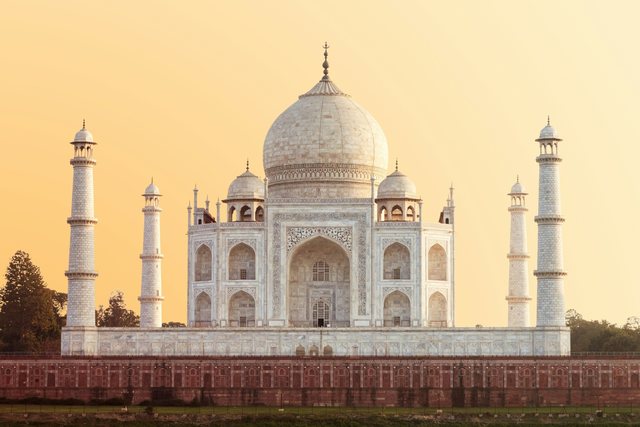
When dealing with a masterpiece of the human mind, which has rightly been called one of the seven modern “wonders of the world”, the question of the cost of construction seems trivial, unnecessary and ultimately irrelevant. And yet, in the case of the Taj Mahal, the incredible story of its construction and its cost add even more to the grandeur of the white marble monument, which reflects royal grandeur and the despair of the loss of a great love.
A special love story
It is known to all that the Taj Mahal is a combination of a mausoleum and a mosque. This construction became a reality both for the worship of God and to house the tomb of Mumtaz Mahal, the beloved wife of the Indian emperor Shah Jahan. The love story that inspired the monument itself is touching, which is why it is also unique in Indian historiography.
Shah Jahan and Arjumad Banu Begum met and became engaged when he was 15 and she was 14. He was the eldest son of the Mughal emperor (this was the name of the empire that stretched across the entire northern part of the Indian subcontinent) and she the daughter of one of the most powerful Persian noble families. Their marriage was arranged largely for political purposes, but legend insists that they fell in love at first sight. Exaggerations are common in these accounts, but events show that in this case they were not far from the truth. Shah Jahan had three marriages, mostly for political purposes, but with the other two he had one child, as was his custom to have heirs from all his wives. With Arjumad, whom he called Mumtaz Mahal (Exalted One of the Palace), he had 14 children in the 19 years of their relationship.
In the 11 years that they were officially married and she held the title of “imperial consort,” Mumtaz Mahal accompanied her husband on his war campaigns, something completely rare for that time, when women rarely left the palaces. She exerted an extraordinary influence on him, advising him on diplomatic, financial, and even military matters. Therefore, her loss, on June 17, 1631, from hemorrhage after the birth of her 14th child, plunged him into despair.
Shah Jahan was on a war campaign at the time of her death. He immediately canceled everything and for a week he locked himself in his tent in mourning, something unprecedented in the long history of Indian rulers. And not only that: according to reliable sources, he was the first eastern ruler to decide to wear dark clothes to mourn his wife for a year. The idea of honoring her memory by creating a magnificent tomb (something also unprecedented for the time) came to him in the first days of mourning.
A human masterpiece
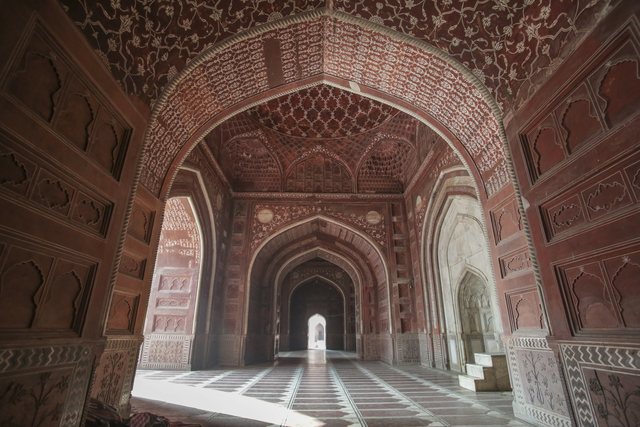
The completion of the monument took 22 years. It is not a simple building, but the formation of an entire area of 17 hectares. The complex of buildings incorporates the design traditions of Indo-Islamic and Mongol architecture. Symmetrical constructions with the use of various shapes and symbols have been applied there. While the mausoleum is made of white marble incorporated with semi-precious stones, red sandstone has been used for other buildings in the complex similar to the buildings of the era of the emperors of the time. The construction work was carried out under the guidance of a board of architects led by Ustad Ahmad Lahori, the architect of the emperor's court. The entire complex is located on a 300-meter-long and 8.7-meter-high platform on the banks of the Yamuna River. The platform is built with different patterns of dark and light-colored sandstone.
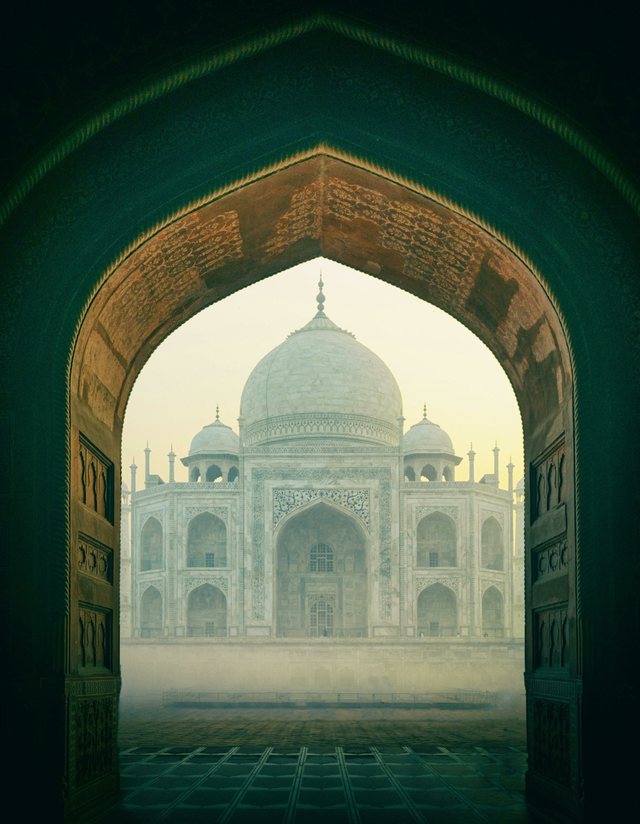
The complex is built mainly of bricks and lime mortar. The exterior of the main building and the interior of the main cenotaph are clad in white marble. The other interior surfaces and other buildings are clad in red sandstone covered with red octagonal stone for protection, except for the exterior surfaces of the domes. The white marble came from the Rajasthan region, while the red sandstone was quarried from the state of Uttar Pradesh. Many precious and semi-precious stones used for decoration were imported from all over the world, such as jade and crystal from China, turquoise from Tibet, lapis lazuli from Afghanistan, sapphire from Sri Lanka, and carnelian from Arabia. In total, 28 types of precious and semi-precious stones were set in the white marble.
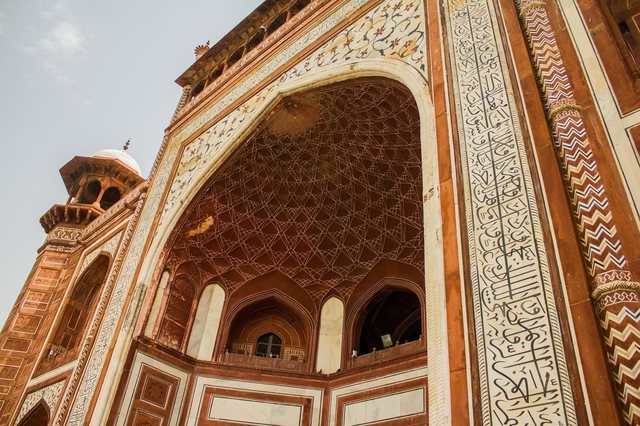
More than 20,000 craftsmen, laborers, painters, and others participated in the construction of the mausoleum. Specialist sculptors from Bukhara, calligraphers from Syria and Persia, designers from southern India, stone carvers from Baluchistan, and Italian craftsmen were employed. A 15 km long ramp was built to transport marble and materials to the site, which was pulled on specially made wagons by teams of oxen and elephants. An elaborate system of pillar and pulley beams was used to raise the blocks into the desired position. Water was drawn from the river by a series of animal-powered hoists.
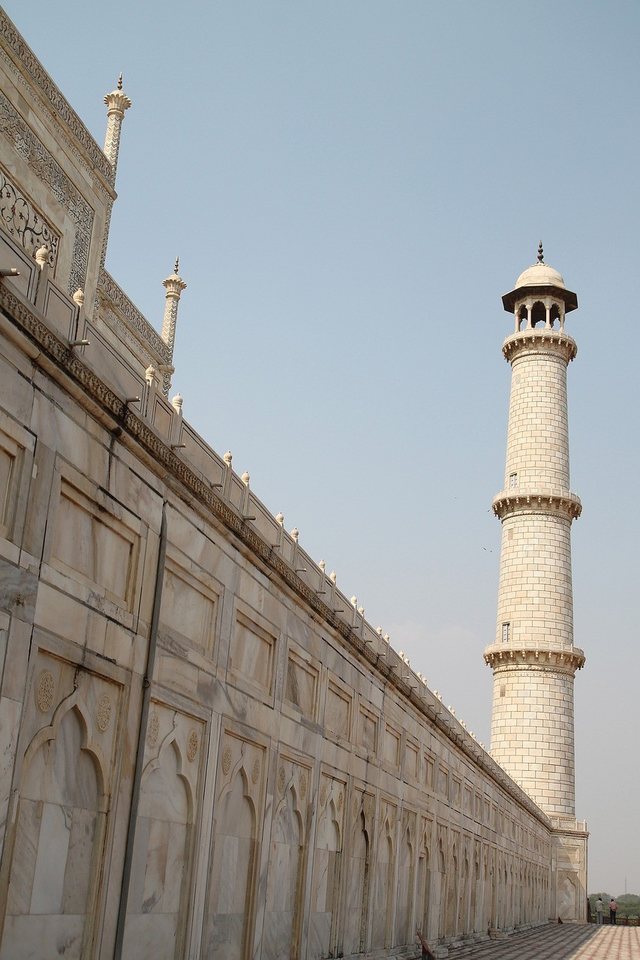
The empress's remains were moved to the imposing monument on the 12th anniversary of her death, on February 6, 1643. Work, of course, continued mostly outdoors for another five years. It is very difficult to calculate the exact cost of this colossal building, but according to estimates by experts and UNESCO, at today's prices it would amount to 80 million dollars.
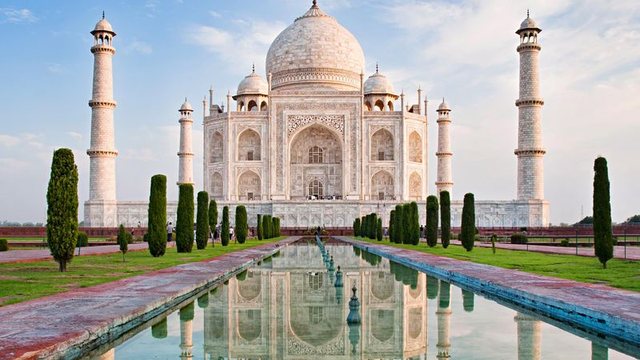
Such was the tranquility that the image of the Taj Mahal evoked in Emperor Shah Jahan that he visited it very often and left instructions to be buried next to his beloved wife when he passed away. The emperor was dethroned in 1658 by his (second) son Aurangzeb, and when he was told that he would be under house arrest for the rest of his life, he asked to be moved to a building overlooking the Taj Mahal. His son granted this wish, but also his last: Shah Jahan's tomb is located in the mausoleum, next to that of his beloved wife.