Is this police force professional and capable of handling violen...
/ 2026-10-16 18:54:07Focus


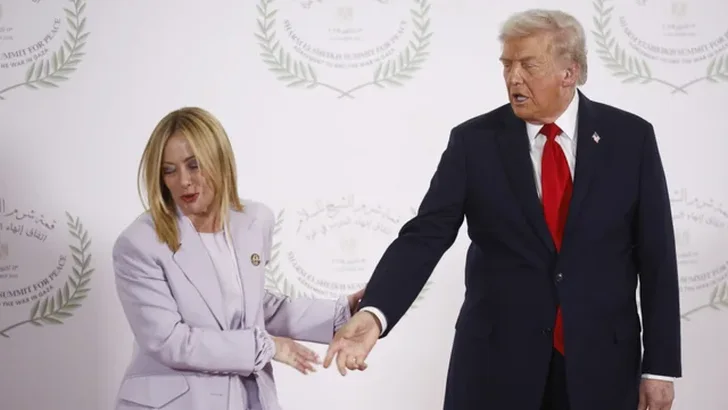
The recent case between Donald Trump and Giorgia Meloni, where the US president claimed that the Italian prime minister "begged" him for a photo during the G7, while she categorically denied it, calling the statements "false and fabricated", should not be seen as an isolated diplomatic episode.
More than that, it is part of a broader pattern of Trump's political behavior toward European leaders and traditional US allies.
Rome's swift reaction, through Meloni and then Foreign Minister Antonio Tajani's decision to cancel the visit to the US, shows that this was not treated as a media misunderstanding, but as a matter of political and institutional dignity. In diplomacy, the cancellation of a visit is not a technical detail, but a political signal.
This episode gains fuller meaning when seen in the context of Trump's similar statements towards other Western leaders. Emmanuel Macron has been described by Trump as a leader who is "always wrong", Keir Starmer has been described as "not Churchill", while Friedrich Merz has been criticized as uninformed. Clashes with Spain and Canada have also been placed in the same vein, mainly over trade and geopolitical issues.
In this series, Meloni is not an exception, but part of the same pattern: a way of communication where European leaders are not treated as equal strategic partners, but as actors who are publicly evaluated by Washington according to their behavior towards the American agenda.
Meloni, the word falls, 'suffers' because of his defense of Pope Leo XIV in his public battle against Trump, as the latter once again cynically mocked the world leader of Catholics through derogatory comments.
This approach departs from the classical tradition of transatlantic relations, which is built on institutional coordination and compromise. Instead, Trump seems to view the international system as a balance of power and political personalities, where dominance and public perception carry more weight than the mechanisms of conventional diplomacy.
This is where the Meloni case becomes significant: it is not just about a disputed statement, but about how a major US ally reacts when it feels its institutional respect is being questioned. The cancellation of Tajani's visit is an expression of this boundary.
The position of the Italian political and public factor is the same. There is no division. No attacks against Meloni because of Trump's comments. But a cohesion that in fact what is being attacked is not Meloni, but Italy itself!
In this sense, the clash is not personal between Trump and Meloni, but a symptom of a broader tension between the US and Europe, where the very way in which the Western alliance is being redefined in a new political phase is being questioned.
And the new sucker of the spirit opposing Trump seems to be his former voice in Europe, his 'favorite', Giorgia Meloni.