Details of the storm in the administration, here's who will resi...
/ 2026-10-22 22:25:00Focus


More than two weeks have passed since Volodymyr Zelensky announced that Kiev agreed to the American conditions, as formulated amid tension and pressure in Washington, regarding the rare earth minerals deal.
No American response has reached Ukraine to date, where it should say "we sign immediately, and we agree."
Despite Ukraine's second step, which accepted the American proposal for a 30-day ceasefire, there has been nothing concrete.
On the contrary , because there is no "vacuum", Europe seems to have maintained its intensity and reflexes and has no intention of letting this opportunity go to waste.
Specifically, France and England have developed a direct and, above all, efficient communication channel and have managed to build - even at a theoretical level - a plan for multi-level support for Ukraine for the coming period.
At today's trilateral meeting in Paris, Macron and Starmer once again gave Zelenskyy assurances that London and Paris have the means and likely the authorization from much of the rest of Europe to accelerate actions that will provide certainty and an advantage, if any, to Ukraine in a future peace negotiation with Russia.
The US, from the beginning, has characterized the three-year war in the east of the Old Continent as a European "problem", and appears to have "frozen" the negotiations, at least in appearance, after the second official phone call between Putin and Trump.
Marco Rubio, of course, has talked about developments in the near future and Donald Trump insists that there will be a positive outcome, but from theory to practice - especially in such a complex and bloody "problem" - there is always a long distance. Germany may not have been present in the European bloc supporting the new Ukrainian effort, but this was for formal reasons. The new German Chancellor has also made it clear that the France-Germany-Britain axis is stable and has the same orientation on this concrete issue.
Guarantees from Europe and pressure on the US
France and Britain appear to have given their plan to Volodymyr Zelenskyy today, regarding the security guarantees that the Ukrainian president is seeking, and apparently will not receive, from Washington.
Paris and London are now clearly talking about intensifying cooperation at the military level, and the Defense Ministers of Britain and France are immediately traveling to Kiev to take a close look at the needs of the Ukrainian military and inform their countries' governments accordingly.
Regarding this plan, Emmanuel Macron and Keir Starmer reiterated that they have no problem deploying a certain number of their forces at strategic points in Ukraine, a day after the signing of the peace agreement between Russia and Ukraine.
It is precisely this move that the White House cannot stop or disapprove of, as it itself pushed in this direction, but at the same time it currently creates significant problems in negotiations with Moscow, as the Kremlin considers the deployment of soldiers as a "provocation."
Although no details have been released about further steps in Ukraine's strategic strengthening, it should be considered certain that, along with France and Britain, Germany is on the same wavelength - in the group of "volunteers."
The French and British plan should also include support from the European Union, as an important part of the "ReArm Europe" program includes corresponding funding.
However, the "ball" that the US threw to Moscow at the beginning of the month has returned to the other side of the Atlantic, as Europe, which is in the middle, decided this time to let it pass.
Trump must find a way to overcome Russian objections and the diplomatic defense that Putin is playing, and manage, without delay, to deliver the promised results.
"Zelenskyy's Country" and the new strategy
A specific statement by Volodymyr Zelenskyy from the Presidential Palace in Paris has left an impression. The Ukrainian president meaningfully noted that Ukraine should be the choice of the entire West in Eastern Europe, and not of Russia.
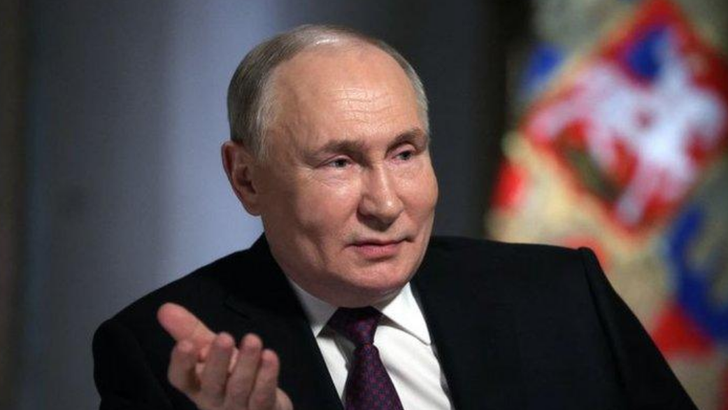
Wanting to emphasize his words, Zelensky emphasized that "Putin will die, I am young," initially raising some questions about whether the translation given was accurate or whether the Ukrainian president meant something different.
Zelenskyy, playing the "card" of veiled provocation, attempted for the first time to use a "traditional" Putin weapon against him.
The Russian president, who in his speech at the start of the Russian invasion of Ukrainian territory in 2022 spoke of the "special operation in Ukraine" and often himself and his circle have characterized the Ukrainian president as a drug addict, but today took a "bullet" from the opposing camp for the first time.
Zelenskyy, speaking in this tone and mainly using these specific words, was referring to the age of the Russian president, but he did not reiterate or clarify anything, leaving open even the most extreme scenarios.