Is this police force professional and capable of handling violen...
/ 2026-10-16 18:54:07Focus


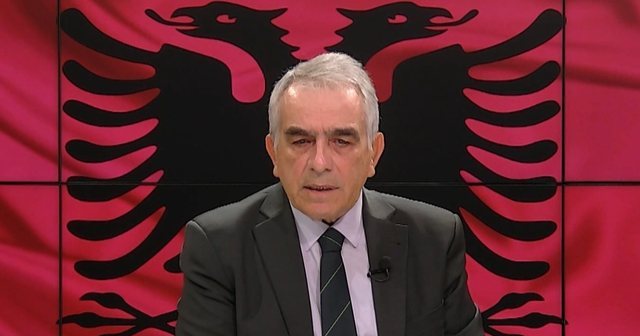
In the context of the 81st anniversary of the Liberation of Albania, renowned historian Prof. Pëllumb Xhufi brings in Albanian by Dritan Hila on Dritare TV an in-depth analysis of World War II in Albania, based on British, American and Italian archival documents that shed light on often debated historical truths.
During the interview, Xhufi touches on hot topics such as the real number of martyrs, the role of the National Front, and the extraordinary history of the Italian battalion "Antonio Gramshi".
One of the key points of discussion was the annual debate on the date of liberation and the number of martyrs. Xhufi emphasizes that the figure of 28 thousand fallen is not a communist myth, but a reality supported by the intensity of the war and international documents. He argues that Albania ranks among the countries with the strongest resistance in Europe in relation to its population, a fact confirmed by great historians such as Martin Gilbert.
According to Xhufi, attempts to devalue this figure or to simplify the partisan war as an ideological war are a form of historical revisionism that damages national memory.
"We have 28 thousand martyrs according to documents, but there could be even more. Let's not forget that there was a war and there are many missing persons. These 28 thousand martyrs are mainly partisans organized in partisan units from the smallest like Çetats to Divisions. In addition to these, there are also members of the territorial Çetats (an integral part of the National Liberation Army), but let's not forget those who started it, who first raised the alarm.
It was precisely the members of the guerrilla units who first organized the Albanian youth in the city and then in all the regions. They are all those who did not choose to be indifferent but to shoulder a patriotic duty, an extraordinary challenge such as that of the Second World War, which was carried out under the motto that sealed it, Winston Churchill.
Churchill, on June 22, 1941, the day after the Soviet Union was attacked, gave a rare speech that is always remembered for its dramatic content. He said:
"I am the greatest anti-communist. Everyone knows me, I have nothing to hide. But today I am with the peoples of the Soviet Union, who are fighting not only for their freedom but also for our freedom."
"Therefore, we say to everyone that whoever sides with us in this struggle for existence against Nazism is our ally. Whoever sides with the Germans is our enemy."
This speech also followed the stance taken by the major allies such as the British, Americans, and Soviets towards the peoples who were occupied by the Nazis.
"That's why it's a great shame to distort the history of the war. A historian should cite the page where he gets the documents, not hide the truth. Or to tear up documents as happened in the Albanian Archives, which 40 years ago you could find, today they are no longer there," said the historian.
Professor Xhufi also brought to attention an often overlooked chapter: the fate of the 20,000 Italian soldiers who remained in Albania after Italy's capitulation in 1943.
He describes the noble gesture of the Albanian people, who, despite poverty and danger from the German Nazis, sheltered these former invaders in their homes. Further, he details the formation of the "Antonio Gramshi" Battalion, where about 1,500 Italians joined forces with the Albanian partisans, fighting heroically to the end. This unusual alliance proves, according to Xhufi, that the war was not simply national, but a great clash of anti-fascist values. Regarding the collaborators of fascism and the myth of "Greater Albania" under the Nazis, Xhufi was categorical.
He argued that territorial unification under German occupation was an illusion and that documents prove that the Balli Kombëtar chose to cooperate with the occupier to fight the communists, a movement that was morally rejected even by British officers of the time. He brought the example of the conversation between Skënder Muço and British officer Kuelle, where the position of the great allies is clarified: whoever fights the Nazis is an ally, regardless of ideology.
Finally, the historian raised the alarm about the way history is being taught in schools today, criticizing superficial approaches that overlook the essence of the anti-fascist struggle. He called for a reading of history without the political complexes of the day, honoring the sacrifice of those young people, often the intellectual elite of the time, who gave their lives for freedom. For Xhufi, anti-fascism remains a fundamental European value that must be protected from deliberate political distortions.