Protests highlight trauma crisis, operating rooms under reconstr...
/ 2026-10-15 18:35:16Focus


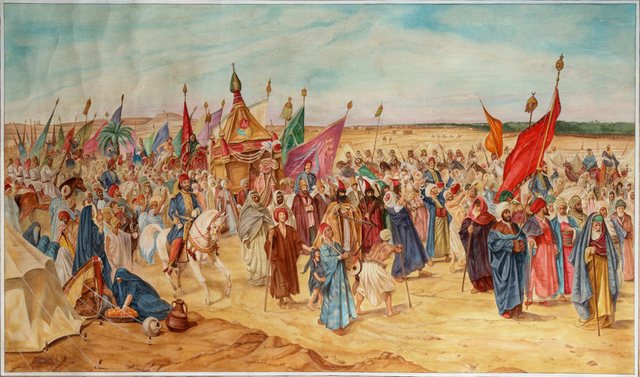
With the beginning of the pilgrimage to the holy place of Mecca, a few lines on the history of Albanians with this holy place.
The arrival of the Albanians for the holy pilgrimage to Mecca does not have a specific date, since the keeping of records by the Albanians has been one of the great “curses” of this nation. Although participants in many historical events, both in the East and in the West, unfortunately Albanian sources are very few. However, thanks to their protagonism, as well as the clothing that distinguished them from the other nations of the Ottoman Empire, often foreign travelers or artists have captured special moments of the Albanians in the eastern spaces.
The presence of the Arnauts in Mecca must have begun with the influence of Istanbul on the Arabian Peninsula and the protection of Mecca and Medina by the Ottoman sultans. The holy caravans of pilgrims were attacked and robbed by the Bedouin tribes of the desert, which created a huge problem for the Istanbul authorities. The massacre of 1750, where the Bedouins massacred over 20,000 pilgrims, made the importance of preserving the caravans one of the most acute problems of the sultanate.
Due to the great importance of the annual pilgrimage, Istanbul created a special “office” that was responsible for organizing and protecting the caravans going to Mecca. The Amir al-Hajj was primarily responsible for the smooth running of the pilgrimage and, probably, at this period, due to their reputation as ruthless warriors, the protection of the pilgrim caravans was given to the Arnauts.
One of the first names I came across as the leader of the Meccan caravans was Abdullah Pasha Qypriliu in 1716, from the famous Albanian dynasty of the Qyprilins. During the period of Mehmet Ali and his control over the Egyptian and Syrian territories, the role of Albanians became even more visible, where we also have the famous paintings with Albanian motifs by Leon Gerome. A very interesting feature was the fact that, under Mehmet Ali, the pilgrim caravans could use musical instruments, an element forbidden by the Arab Wahhabis.
One of the most interesting records about Albanians in Mecca, still unknown to scholars, is the testimony of the famous British explorer Sir Richard Burton, who traveled disguised as a Persian merchant in a caravan departing from Cairo. An excellent connoisseur of oriental language and customs, he was the first documented Christian to have entered Mecca, where he performed all the religious rites.
It is likely that Sir Richard Burton, a member of the Royal Geographical Society and one of the greatest explorers of the 19th century, stayed in Cairo for a long time. Heavily influenced by Muslim culture, he is believed to have converted to the Bektashi order, but this remains an unconfirmed fact.
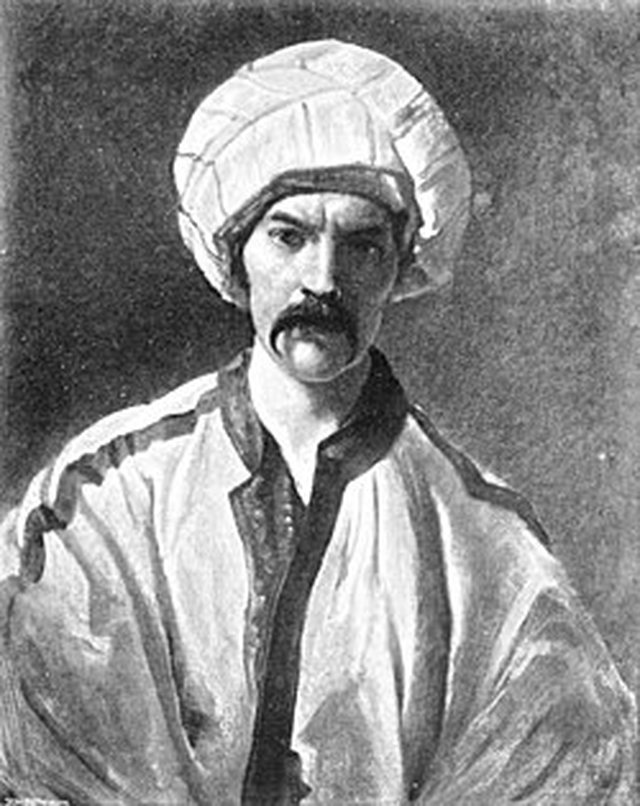
However, in his memoir Personal Narrative of a Pilgrimage to Al-Madinah and Meccah, Sir Richard Burton, who knew the Albanians well from his time in Egypt, where he had connections with two of Mehmet Ali's sons who had financed his expedition to discover the sources of the Nile River, writes that the Egyptian administration was dominated by Albanians. According to him, they were also the people responsible for the caravans of pilgrims to Mecca. Upon his arrival in Mecca, Sir Richard writes that there he accidentally met a large family of Al-Nassers from Cairo who had with them a young man named Giorgo, an Albanian Christian who had been captured by the pirates of Algiers and entered the service of the Al-Nassers in Egypt. Burton writes with a kind of obvious sadness that "he was not the first Christian in Mecca".