Is this police force professional and capable of handling violen...
/ 2026-10-16 18:54:07Focus


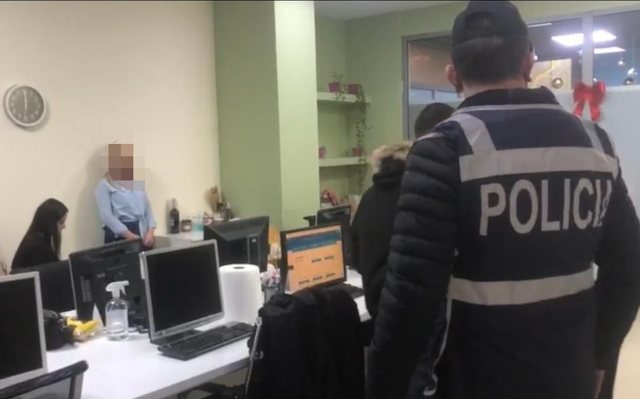
At first glance, the offices look like any other modern corporation in the heart of Tirana. Bright neon lights, endless rows of large-screen computers, ergonomic chairs, and hundreds of young people in their twenties with headphones on, speaking fluently in several foreign languages, making the environment seem like a sort of Tower of Babel.
The new operators are registered as employees of seemingly legitimate companies with catchy names, such as “Magnolia Group”, “Espiron Studio”, “IOTA Network” or “Koppa Network”.
However, it's all a facade.
When police raided the offices of these companies in downtown Tirana on April 14, they uncovered a fraud ring with over 400 employees. Footage of the operation shows over 900,000 euros in cash distributed in envelopes as bonuses intended for the most successful operators in extorting citizens from a dozen European countries and the United States.
This is just one of dozens of similar operations in recent years in Albania, which shows that the call center industry has undergone a frightening mutation. From a once promising sector for thousands of young people with diplomas in their pockets, but without job prospects, today it has transformed into a massive industry of financial fraud and cybercrime.
According to prosecutors who have investigated the cases, this industry is competing in terms of speed of illegal enrichment with narcotics trafficking and is criminalizing thousands of young Albanians.
“It is a very worrying phenomenon,” says a prosecutor in Tirana, who spoke to BIRN on condition of anonymity.
"If we talk about how much it affects the criminalization of society, for me it is more dangerous than the distribution of drugs, because the mass is large and some of them are simply used," she added.
This alarm is also shared by security expert Redion Qirjazi, who sees this sector as a space where crime is normalized.
“In these environments, a gradual normalization of illegal behavior occurs, while individuals acquire practical skills and create contact networks that can be used later,” explains Qirjazi, emphasizing that for this army of young people, the transition to more sophisticated crimes “is more of an evolution than a revolution.”
Conscious of crime
The call center business in Albania began to flourish in the late 2000s, relying on a cheap labor force composed mainly of young people with knowledge of foreign languages. But the dynamics changed once the low profits of legitimate customer service campaigns were replaced by fictitious financial markets.
Investigative documents, police statistics, reports from international agencies and expert analyses reveal a grim picture, where the figures speak of an industry organized almost militarily, which exploits thousands of young people and generates tens of millions of stolen euros every year.
Based on data from prosecution and police operations from 2021 to early 2026, the scale of arrests and damages resembles that of international cartels.
In April 2026 alone, authorities cracked down on several different groups. Among them was the operation codenamed "Ghost Call," during which 10 people from several companies with over 400 registered employees were arrested.
The action came as a result of cooperation between Austrian authorities, Europol and the Tirana Prosecutor's Office, following investigations that revealed damage estimated at a record figure of at least 50 million euros.
“The call centers were professionally set up and organized, resembling legitimate business structures that display a clear separation of roles and hierarchical management,” Europol said after the operation. After initial registration, victims were assigned agents who posed as investment advisors.
In another wave of crackdowns in January this year, six more people were arrested for defrauding Italian citizens. These fraud centers often occupied luxurious spaces in the towers of downtown Tirana, which in itself indicates the financial power of these groups.
In the last two operations in Tirana alone, at the time of police intervention, around 150 operators were found at work. A digital army consisting mainly of individuals aged 18 to 28.
But are these operators, many of whom are students and others with degrees in various fields, aware of what they are doing?
“Most of them are young people, students or those who have completed their studies and have not found a job in their field. But I want to say this; they are aware of what they are doing, they are subjectively aware that they are involved in crime,” stressed the prosecutor who spoke to BIRN on condition of anonymity.
Active participation in crime is explained by their behavior when confronted by the police.
"They have a script ready, they know what they're going to say as soon as the police come in," the prosecutor said.
"Everyone is aware of what they are doing because they are trained and go through different stages of training, they have scripts to attract clients," she emphasized.
Spectacle, champagne and cash bonuses
Journalist Luela Gaxhja of the show "Piranjat", who has investigated a number of fraudulent companies disguised as call centers, also told BIRN that the operators working in these businesses are aware of their participation in crime.
She refers to the case of a company located in a villa on the outskirts of the capital, where she had gone to film with cameras.
"About 100 people who were present fled from sight as soon as they detected the cameras," she said.
Gaxha says that the reasons why young people get involved in this activity are basic: quick money, a life of luxury, and the illusion that this is a "clean crime" due to hiding behind NIPTs and company names.
And the evidence collected by her is reminiscent of scenes similar to the movie "The Wolf of Wall Street"; with a spectacular incentive system distributed live by managers.
"When a consultant cheated the client out of a large sum, here we are talking about over 50 thousand euros, then the manager would stop working, everyone would gather in the center, champagne would be opened, and the best thing was that the consultant would be rewarded in cash, directly there with the percentage that was due to him," she summarizes the testimony of one of the operators.
Experts also speak of the risk of further criminalization, as long as computer fraud is also associated with the laundering of a large volume of money.
Security expert Redion Qirjazi analyzes this atmosphere as a direct springboard to a deeper descent into illegality. He explains that while fraudulent call centers do not constitute a structured recruitment mechanism, they function as a perfect intermediary space.
"In the absence of opportunities for reintegration into the formal sector, there is a risk that these skills will be reoriented towards other illegal activities (absorbed by more sophisticated criminal structures that require this profile), whether within the country or abroad," says Qirjazi.
This is perhaps the darkest warning for the future.
"If not addressed in a comprehensive and coordinated manner, there is a risk that the country will produce an entire generation of young people with real and valuable skills, but oriented in the wrong direction," he added.
Crisis of values
Sociologist Ergys Mërtiri explains the influx of young people into this criminal activity with what he calls a long cultural collapse.
"Under the conditions of a 50-year-old heritage cultivated with dialectical materialism, accompanied by extreme poverty and the decline of traditional values, Albanian society today finds itself in a deep crisis of values, primarily moral and cultural," said Mërtiri.
He also emphasizes that the models of an honest life have completely faded in Albania.
"The models that nurture young people today are not those that reflect moral values, but generally models that are more oriented towards money, vice, and instinct," argues Mërtiri, adding that the media also promotes success and money earned quickly and easily, without hard work or sweat.
For expert Redion Qirjazi, the reality is more structural and directly related to the inability of authorities to combat cybercrime.
According to Qirjazi, crime is more innovative and adapts faster than institutions, while also not excluding silent complicity, especially when such activities are disguised as legitimate businesses and generate income.
This long-term tolerance has begun to create serious consequences not only for the hundreds of young people involved in this industry, but also for the country's image.
“The long-term tolerance of these activities negatively affects the perception of international partners, especially in terms of institutional credibility and law enforcement capacity,” says Qirjazi, adding that there is a real risk that Albania will be perceived internationally as “an environment where such activities can easily take place.”