Is this police force professional and capable of handling violen...
/ 2026-10-16 18:54:07Focus


Arben Ahmetaj, the former deputy prime minister on the run from justice, faces in one of the two criminal cases against him on a charge of abuse of office, through failure to perform a legal obligation. According to the 2023 indictment, Ahmetaj did not comply with a final court decision causing millions of euros in damage to the Myderizi family. Ahmetaj has denied the charges of escape.
Whatever the case, in case the new Criminal Code proposed by the government for public discussion were to be approved, it would probably save Ahmetaj from this accusation for the simple reason that the criminal offense provided for this time requires the prosecution to prove not only the action or inaction of the official who caused the damage, But he must prove that the official acted with criminal intent. And since the criminal intentions are inside the mind of the person suspected of violation, it is likely that the court will be forced to dismiss the lawsuit as not supported by law and evidence, as the criminal intent cannot be proven.
Abuse of office and violation of equality in tenders or public auctions are two major changes provided for in the proposals for amending the Criminal Code. The government has distanced itself from the authorship of the legal changes and says that the Code was drafted by a group of experts, but to date, none of the mentioned experts have come out publicly to defend their work.
The intervention in these two articles practically invalidates the entire concept of abuse of office by public officials or that of creating unequal conditions for economic operators in cases of public tenders or auctions.
'1. A public official, directly or indirectly charged with the administration of public funds, who intends, with criminal intent and intent, to cause economic damage to the activity of his institution or to another person, because: (a) he exercises his powers illegally; b) exceeds its legal authority by using the funds outside their destination, or c) creates obstacles to fulfilling a duty derived from its legal tags or from a court decision, when the action does not constitute any more serious criminal offense, it is punishable by imprisonment for up to four years," the proposed draft reads, which fundamentally changes the current legal concept of abuse of office, restricts this criminal offense to the field of administration of public funds or requires prosecutors to prove that the official acted with "criminal intent".
Unlike the proposed version, the current Criminal Code in Article 248 is much more laconic, concise and clear. It reads: "Intentionally committing or not committing acts or omissions in violation of the law, which constitutes a regular failure to perform the duty, by a person exercising public functions, when they have brought him or other persons unfair material or intangible benefits or have harmed the legitimate interests of the state, citizens and other legal persons, if it does not constitute another criminal offense, it is punishable by imprisonment for up to seven years."
As can be seen, the drafters of the new Criminal Code needed 162 words to replace an article with 71 words, which simply requires the official to be held responsible in case an action or inaction contrary to the law has caused damage to the state or citizens in material or non-material benefits of himself or others.
No more violations of equality with tenders
The current Criminal Code provides in Article 258 for the criminal offense of violation of equality in public tenders or auctions, where it is provided that the creation of unequal conditions in tenders or auctions, in any form or regardless of the intention of the violator of the law, is punishable by a fine or imprisonment of up to three years.
Unlike the current article, the proposal in the new code in Article 324 provides that public procurement officials will be able to be held liable only in cases where the above violation was committed "for the purpose of profit".
"Intentionally committing unequal actions by a person in charge of state functions or in the public service, which for the purpose of profit [SIC], avoid real competition, fair competition and violate the equality of candidates, economic operators, in the procedures required by law in a public procurement, taking measures with the aim of discriminating against or favoring particular commercial entities, When the procurement is at the value of the limit of small value procurements according to the provisions of the legislation of the field, or when for the same reasons it has been decided or influenced to decide the winner of the process an undeserving subject, when the relevant administrative measures have been taken beforehand, it is punished with imprisonment from one to five years," the current proposal states.
The way this article is worded is clearly a legal nonsense because, if an official has benefited from the violation of equality in tenders or auctions, he is punished for corruption while, in the absence of proof by the prosecutors of the purpose of the benefit, the official can commit as much violation as he wants without worrying that he will be punished, as long as it manages to hide the potential benefits.
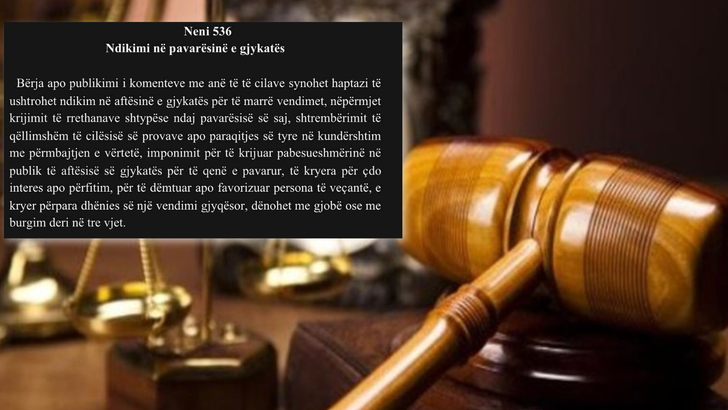
The new Criminal Code has so far been criticized as "arbitrary", "inquisitive" and "not in accordance with international standards" in terms of the part of the numerous criminal offenses that citizens can commit, according to this code, not through action, but through speaking or writing. The code has also been criticized as vague, as a step backwards in some directions or one that will cause unnecessary confusion or even jeopardize the entire functioning of the country's criminal justice.
Some have also questioned the need to draft a new Code, in a country where there has been no recent regime change and in which, the current code, originally adopted in 1995, has been elaborated for three decades by the justice system through case law, unifying decisions of the Supreme Court or interpretations of the Constitutional Court or even by the parliament itself, by removing many negative articles, rewriting or reinterpreting other articles or adding articles, not always in a very reasonable way, but in most cases, through a detailed discussion process for each article and every word.
The work of three decades will probably have to start from scratch, as the justice system will have to examine completely different linguistic formulations, expressed in a language that, according to Professor Artan Fuga, "can be interpreted like an accordion, like an elastic."
In addition to these, the existence of articles that clearly contradict some of the most debated issues at the European Court of Human Rights, such as freedom of expression or the inviolability of the dignity of state authorities such as the president of the republic, raises serious questions about the level of professionalism of those whom the government refers to as a "group of experts", None of whom has come out to this day to defend what should normally have been the pride of every lawyer's career.
With power on current affairs
One of the fundamental principles of criminal law is that, if the citizen who has committed an offence is faced with a change in the legislation that provides for the offence committed by him before the final trial, his interest prevails. This means that, in cases where the revised criminal offense carries a higher sentence than was foreseen at the time the offense was committed, the offender is tried according to the old law. While in case the new law favors him over the previous one, he enjoys the right to be judged according to the new law. This means that all officials who are currently facing criminal charges or are under investigation for criminal offenses will be able to choose the option most convenient for them, both in terms of the substance and the extent of the sentence. For example, the criminal offense of passive corruption is provided for in the proposed draft code to be punishable by 3 to 8 years of imprisonment. But for all possible violations committed before the entry into force of this code, they will be able to choose to be judged by the current code which provides for a sentence of between 2 and eight years. While officials accused of violating equality in tenders are likely to seek trial or retrial under the new criminal code, benefiting in practice from an unannounced form of amnesty.
The principle of using the most favorable law for the subject is expressly clarified in the draft criminal code introduced in Article 9 where it is written: The new law that does not punish the criminal offense has retroactive power. The criminal proceedings initiated shall cease, while in case the person has been convicted, the execution of the sentence may not commence and, if it has commenced, shall cease." And also, in this article it is added: "When the law of the time when the criminal offense was committed and the subsequent law are different, the law whose provisions are more favorable to the person who committed the criminal offense shall apply, except in cases where the adjudicated thing must be avoided. Any request that refers to the different content of the penal provisions or to the extent and type of criminal punishment they provide, when the right arises at the stage of serving the sentence, shall be resolved by the criminal court of the stage during the execution of the sentences."