Is this police force professional and capable of handling violen...
/ 2026-10-16 18:54:07Focus


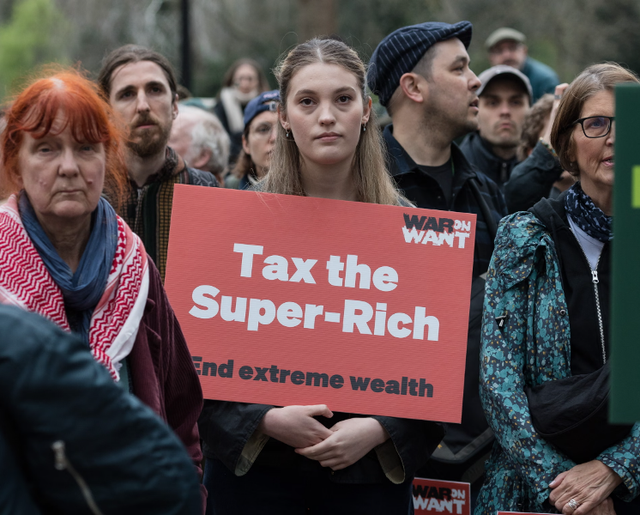
Less than 60,000 people, just 0.001% of the global population, own three times more wealth than the poorest half of humanity, according to the latest World Inequality Report 2026, which warns that global economic inequalities have reached alarming levels that require urgent action.
The report, based on data collected by 200 researchers, also shows that the top 10% of income earners exceed the income of the other 90%, while the poorest half of the global population receives less than 10% of total income.
When it comes to wealth, property values and investments, the situation is even more extreme: 10% of the world's wealth owns 75% of all wealth, while the poorest half owns just 2%. In almost every region, the richest 1% are richer than the bottom 90% combined, with inequality growing rapidly around the world.
"The result is a world where a small minority has unprecedented financial power, while billions of people remain outside basic economic stability," write the authors, led by Ricardo Gómez-Carrera of the Paris School of Economics.
The report notes that the share of global wealth held by the richest 0.001% has grown from 4% in 1995 to more than 6% today, while the wealth of multimillionaires has grown by an average of about 8% per year since the 1990s, nearly twice as fast as the poorest half of the population.
According to the authors, including renowned French economist Thomas Piketty, inequality is no longer a purely economic phenomenon. It has reached levels that require urgent action, not only for social justice, but also for the sustainability of economies, the stability of democracies, and the survival of the planet.
The report notes that inequality of opportunity feeds inequality of outcomes. For example, spending on education per child in Europe and North America is over 40 times higher than in sub-Saharan Africa, creating a “geography of opportunity” that determines individuals’ economic fates from the start.
A 3% global tax on fewer than 100,000 billionaires and centibillionaires could generate $750 billion a year, enough for the education budgets of low- and middle-income countries.
The report also shows that the global financial system is rigged in favor of rich countries, allowing them to borrow at low cost and invest abroad at high profits. About 1% of global GDP is transferred annually from poor to rich countries through these mechanisms, almost three times the amount of international development assistance.
In terms of gender, the report highlights that women's wages are only 61% of men's earnings per hour of work, and including unpaid work, this number drops to 32%.
The report links wealth to the impact on climate change: the world's richest 10% cause about 77% of carbon emissions related to capital ownership, while the poorest half only 3%. Those who emit more are more protected from the consequences, while those who emit less, mainly in low-income countries, are more exposed to climate disasters.
The authors point out that inequality can be reduced through public investment in education and health, as well as effective tax and wealth redistribution programs, but this requires political will, while the ultra-rich often avoid taxes.
"The tools exist. The challenge is political will," the report concludes.