Is this police force professional and capable of handling violen...
/ 2026-10-16 18:54:07Focus


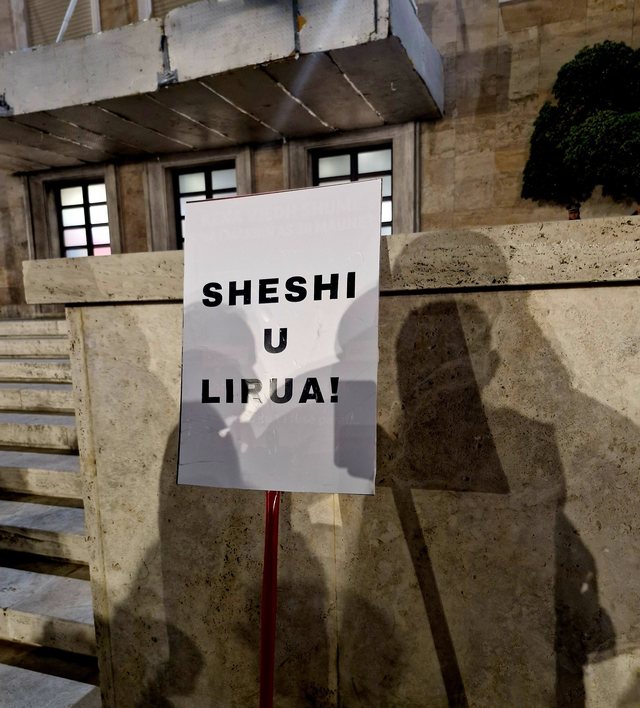
Adriatik Lapaj's 108-day protest is an illustration of a well-known phenomenon in political science when a political act aims more at symbolism than at real effect. The resistance in front of the Prime Minister's Office was, without a doubt, a strong individual act, but politics is not a sport of endurance. It is not the one who stays the longest who wins, but the one who convinces the most.
Essentially, protests function as catalysts; they gather the discontent of social groups, structure it, and turn it into public pressure. But this only happens when there is a real connection between the organizers and the public. In this particular case, it was clearly evident that there was a huge gap not between the message and the citizens, but between the credibility of the organizers and the public. It is not enough to be against something, it is not enough to be right in what you say; you must also be credible in what you offer in its place. Without this, the protest remains a long monologue in an empty square.
If we analyze the credibility component in the political context of 2025 and beyond, the picture of abandonment becomes even clearer.
The debate on open and closed lists in small parties turned into a technical, almost bureaucratic discussion, without any mobilizing spirit. Moreover, the quality of the candidates and the lack of meritocracy further weakened the claim to “different politics” compared to the main parties. Instead of a new alternative, the public saw a more confused version of the old one.
The banal quarrel for a mandate between the allies "Thurrja" and "Albania is Made", in the often amateurish public space, reinforced the idea that these are young in age, but old in vice. The bargaining with the DP for the so-called independent candidate in the local by-elections put a lid on the ideal that we finally have an alternative choice. Finally, the extreme personalization of the electoral campaign by identifying a movement completely with an individual, greatly limiting the potential for expansion, because people do not unite with a person, but with an idea that represents them, put their stamp on it.
In this sense, Lapaj’s protest was not simply an isolated failure, but a reflection of the deeper problems of new political movements in Albania. They often start with strong rhetoric against the system, but end up reproducing the same behaviors that criticize the old parties, such as petty bargaining, lack of vision, and a focus on the moment, not on strategy.
In the end, the problem is not that Lapaj or another similar movement “lost”, these are replaceable in a political system that recycles figures and attempts. What is really lost is something more serious, the belief that there is a real alternative beyond the SP and the DP. Every new attempt that ends up imitating the old one, the citizen is not simply disappointed by an individual, he surrenders to the idea that the choice makes sense. This is the real crisis we currently have, not the lack of actors, but the lack of hope that in the next elections we can choose beyond the SP and the DP. A bitter news, because without this hope, the elections remain just a ritual, a rotation in the form of SP = DP and vice versa, not a real opportunity for change. As has happened in 35 years.