Is this police force professional and capable of handling violen...
/ 2026-10-16 18:54:07Focus


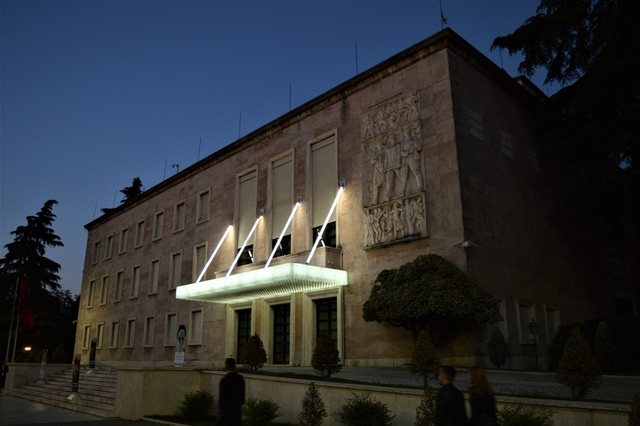
This is not just a piece of writing. It is a moment of contemplation, where the morning light awakens not only the streets, but also sleeping thoughts. It is six o'clock, and the Prime Minister's Office still sits in the shadows, silent, but not without a sound.
The daily routine has taught me not to pay attention to things that don't change. But today, my eyes stop differently, at the entrance to the building and its courtyard.
From day one, Edi Rama left two traces there, two signs that were not accidental. The entrance, like a Broadway stage, and the mushroom, that enigmatic structure that stands in a corner of the building, in silence, but not in oblivion. Two first gestures, simple in appearance, but deeply charged with meaning.
The entrance, with its theatrical stairs and gate that are more reminiscent of a theater than a state institution, is the portal to a spectacle that never closes. It is the entrance of a man who comes not to administer, but to dominate; not to pass, but to stay. A place where politics has become directing, and the state into scenography. Edi Rama, the absolute director of the state stage, an infinitely prolonged “One Man Show”, where the audience becomes the background and the spectacle is itself.
And then, the mushroom, invisible to many, but always there. Like a semi-urban fairy tale, like a footnote that has taken up the entire page. It is not just an installation, it is a metaphor. Because mushrooms are not planted; they emerge on their own. They emerge in damp soil, in places where life is not expected, in cracks in the ground, in rotten tree roots, in darkness and silence. And they always survive.
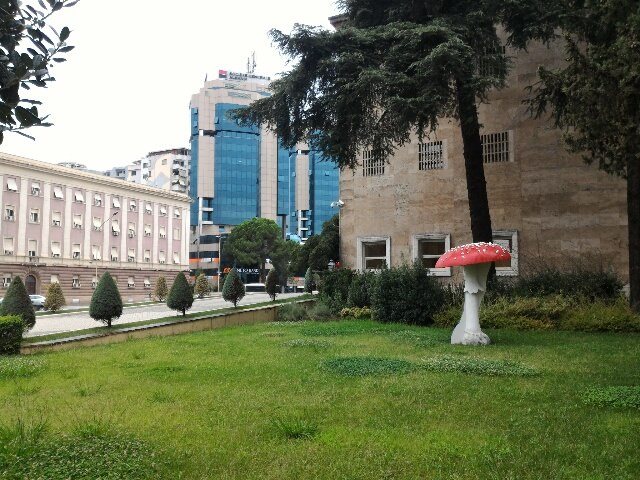
The mushroom, there in the courtyard of the Prime Minister's Office, is like the shadow of power that sprouts everywhere, without permission, without noise, but with a persistence that knows no season. It is the trace that remains even when everything else is hidden. It is the symbol of that power that does not need to shout to be. It withstands rain, sun, oblivion. It has no visible roots, but it never disappears.
There are two symbols that have not moved since then. Because they are not just pieces of decor, they are silent declarations of the eternity of a figure in that place. As if they were roots embedded in concrete. The first to be placed. The last to be removed!
In a place where everything is temporary, those attitudes seem eternal. Like him!
JS