"We are drowning..." - From Lisbon, Milan to Tirana, "The Guardi...
/ 2026-10-18 23:13:32Focus


Question marks over the selection of the new member of the Constitutional Court continue.
Tch writes that it has secured the audio and minutes of the special meeting of the Supreme Court on September 30, where 15 members were present to vote on the candidates, materials that do not fully match.

Shadows of doubt are added to the vote, where Supreme Court judge Asim Vokshi was declared the winner for the vacancy with 6 votes, although Naureda Llagami received 3 more votes than him, but one was not considered valid, making it impossible to achieve the 3/5 vote criterion for the appointment.
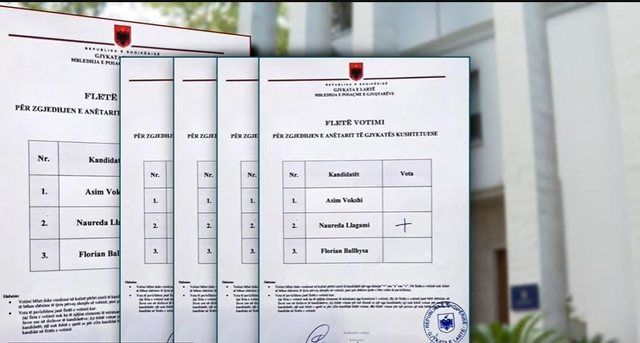
The minutes show the lack of complete disclosure of the audio with the dissenting voices of the judges who do not accept the invalid assessment on the ballot for the most voted candidate, Naureda Llagami.
The intervention of chairman Sokol Sadushi, who silenced the voices and gave the secretaries the right to make their own assessment, was not reflected either.
Full discussion:
Anisa Kulo (chancellor): "Regarding a ballot, where one of the causes of invalidity of the vote is any mark other than the voting mark, it will be considered invalid. The Commission considers this ballot invalid, and for the sake of transparency, a mark other than the voting mark has been made on number 2."
Judges: "Valid, it's on number 2 signs."
Anisa Kulo (chancellor): “Yes, since it is one of the causes besides the signs, no other kind of note.”
(Noise)
Sokol Sadushi : "Please, the committee has the paper in hand, none of the members have the right to be consulted. Let the committee decide. Then the opinion... your decision?"
Anisa Kulo (Chancellor): "Our decision is to consider this ballot invalid!"
In the lawsuit filed by Naureda Llagami from the Administrative Court to the Constitutional Court itself, where she requests the suspension of the implementation of the decision and the declaration of the voting result in her favor, she describes the decision-making made by the Technical Commission composed of the court chancellor, the chief secretary and a judicial secretary as an irregular procedure and not provided for by law.
"If there are doubts about an invalid vote, the Voting Commission cannot be the competent structure for declaring such a vote. The issue should be brought to the General Meeting of Judges and there should be a decision-making by the judges themselves on the invalidity or not of this vote."
Judge Naureda Llagami draws a parallel with the Electoral Code and describes the clarity of the voter's will for her name.
"The ballot paper considered invalid by the relevant commission clearly shows the choice made for the candidate Naureda Llagami. The marking was made only in the relevant line, no marking lines appear in the columns of other candidates, and consequently no vote was cast for more than one candidate. Meanwhile, placing the circle on number 2 only reinforces the clear choice and does not affect the choice of any other candidate. The Central Election Commission, in an identical case when there are these two marks, in the same way and form on a ballot paper for an electoral subject, has considered them in its Work Manuals for the evaluation of votes as valid votes cast in favor of the relevant electoral subject."
The case of declaring the vote invalid in the selection of a member of the Constitutional Court is a challenge to the integrity of the Albanian judicial system.
So the questions still remain unanswered… Will form triumph over content, procedure over law, and administration over judges? The Constitutional Court has the final say./ Tch