"Condemned" protesters?! Who trapped Rama inside the Prime Minis...
/ 2026-10-23 16:02:00Focus


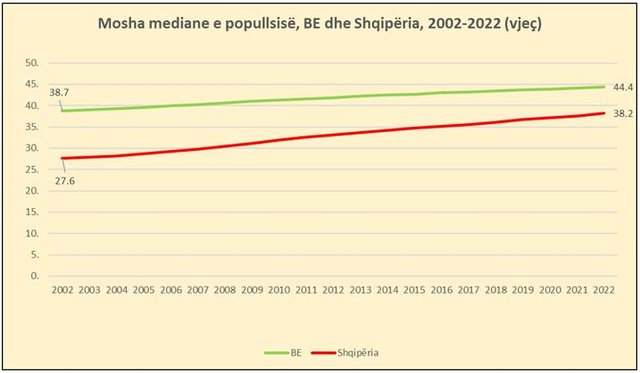
The median age of the Albanian population in 2022 was 38.2 years, according to INSTAT.
Median age means that half of the population is younger than 38.2 years and the other half older.
Compared to the average of the European Union, Albania still remains one of the youngest populations, (sixth) as the average of the European Union, which divides the population into two groups, was 44.4 years old on January 1, 2022.
But Albania is aging faster than the European Union average. According to Eurostat, the median age has increased by 2.5 years (an average of 0.25 years per year) from 41.9 years in 2012 for the European Union, while for Albania by 5 years, double the EU. The youngest European states are Kosovo (30 years old for 2020) and Turkey (32.8 years old for 2021).
In the last decade, Albania has recorded the highest increase in the median age of all other European countries. Second behind us is North Macedonia, which has aged by 4.7 years, and Portugal, by 4.7 years.
In 1994, when Eurostat reports the first data for Albania, half of the population was under 27.6 years old, while for the (then) European Union, the median age was 38.7 years old, with a difference of 11.1 years.
Due to the high rates of immigration, the gradual aging of the population and the change in lifestyle that led to the decrease in the number of births per woman, the low level of economic development (Albania remains among the poorest in Europe, with 32% income of the European middle class) Albania is aging much faster and the gap has narrowed to 6.2 years in 2022.
Italy is the oldest country in Europe
According to Eurostat, on 1 January 2022, the median age of the EU population reached 44.4 years, 0.3 years more than in 2021. This indicator has increased by 2.5 years (an average of 0.25 years per year) from 41.9 years in 2012 This means that half of the EU population was older than 44.4 years, while the other half was younger.
Across EU countries, the median age ranged from 38.3 in Cyprus, 38.8 in Ireland and 39.7 in Luxembourg to 48.0 in Italy, 46.8 in Portugal and 46.1 in Greece. In total, 18 EU countries were below the EU median age.
Between 2012 and 2022, this indicator increased in all EU members, except Sweden, where it decreased (from 40.8 years in 2012 to 40.7 years in 2022). In Malta, there was no change in median age between 2012 and 2022, remaining at 40.4 years. In five EU countries, the median age of the population increased by 4 years or more. The median age in Portugal increased the most among EU countries (+4.7 years), followed by Spain (+4.3), Greece and Slovakia (both +4.1) and Italy (+4 ,0).