Berisha: Altin "Troplini" Dumani amnestied electoral crimes, SKA...
/ 2026-10-19 11:44:20Focus


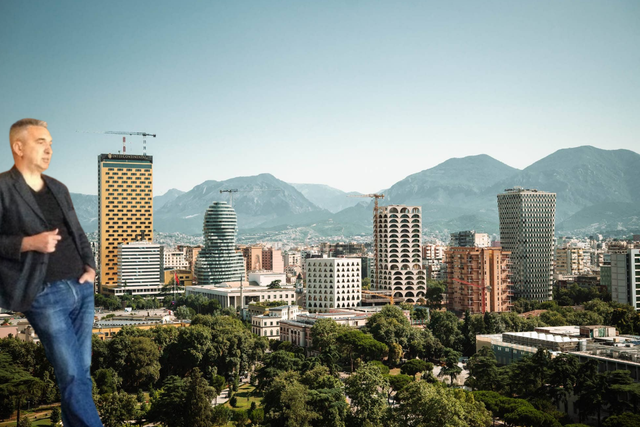
Astrit Nixha, one of the prominent names in Albanian architecture, with a 30-year career, awarded with several international awards, director of the Anarch studio in Pristina and Tirana for over 20 years, has recently undertaken a rare act for a society like ours. Faced with a phenomenon that is more than humiliating for Albanian architects, who have been de facto excluded from the right to compete for important architectural projects, in a reality where in the last 10 years almost 100 percent of public and private buildings (with an unwritten law, no investor can obtain a construction permit unless a studio designated by Edi Rama personally has paid for the architectural project), Astrit Nixha has decided to surrender his architect's license as an act of dignity and professional and social responsibility.
"It is a rejection of the false role within a show that has been going on for years: the show where politics plays the role of the architect, economics plays the role of the urban planner, and the architect is ultimately relegated to the role of a "designer"... I do not have the luxury of changing society alone; no one does. But I have the obligation not to deceive myself, not to pretend to be an architect in a system where the architect is treated only as a technical hand ," writes Nixha.
At a time when not only architects, but also teachers, doctors, and academics have bowed their heads and submitted to a humiliating reality for their professions, Astrit Nixha's public act is one of those forgotten examples of an engaged intellectual. An example that, more than the dignity of a professional, reveals the castration of an entire society.
Below is the full article by Astrit Nixha.
By Astrit Nixha
Somewhere, in one of those turbulent years of World War II, after the capitulation of Italy, the Germans entered a city in what was then Albania. Classic scene: armed soldiers, people lined up, fear, fog. The commander orders all the men to be rounded up and divided by nationality. But there were no prisons; the commander ordered the use of large wooden wine barrels on the outskirts.
The Jews, said the captain, we put them in this barrel.
"Cover them with a lid and nail them so they don't escape," the commander ordered.
We have the Serbs in the other one.
-Close these too with a lid and nail them down.
The Croats, too. Even these with a cap and a nail.
-What about these, in the last barrel?- asked the commander.
"These are Albanians," the captain replied.
The commander smiled slightly:
-Leave these people without a lid. Time will punish them. Even if one wants to come out, the others won't let him.
The crudeness of the joke is poignant, but sadly functional as a metaphor. That, instead of knocking off the lid together, we deal with what is climbing to the edge of the barrel: “Where is this going? Who gave him the right? Why not me? Why not my friend?” And in the meantime, time does its thing: it punishes, it weighs down, it sinks…
For this year, I have made a simple, but difficult decision: I will no longer hang out with people to whom no one says "good job" - and, likewise, I will not hang out with those who say "good job" to no one. The former are not doing work; they are parasites who live like lice, clinging to the bodies of others. The latter are people who cannot stand the work of others: they do not recognize it, they do not respect it, but always have time to curse and despise it.
These are people who do not produce, but comment; they do not build, but tear down with words. They have no expertise, but they have an opinion about everything; they have no project, but they have prejudice about every project.
When cheating becomes the moral norm
In our society, the moral standard of the fraudster has been installed, step by step. It is no longer the exception; it has become the norm. To soften the word “thief” or “fraud”, we have invented the term “misuse”. Misuse of duty, misuse of funds, misuse of powers… If only the word were milder, the crime would be lighter.
Precisely for this reason, in this text I am using a new word: hamakeq. It is an acronym that brings together in a single word three different behaviors, but with the same moral foundation: HA- theft, MA- fraud and KEQ- misuse. So, when I say “hamakeq”, I am referring to that profile of a person who steals, deceives and misuses to any extent and level.
But in essence, there is no great moral difference between the one who “scams” 1 euro and the one who “scams” 100,000 euros. The first has no access, the second has the opportunity. The moral character is the same; only the amount changes. If tomorrow the one who has 100 million in his hand today were to be left without power, he would be the same person who scams 1 euro at the market. The character does not change; only the scene changes.
The faces that in Albania are called "cured" come to mind, of those who are in positions today - with ties and podiums - and in another reality would be simply pickpockets in the market. The difference is only in clothing; not in morals.
Politics as a haven for the uneducated/ignorant
Let us ask ourselves: how does one gain position in Albanian society? Ask someone on the street to name five academicians of the Academy of Sciences and Arts; five Albanian architects; five composers, five engineers, five scientists. Most will hesitate. But if you ask them five politicians, they will ask you: “From which party…?”
Position in our society does not come from professional value, nor from responsibility, nor from license. It comes from the party. Consequently, those who hold political power automatically hold in their hands both the social status and the future of professionals: doctors, engineers, architects, artists. And this is where the paradox arises:
-Becoming a doctor requires years of study, specialization, testing, and a license.
-Becoming an architect or engineer requires years of study, work, experience, and a professional license.
– To drive a vehicle, theoretical and practical tests are required.
But to “steer” a state, a city, an economy, a territory, neither compulsory education, nor professional experience, nor an ethical license is required. Politicians call themselves professionals, but they are not subject to any professional market and no minimum standards. This turns politics into a haven for those who did not succeed in other professions - and often into a place where failures from various fields, but with a great appetite for power, gather.
The Albanian architect, from author to draftsman
In this reality, the Albanian architect has gradually lost his natural role in society. The architect is not simply someone who “draws buildings”; he is the professional who reads the needs of society and translates them into habitable spaces, into healthy cities, into places where life has dignity. Architecture is not just form; it is morality built in concrete, glass and light.
But in our society, politics has penetrated so deeply into every pore that it has even turned this profession into something else: the licensed Albanian architect, with years of study and experience, with legal responsibility on his head, is being transformed into a draftsman for the account of others.
I am taking the opportunity from the visit of 80 architects to Zvërnec for investments. For those who do not know the details: the way the relationships are built reduces licensed Albanian architects to signatories of projects drawn and conceived elsewhere. To put it bluntly: it is like giving an Albanian painter Salvador Dalí's sketches and telling him: "Color it, but you are criminally liable if you go outside the lines."
No, I'm not saying that we are better than others, nor that we have a monopoly on talent; but we have the right not to be despised, not to be placed at the end of the line, not to be treated as technicians who only sign. The local architect cannot be a spectator in his own territory with his own taxes.
Albanian barrel and license submission
I return to the barrel of Albanians without a lid. Instead of seeing it as an anecdote to laugh at ourselves, we should read it as an indictment: we tend to pull down what tries to emerge. We do this with professions too. The architect who talks about spatial quality is called a “snob”. The one who talks about cultural heritage is called “unemployed”. The one who opposes a brutal intervention on the city is labeled as an “impediment to development”.
In this climate, in this national barrel without a lid, the role of the architect has become almost incomprehensible to the public. Many see only the facade of the building, but not the process, the conflict, the responsibility. No one asks who signs the morality of what we are building. In the face of this, my decision is personal, but I believe it speaks to a collective condition.
After all this, I solemnly hand it back to the Albanian state:
• License A.0951/1 – in design, and
• License MK.3867 – for supervision and approval of implementation works.
I am not a draftsman. I am not someone who colors someone else's sketches, bearing all legal and moral responsibility. I am not willing to accept a role where the local architect is only a formal signatory of imported projects, while politics negotiates interests without involving local professionals.
This act is not theater. It is a rejection of the false role within a play that has been going on for years: the play where politics plays the role of the architect, economics plays the role of the urban planner, and the architect is relegated to the bottom as a "drawer."
The role of the architect we love and the society we have
Albanian society needs architects who think, not just draw. It needs professionals who ask: What kind of city are we leaving to our children? What will life be like among these buildings in 30 years? Are we building just for today, or for tomorrow as well?
But to have these architects, society must recognize and respect them as such. It must understand that the architect is not a decoration; he is one of the main filters between power, capital and the daily life of the citizen. If this filter turns into a draftsman, who protects the city?
I don't have the luxury of changing society alone; no one does. But I have an obligation not to deceive myself, not to pretend to be an architect in a system where the architect is treated only as a technical hand. Therefore, this is a personal act of defiance: not against my profession, but against the way it is being treated.
At the end of the day, our role as architects is not measured by the number of buildings we have designed, but by the quality of life those buildings produce.
And for that, we must first get out of the barrel. Or at least refuse to be the ones who pull others down.
Astrit Nixha is an architect and project manager with over three decades of experience in Kosovo, Albania and abroad. A graduate of the Faculty of Civil Engineering and Architecture at the University of Pristina, he has been the founder and director of several architecture offices, including “anarch”, where he worked as a lead designer and manager of large public, cultural, commercial and residential projects./ Lapsi.al