Details of the storm in the administration, here's who will resi...
/ 2026-10-22 22:25:00Focus


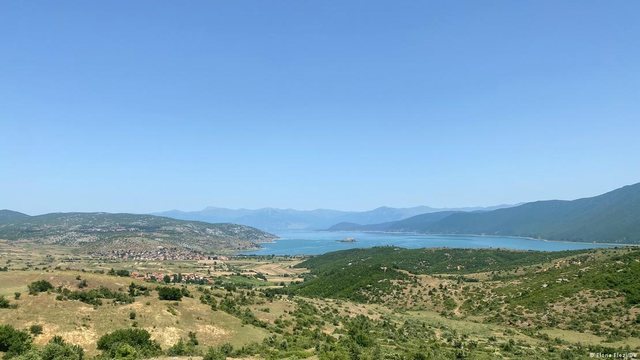
In the village of Liqenas, in Korçë, Spase Tërpo controls the level of the lake of Prespa e Madhe. His task is to regularly measure the level of precipitation and water, which unfortunately are giving disturbing signals day by day. He is the third generation of his family, which is closely connected with the lake. What started as a passion in the Tërpo family, later turned into a profession for them. "From 1946 onwards, from the measurements we made, it shows that the lake has always had changes and fluctuations. Big fluctuations, big increases, there were in the 70s, when the lake was 8 meters higher than now. Since that moment, the lake has always decreased. Now that we are talking, it took longer for the lake to decrease, so it has been going down for about 3-4 years or more."
At the Institute of Geosciences in Tirana, where Tërpo sends the data it collects in the field, engineers have calculated the continuous shrinkage of Lake Prespa. "In Prespa e Madhe we again have a visible decrease and reduction of the water surface. Around 1967, an area of around 329 km2 was calculated for both Prespa. Nowadays we have a surface that has reached about 250 km2. So we have a contraction of these two lakes, very big" - emphasizes Emanuela Kiri, hydro-geologist at this Institute. Prespa e Maghe, according to Kiri, has "food" for the lake of Prespa e Vogël, which today has turned into a reed.
Spills filled the lake bed
Around the 70s, the river Devoll was artificially diverted from its course to enter the Little Prespa Lake, through the opening of a canal. The primary purpose was for agricultural reasons, since the water of the lake was calculated to irrigate the entire field of Korça, at that time with a very developed agriculture. But the project appears to have underestimated and overlooked the volume of river sediments that would be deposited in the new river mouth. Their accumulation filled the lake bed.
The danger that threatens the lake of Prespa e Madhe today comes from many factors. Experts say that among the most important are the high temperature increase during the last years, which increases evaporation, the decrease in the amount of precipitation, as well as the interaction with Lake Ohrid. "The less precipitation there is in a hydrological year, the more water we get from Prespa, because Prespa has a disadvantage to Lake Ohrid: it is located 150 meters above Lake Ohrid, in the geographical position. And since it is separated by a mountain of karstified, i.e. limestone and very fissured, the water passes eastward in this gap between the two lakes and flows into Lake Ohrid. What does this mean? That Prespa cannot be considered an undivided watershed, at least hydrologically geological" - emphasizes Kiri. According to her, the year 2002 marks the biggest drop in the water level of Lake Prespa, drop of 8 meters and 79 centimeters. "Whereas today, from 2019 to 2022 we have a decrease of 0.79 centimeters. And that's pretty big for such a period of time, because it's continuing. The return is not replacing what we're losing."
There is no clear strategy in the interest of Prespa
Aleksandër Trajçe, head of PPNEA, the Center for Conservation and Protection of the Natural Environment in Tirana, says that Prespa Cross-Border Park has always had increased national and international attention, but without focus on the lake. "The projects in Prespa have not directly addressed or taken seriously the lowering of the lake level, as one of the main ecological problems of the region. There are numerous discussions, it is discussed in meetings between governments, between interested organizations, between the institutions, but in reality at the moment we are talking there is no clear strategy on how to address this problem and how the work of all these institutions and all this interest that is for Prespa, to be coordinated in a way that this problem addressed very strongly and quickly".
The lack of focusing precisely on the drop in the level of Lake Prespa is also accepted by the institutions. One of the projects where they cooperate with foreign donors was the "Management Plan of the National Park of Prespa in Albania, 2014-2024". it is also the lake. We have managed land surfaces, forest ecosystems, pasture ecosystems, so in general the protection of biodiversity" - explains Vasil Male, Head of the Management of Protected Areas of the Korçë district.
Changing the world of fish in Prespa
Kallamasi is perhaps the village where the drop in the level of Prespa is felt the most. The fish caught here have changed with changing climatic conditions. "We have had a decrease in the production of cironka and we have an increase in the production of carp, due to the movement of the lake" - says Kosta Trajçe, chairman of the Fishing Management Association in Prespa e Madhe. The hydrobiologist Spase Shumka has dedicated almost his entire career to the preservation and study of the lakes of Prespa and the species that live in these waters. "In the world of fish in Prespa we have 8 types of endemic species and in the world of gastropods or snails we have about 18 endemic species. There are endemic species in almost all axionomic groups of the living world, which is mostly associated with the littoral part, in other words with the bottom part, with the shore of the lake. For example, one of the most economically important fish is the cichlid. It is a species which is connected in its livelihood and as its main reproduction habitat has the shore of the lake and requires a shore that is rocky, which has practically disappeared" - says the hydrobiologist Shumka.
The International Organization Prespa-Ohrid Nature Trust, PONT, has been helping Albania, Greece and North Macedonia for years to preserve biodiversity in the Transfrontier Park of Prespa. In order to be closer to the affected area, they also have an office in Tirana for some time. The threat to the lake, according to the leader of PONT, is not only the change in climatic conditions. "We all know that unfortunately the levels of Prespa are falling and this may come as a result of climate change, very intensive agriculture, mainly in North Macedonia and Greece. In Greece, beans and in North Macedonia are apples. They they use the water for irrigation and many lands are moving towards the lake, the lake loses its level and there is more valuable space for new plantations, which is not good at all. I must say that in Albania there is more agriculture for personal consumption, and the threat is less. Water quality is another issue, because intensive agriculture uses pesticides which are not good for water quality. It is called eutrophication of the lake, there are many components in the lake and the water is not clean. This affects all habitats of important species such as fish, birds... Everyone is affected" - says Mirjam de Koning.
"Three countries, two lakes, one future"
On February 2, 2000, in Agios Romanos in Prespa, Greece, the agreement was signed for the declaration of the Prespa Transfrontier Park, where the three prime ministers of the time agreed to protect Prespa, which at the time was considered innovative diplomacy. Myrsini Malakou, biologist and one of the veterans of the defense of Prespa, witnessed that day, which today is remembered by the slogan "Three states, two lakes, one future".
"We have less water. What should we do for agriculture and for fishing? In Greece we are thinking about many, many solutions. For example, we have decided to change the irrigation system and switch to the drip system. It is a very investment big for the area but because of the biodiversity, we think it's important. I don't know if that's enough. We all have to work together to find new ways to adapt to the climate. With other types of plants, planted new and point-to-point irrigation system in the whole area".
Mirjam de Koning from the International Organization Prespa-Ohrid Nature Trust, PONTPhoto: Elona Elezi/DW
Panagiotis Paskalidis, mayor of Prespa, Greece, thinks that for the decrease in the level of the lake, a coordination of the three countries is needed. "One of the reasons we are building the irrigation system is to reduce the water that is used to irrigate certain areas. This reduction of water used would be up to 46%. This is something very important and could increase a little the level of the Little Prespa. We need to cooperate. The goal is to identify the problems, raise the problems in the European Union and be able to agree, the three countries in a coordinated way, on the problem of water scarcity ".
While in North Macedonia, experts think that climate change is not the only thing that endangers Lake Prespa. "In fact, the biggest problem of the moment in Lake Prespa is precisely this: the significant amount of nutrients found there. In the past, the lake had a low presence of these nutrients. At the moment we speak, their presence is high .Which means that all these organisms that we consider endemic, have adapted to live and have lived in an environment with very low presence of nutrients and pollutants" - says Zlatko Levkov from the Institute of Biology.
For Vasko Stojov, hydrologist at the Macedonian Hydro-Meteorological Service, the use of lake water by agriculture is problematic. "According to agro-meteorologists, these amounts are not large. They assume that only 12-20 centimeters of Prespa lake water is used for irrigation, a figure which seems small. But if these 20 centimeters are multiplied by 30 years, only then we we have a complete panorama of the water that is taken from Lake Prespa".
Prespa, "spoiled" by donors
As all the actors try to protect themselves, leaving the responsibility to each other, the Cross-Border Park, on its three sides, remains one of the areas with the greatest attention of donors. The European Union has provided millions of euros of funding in the form of grants for the sustainable development of the area on all three sides of Lake Prespa. Through the "EU for Prespa" funding program, North Macedonia has received an 18 million euro grant for the purpose of implementing the Green Agenda for the Western Balkans in the transboundary lake. Another 1 million euro has been given to Albania and North Macedonia for improving the collection and wastewater treatment in Resnje and Devoll.
Another important donor for cross-border Prespa is the German Development Bank. KfW has financed over 7 million euros in projects that support the preservation of nature as well as the improvement of living conditions for the local population. Although the projects are not directly related to the water level of the lake and its quality, their contribution is essential, especially for Albania where the authorities do not seem to prioritize the 'fate' of the lake. At least for 8 years, the state budget has not provided a penny for the preservation or development of the protected area.
"In Prespa, theoretically, the attention has been there. There have been many financings, there have been projects worth millions of euros over the years, but in reality they have made very little difference in the lives of the residents, and the fact is that the area is being depopulated just like all other areas" - points out Trajçe from PPNEA.
In the last census in Albania in 2011, the Municipality of Liqenas had 5200 inhabitants. But today in the village you can find less than half of them. Despite millions in donations, why do people leave? "This question, in my opinion, requires a deeper analysis. Simply, we do not receive funds for the preservation of the lake. Secondly, what I want to clarify and which is a very disturbing problem - expressed by the residents but also felt by the municipality - is that the competences of the local government are almost 0 in the direction of the lake. The same thing happens with foreign funds. There have been investments to our knowledge, but they have been in cooperation with the Ministry of Tourism and Environment. I think they have not had the influence they should have" - says Pali Kolefski, mayor of Liqena Municipality.
"Every drop of water must be saved"
Residents, experts and lawmakers on all three sides of the border are divided over the lake's future. For the locals, the lake is their whole life, while others have to find quick and long-term solutions to mitigate the continuing decline of the water level. "We cannot control the impact of climate, high temperatures, evaporation, but we can use water more sustainably, especially in agriculture" - says Maja Shukova, Macedonian Minister of Environment.
Biologist Shumka says he is in doubt about the future of the lake. "We are a small country. Obviously, the people who live there cannot be a key factor in solving the situation there. People have to deal with their own little affairs, but I understand that globally it reaches from local work. However, everything will depend on the climate trend," he says.
"At every point of water, we must decide together. In order to decide, we must understand the importance of saving water, of managing it. In order to finalize what needs to be done for water management, to have sustainability for our lives, we must first understand why water is important. That is not for the government to decide. We all need to understand why. Because if you would take water to water your garden, then I am doing the same thing. I can throw a lot of water or use a small amount of water. All of us, in the three countries, must understand the importance of water for this area. It will be better for our future," says Myrsini Malakou.