Protests, violence, curfews: From France to Albania, why Europe'...
/ 2026-10-20 23:47:20Focus


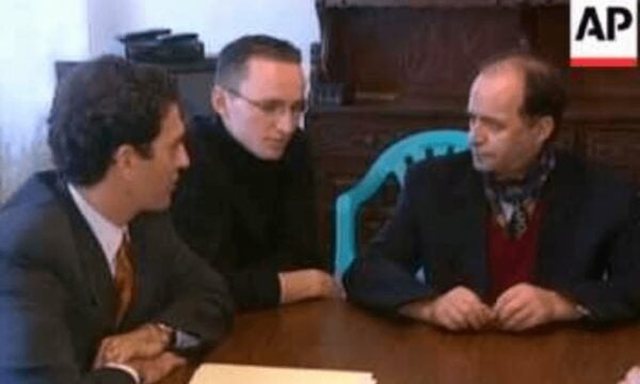
The trial against former leaders of the Kosovo Liberation Army has begun in The Hague, where the defense is presenting its witnesses.
The first witness is James Rubin, former Undersecretary of State and Madeleine Albright's right-hand man.
Top Channel journalist Muhamed Veliu, who is in The Hague, has reported and provided photos of James Rubin's testimony.
In his testimony, Rubin recalled that he first came to Kosovo during the war in Croatia and Sarajevo - and that "aware that such conflicts could extend beyond", he said that he visited Kosovo and met "once or twice" with former President Ibrahim Rugova.
"I visited in the period 1991, 1992, 1993, before the Croatia-Serbia war, and then I visited Sarajevo during the attacks as well as during the war in Bosnia. I was in several cities and also at the very end I accompanied Senator Biden in the spring of 1993.
"During the wars at that time in Croatia, Serbia, Bosnia, these were the foci, the respective places. Being aware that such conflicts could spread further, we understood that what was happening in Kosovo was important. I visited Pristina 2-3 times, I met with Rugova once or twice," Rubin said.
Rubin dwelled at length on his experience with Hashim Thaçi, for whom he said there had been a key moment when it was realized that he was the leader of the Albanian delegation and part of the KLA.
"We didn't know the KLA structures well. When we got there, we realized that the leader of the Albanian delegation was part of the KLA. We talked about the meeting with Thaçi in Rambouillet. During the meeting, he immediately recognized me because of the TV. Albright told me to stay with him, to get to know Thaçi better. Throughout the week, I stayed with him, we met, we had coffee, tea and cigarettes. Thaçi didn't speak English in these circumstances, we communicated through body language. At the diplomatic level, there was an interpreter," he said.
Rubin said that at the time of Rambouillet they could not make statements about Kosovo's independence.
"The idea was that there could be no specific declarations of independence, and that was the essence of diplomacy, that was what was being discussed in Rambouillet. We wanted the great powers to work together, not just the US. Albright wanted as much unanimity as possible among the great powers, and also the help of Russia. Russia was in favor of the Serbian desire not to have declarations of independence translated into a document. We did not yet have a clear position on independence, we needed a compromise, a diplomatic move, an effort to move to the next phase where we would have the whole world on our side to convince the Serbs to agree to the peace agreement," he said.
"He (Thaci) told us that he could not say 'yes' to us without having a specific declaration on Independence, because he had to discuss with the KLA commanders. The people who demanded Kosovo's independence were maximalists, they wanted it all," he said.
"We were trying to find a middle ground," he added.
Rubin then said that Thaçi was told that if he did not use the word independence, he would be considered a person who had given up on independence.
"He told us that if I didn't use the word independence, then they would consider me as someone who had given up on the country's independence, as a traitor. It was a very difficult moment."