How Belinda Balluku is fabricating the rumor about Top Channel's...
/ 2026-10-19 16:19:00Focus


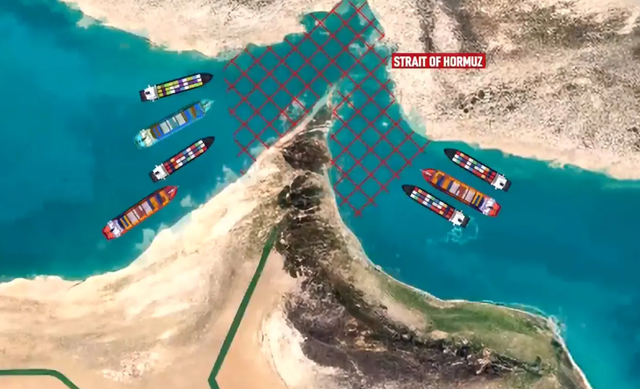
For days, Iran has blocked commercial ships from passing through the Strait of Hormuz, a vital point for transporting oil and gas extracted from Persian Gulf countries to the rest of the world.
This is a big problem because if a Gulf country wants to export oil and gas, it almost always has to go through the Strait of Hormuz. The reasons have to do with both geography and the complicated relationships between the Gulf countries themselves.
There is virtually no alternative, and although it has always been known that this part of the sea is one of the most critical in the entire region, an effective way to bypass the strait and transport large quantities of gas and oil by other means has never been found.
The Strait of Hormuz is only 30 kilometers wide, but crucial for shipping. It separates the Arabian Peninsula from the coast of Iran and is the only passage connecting the Persian Gulf with the Gulf of Oman and the Arabian Sea.
Roughly a fifth of all oil sold worldwide passes through it each year. The blockade of the Strait has halted oil exports from the Persian Gulf countries, which are among the world's largest producers, and has caused a global energy crisis, with major consequences for the price of oil, which in recent days has exceeded $100 a barrel, the highest since the first months of the war in Ukraine.
In fact, the only way to export oil and gas without going through the Strait of Hormuz would be to use oil and gas pipelines. Saudi Arabia has a pipeline that runs from the Persian Gulf to the Red Sea, and the United Arab Emirates has one from the Persian Gulf to the Gulf of Oman.
However, both have very limited capacity, only about 6 million barrels of oil per day, while the Strait of Hormuz can handle more than 20 million barrels per day. Furthermore, building these infrastructures is a very long and expensive process.

Meanwhile, transporting liquefied natural gas (LNG) is even more complicated, as there are no pipelines that pass through the Gulf countries. The only way to transport it is to rely on LNG carriers that pass through that part of the sea.
The fact that none has been built is due to a number of reasons, all of which have to do with the complex political and commercial relations between the Gulf countries. The main gas producer, Qatar, borders only Saudi Arabia, and any pipeline would necessarily have to pass through that country, with which relations were very tense until a few years ago.
In 2017, Saudi Arabia, the United Arab Emirates, and Egypt accused Qatar of supporting terrorism and Islamist groups in the region, as well as its close ties to Iran, and blocked all diplomatic relations with the Qatari government. The crisis was only resolved in 2021, but no plans have been made to build a gas or oil pipeline since then.