


"The fate of the homeland is in our hands" - An appeal by Ismail...
/ 2026-10-18 16:09:54Focus


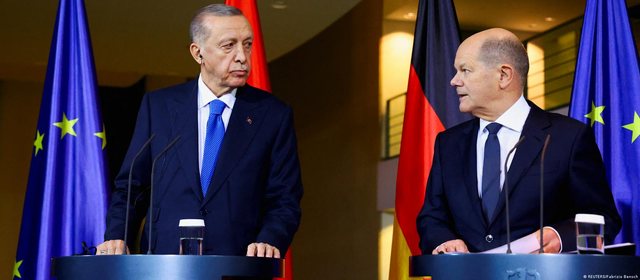
Turkish President Recep Tayyip Erdogan and German Chancellor Olaf Scholz on Friday displayed deep divisions over the war between Israel and Hamas, as the Turkish leader made a tense and brief visit to Berlin.
Mr Erdogan was invited to visit Germany months ago after being re-elected, but in recent weeks his increasingly tough stance on Israel has caused concern in Berlin. Turkey has always been seen as an unusual but essential partner for Germany, where there are over 3 million people of Turkish origin. Turkey is also a member of NATO, which also has an important role in controlling the flow of refugees and immigrants to Europe, an issue for which Mr. Scholz faces great pressure within the country. There has been frequent tension between the two countries in recent years.
The most recent rift between the two countries was created over attitudes after Hamas' attack on Israel on October 7.
Germany is a staunch ally of Israel and has opposed calls for a ceasefire, while pushing for aid to civilians in Gaza, calling for a "humanitarian pause" and trying to keep communication channels open with other countries in the region, to prevent the spread of conflict.
Turkish President Erdogan this week called Israel a "terrorist country" that aims to destroy Gaza and all its inhabitants. He described Hamas militants as "resistance fighters" trying to defend their land and people. Hamas is considered a terrorist organization by Israel, the United States and the European Union.
These and similar comments have outraged politicians across the spectrum in Germany. Chancellor Scholz has described Mr. Erdogan's accusations against Israel as "absurd".
"It's no secret that we partly have very different views on the current conflict," Mr. Scholz said during a brief press conference alongside Mr. Erdogan, before the talks were held. But, "especially in difficult moments, we have to talk directly to each other".
"Hamas' attack means that Israel must defend itself and it must have this opportunity," he said. "A terrorist organization that governs this region cannot continue to undertake such activities from there repeatedly, with incredible military strength. This must end and this is an objective that must be supported - we support it in any case".
At the same time, Mr. Scholz said that it is important "to do everything to keep the number of civilian casualties as low as possible", and emphasized that "the suffering of the Palestinian civilian population in Gaza hurts us as well".
Mr. Scholz said that Turkey and Germany fear an expansion of the conflict in the region, and that they will consider how to prevent it.
While Chancellor Scholz repeated the request for a pause in the fighting, President Erdogan said that: "If we can establish a humanitarian truce together with Germany, we will have the opportunity to save the region from this circle of flames."
"So far, 13,000 Palestinians, children, women and the elderly have been killed," he said. "There is hardly a place called Gaza anymore; everything is destroyed".
Mr. Erdogan suggested that Germany cannot criticize Israel because of the Holocaust.
"I speak freely as we owe nothing to Israel. If we were in debt, we wouldn't be able to speak freely," he said. "Those who are in debt cannot speak freely. We did not experience the Holocaust and we are not in such a situation."
Israel withdrew diplomats from Turkey last month after Mr Erdogan accused Israel of war crimes. Later, Turkey also withdrew its ambassador from Israel.
Another potential source of tension emerged ahead of Friday's visit when Turkish Defense Minister Yasar Guler said Turkey intended to buy 40 Eurofighter Typhoon fighter jets but that Germany was blocking the sale of the planes, which are made by Germany, Britain , Spain and Italy.
Mr Guler told members of the Turkish parliament's defense committee that Spain and Britain support the sale of the jets to Turkey and are working to convince Germany.
"Germany can sell them, or not," Mr Erdogan said on Friday. "Is Germany the only country that produces planes? We can buy them from many other countries."
Chancellor Scholz did not speak on the matter, and neither did other German officials. VOA


