Is this police force professional and capable of handling violen...
/ 2026-10-16 18:54:07Focus


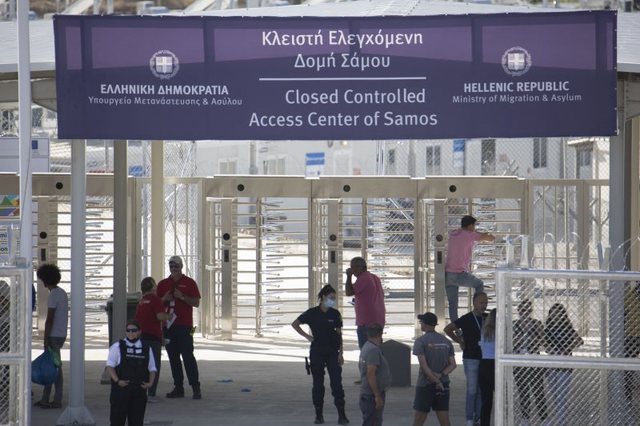
The Greek government has presented a new draft law on legal migration, which aims to solve the numerous problems with delays and bureaucracy in issuing residence permits.
Minister of Immigration and Asylum, Thanos Plevris, said that this initiative "is putting an end to the chronic blockages that have hindered workers and businesses."
The draft law, which is expected to be presented to the relevant Parliamentary Committee in the coming period, comes at a time when the debate on immigration is returning to the spotlight both at the national and European levels, with the Greek government calling for a clear distinction between legal and illegal migration.
There are currently around 793,000 legal immigrants living in Greece, but nearly 293,000 applications for residence permits remain pending. Delays in their processing have caused problems for beneficiaries, as permits are often issued after they have expired, creating uncertainty and difficulties in employment and social integration. With the new rules, it is expected that around 90,000 suspended permits will be resolved immediately, while another 90,000 will be resolved over the next two years.
Provisions of the draft law
According to the newspaper Protothema, the draft law introduces regulations to facilitate immigrants who are already legally in the country. It provides for the automatic renewal of some categories of residence permits, especially when the immigrant continues to work for the same employer, to avoid repeated submission of files without good reasons. At the same time, each new permit will have a minimum duration of two years, so that administrative delays do not burden the immigrant himself and do not lead to the formal loss of legal status.
There is a special provision for immigrants who have resided legally in Greece for five years or more and whose application was previously rejected for purely formal reasons. These individuals are given the opportunity to reapply and obtain a residence permit, provided that the formal deficiencies are corrected, ensuring full integration into the country.
At the same time, the ministry is strengthening the decentralized administrations that examine applications and is introducing the possibility of transferring files between regions, in order to free up heavily loaded services and speed up the process as a whole. In the same context, it is envisaged that immigrants over 65 years of age, mainly of the first generation, who have lived and worked legally in Greece for at least 20 years, will have the opportunity to stay without the obligation to work, provided that they have private health insurance and a pension, avoiding the burden on the public social security system.
Direct recruitment of workers from third countries
The draft law also introduces important changes to the procedure for calling up workers from third countries, in order to reduce bureaucracy and fill vacancies more quickly. Procedures are simplified and temporary employment agencies are given the opportunity to make calls upon request on behalf of companies facing immediate staffing needs. Particular emphasis is placed on large projects, where up to 500 workers will be recruited immediately, while procedures at consulates are simplified, reducing the time needed to issue documents.
An important innovation is the possibility of changing employers for those who enter the country through a call, without losing their legal residence status, increasing mobility in the labor market and reducing the phenomena of dependence or exploitation. In addition, international agreements with third countries, such as the Philippines, Armenia and Egypt, especially in areas such as agricultural production, are made with the clear condition of cooperation in the fight against illegal immigration.
"Greece is reshaping the legal path"
With the new framework, the Ministry of Immigration and Asylum aims to create a more efficient and functional legal migration system that will support the economy and the labor market, restore legal certainty for legally residing immigrants, and at the same time maintain a strict stance against illegal migration.
"We are liberalizing and accelerating the procedures for issuing and renewing residence and work permits, with simpler procedures. Greece remains absolutely strict against illegal immigration, but is reshaping the legal path for those who want to work by filling labor gaps in sectors such as agriculture, construction and tourism," emphasized Minister Plevris, speaking to APE-MPE.