Protests highlight trauma crisis, operating rooms under reconstr...
/ 2026-10-15 18:35:16Focus


Strategically located where the Adriatic and Ionian seas meet, a small rock has once again become an object of desire for the rich and powerful.
From National Geographic / For thousands of years, world powers have vied for control of a small, lush island off the southwestern coast of Albania. Sazan Island, a 2.2-square-mile expanse of land, lies within the Strait of Otranto, a narrow channel that separates Italy and Albania, and that has served as an important base for powers seeking to dominate the Adriatic and Ionian seas.
There are no permanent residents in Sazan, yet it has played a key role in the history of Albania for more than a century.
“The island certainly has a long and complicated history,” says Theodora Dragostinova, a history professor at Ohio State University who specializes in Balkan studies. With its strategic location on the edge of the Gulf of Vlora in Albania, various empires — including the Romans, Venetians, British and Ottomans — have controlled it.
“It is certainly one of the best examples of how location can disproportionately determine the importance of a given place,” Petar Kurečić, a professor of political science at the Northern University in Croatia, notes in an email.
“There has been no significant historical power in the region (or even outside it) that has not controlled or attempted to control Sazan.” Possession of the island once helped determine control of the Adriatic, and with it countless port cities, such as Venice, Dubrovnik, and Trieste. (Today, the area is valued primarily for its ecological beauty and potential to attract tourists.)
In antiquity, the Romans used the Gulf of Vlora as a resting place for their ships. Several key battles during the Roman Civil War - a fierce struggle between Julius Caesar and Pompey the Great from 49-45 BC - took place along the coast of mainland Albania.
More than a millennium later, in 1264, the Venetians and Genoese, fighting for dominance in trade, staged a naval battle off the coast of Sazan. And by the 15th century, Sazan had become an official naval outpost for the Ottoman Empire, explains Steven Seegel, professor of European and Eurasian Studies at the University of Texas at Austin.
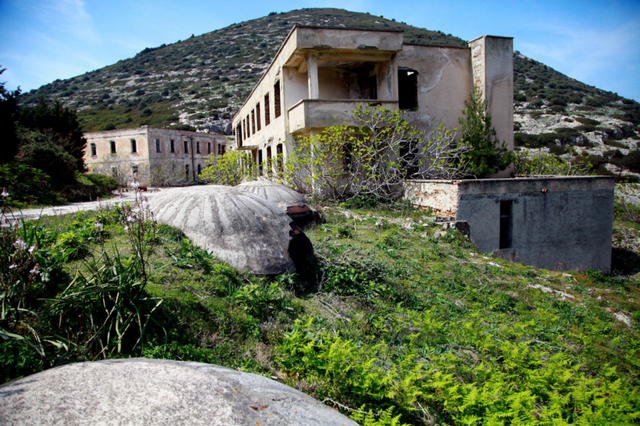
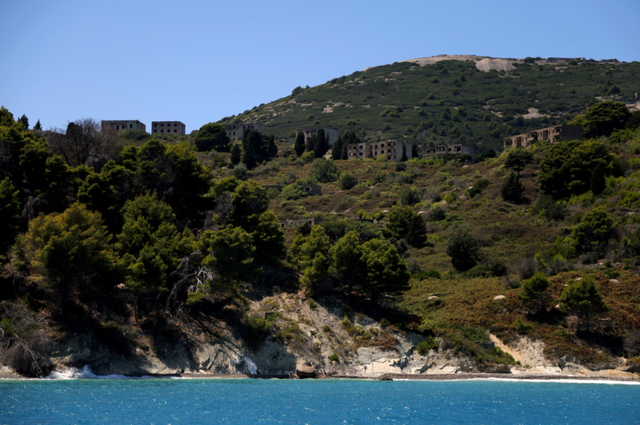
Sazan Island is home to an extensive network of tunnels, barracks, and other abandoned military infrastructure. Since few people have visited the island in recent decades, the ecosystem has flourished.
Fast forward to 1912, when Albania declared independence from the Ottomans. Suddenly, Sazan became a disputed territory, with many nations—Greece, Albania, and Italy—vying for control.
8 years later, Italy took possession of the island, which it held after Mussolini came to power in 1922.
“[His] forces in the interwar period built defensive infrastructure there, including barracks and military installations that proved important for control of the Adriatic Sea,” says Seegel. During World War II, the Italians and, for a brief period, the Germans occupied the island.
When World War II ended, Albania finally gained ownership of Sazan as part of the Paris Peace Treaty in 1947. The island then played a prominent role in the regime of Enver Hoxha, who led the country from 1944 until his death in 1985. His communist government was isolationist and repressive. Religious figures and other individuals seen as threats to the state were imprisoned, exiled, or executed, and the government seized private property.
“Hoxha was obsessed with the idea of a military attack on Albania,” says Elidor Mehilli, an associate professor of history at Hunter College. With the help of the Soviet Union, an ally of Albania, he built up Sazan’s defenses, including thousands of bunkers to protect against invasion and a secret network of tunnels used to store submarines. (A secret CIA memo from 1961 referred to Sazan as a “Red Gibraltar in the Mediterranean.”)
When Hoxha's relationship with the USSR finally broke down, he reportedly refused to give up some of the submarines. The Soviets, not wanting to cause a conflict by crossing NATO waters to reclaim them, let their prized ships go.
Throughout his regime, the military infrastructure in Sazan had dual functions: protecting against perceived threats and helping to prevent Albanians from leaving the country, says Dragostinova. “The way I see it, it became a symbol of the regime’s brutality, secrecy and paranoia.”
When Hoxha’s communist government finally fell in the 1990s, “the island was reclaimed for the nation and nature,” says Dragostinova, and in turn became a symbol of liberation for many Albanians. In 2010, the Albanian government created the Karaburun-Sazan National Marine Park, which includes Sazan and is home to about 300 plant species and 40 bird species, such as the alpine wagtail and the Eurasian eagle-owl, one of the largest species of owl. Over time, the national park has also become a haven for endangered Mediterranean seals, nesting loggerhead sea turtles, and hundreds of flamingos.
Five years later, says Mehilli, Sazani was demilitarized and opened to the public. (Technically, it is still a military exclusion zone, placing it under the jurisdiction of Albania’s Ministry of Defense.) Although parts of Sazani have been opened to tourism, it still lacks significant infrastructure, and overnight stays are usually prohibited. Visitors hoping to see its limestone cliffs must travel by boat during the day.
Today, Sazan is “a unique Cold War time capsule in the middle of the sea,” says Mehilli. Its network of tunnels still remains, as well as relics of command bunkers, weapons depots and nuclear shelters. Unexploded mines and other munitions have been found on and near the island, according to several media reports. Since Sazan once housed military officers and several families, it also had a collection of houses, schools and medical clinics, Mehilli says. (Parts of Sazan, he notes, were looted during civil unrest in 1997.) Because of the region’s long history of war, the waters surrounding Sazan and in the Gulf of Vlora are littered with shipwrecks, mostly from World Wars I and II. The area has yielded several important archaeological discoveries and has become popular with divers.
Because few people had access to the island for decades, its ecosystems are largely untouched. “From a historian’s perspective,” says Mehilli, “this is one of the few relatively untouched places left in Albania that speaks to its deep history.”