


Is this police force professional and capable of handling violen...
/ 2026-10-16 18:54:07Focus


In Caraffa (Arbëresh municipality) a woman has decided to give her daughter a faithful reproduction of the community's costume. It is a long white dress with characteristic embroidery bought in the Albanian city of Kruja.
Another language, another tradition, another culture. That of Arbëresh is a story that starts from far away, from Albania. A fragment of humanity that knows the weight of detachment, of distance, of the strength it takes to uproot one's roots from mother earth and transfer them elsewhere. On the other side of the sea, with the hope that they will take root as soon as possible to feel homesickness less in their everyday life.
From the 15th to the 18th century, various migrations led groups of Albanians to establish new villages or repopulate existing communities in southern Italy. To escape the Ottoman occupation of Albania and in some cases to provide military aid to the Italian peninsula, over time the Albanians ended up crossing the sea entrusting another country with the task of sheltering and hosting them: this is the first page of the history of the Arberian countries, the small cultural and linguistic islands that belong to the Arberian archipelago. But an experience lived by a large people, no matter how convincing it is, must be written, narrated, supported and renewed in order not to pass into the pulp of oblivion.
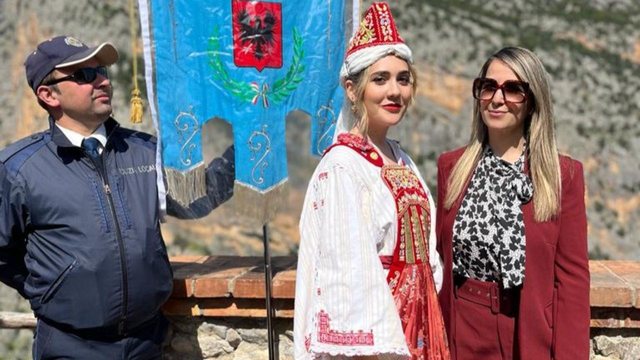
In Caraffa, a small village in the interior of Calabria, teacher Assunta Scerbo decided to order and then give her daughter Greta a faithful reproduction of the Arber costume of the community of Catanzaro province. A dress made with patience and care by designer Lucia Bubba, also from Caraffa. A way to have care, attention and respect for what past generations have transferred to the present, in a kind of cultural relay.
But that's not all. The costume that Assunta wanted to give to her daughter was actually enriched with a "line", a long white dress with characteristic embroidery, quite special: the dress was bought by Francesco, Greta's brother, in the Albanian town of Kruja . A fraternal gift that makes even closer the connection between the identity represented by the clothing and the material elements from which it is made.
However, one piece is still missing from the story surrounding the making of the dress. Greta's aunt, Virginia Scerbo, provided the precious damask fabric that was used to make the skirt. In short, a garment that carries not only the weight of history and centuries-old traditions, but also a conscious and joint action of preserving the Arber culture through the reproduction of a garment whose details amaze you.

On the occasion of the manifestation of the Festival of Dance, which recently took place in Civita, a delegation from the municipality of Caraffa in the interest of the delegate for culture and the president of the municipal council Serena Notaro, in synergy with the group "Le stelle del folk" , joined the community sheltered at the feet of Pollinos.
And right here, for the first time and in front of hundreds of inhabitants of Arbëresh villages, Greta wore the precious dress, letting the traditional and evocative costume show, as in the silence of an exhibition, the reasons why it is important not to lose the uniqueness, the unique beauty of which it makes diversity an expression.
In the frenzied scramble of the present, in a world with eyes and thoughts almost always turned to tomorrow, in a period where the difference between living and running towards the future is getting closer, remembering is a verb that is rarely articulated.
In our rush to draw tomorrow, we end up blurring the outlines of the past. We leave history exposed to the wear and tear of time and the painfully lived experiences of those who came before us, tending to no longer listen to them.
However, that is where we come from: from the footsteps of our ancestors, from the sweat of our fathers, from the cradle of our ancient communities, from the land to which we owe the roots that connect us to the world and life. Remembering is not an obligation. But this is the only way not to lose control over identity.
If, contrary to the pace sustained by current society, we slow down to turn our backs on the future, in an unusual reversal of perspectives and habits, and for once look the past in the face, we can become aware of the legacy extraordinary historical, linguistic and cultural heritage inherited from history and for which we can, and perhaps should, be guardians.
Maybe one day, not too far, we will do like Assunta and understand how important it is to give not only what is needed, but above all what matters.
Francesco Graziano/ La Calabria Visione


