Is this police force professional and capable of handling violen...
/ 2026-10-16 18:54:07Focus


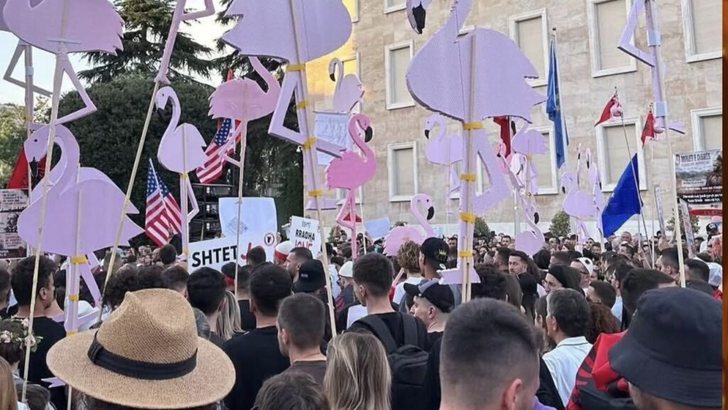
While protests over Sazan and Zvërnec continue to fill Tirana's squares and the debate over the fate of the Albanian coast has become stronger than ever, another government decision was passed last week.
This time it's about Porto Palermo.
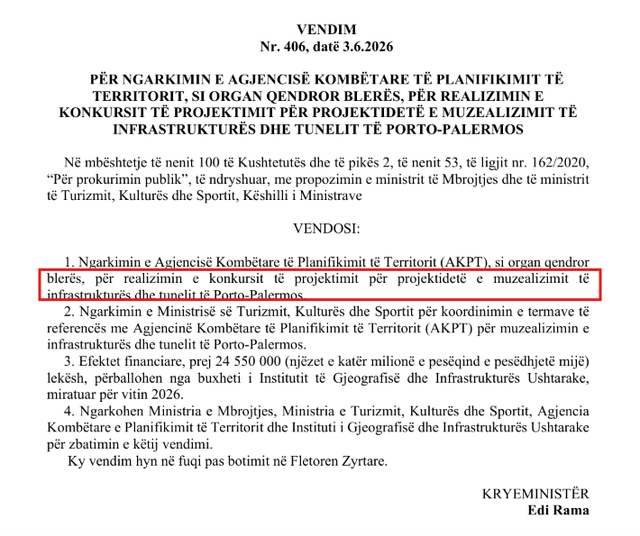
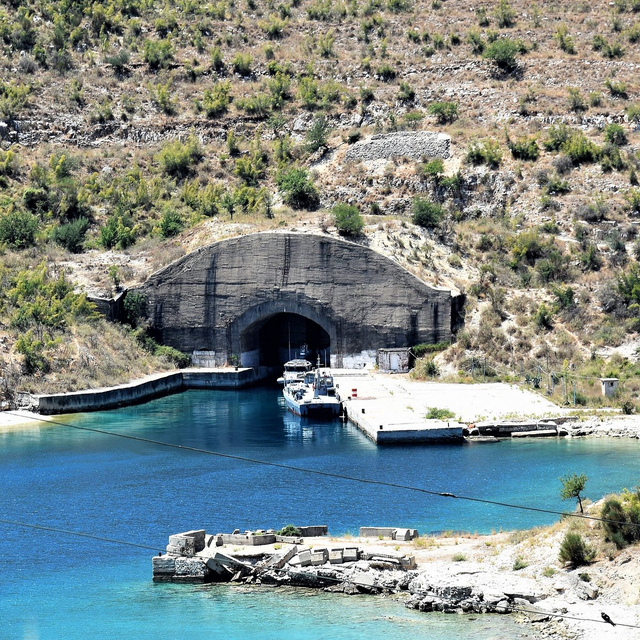
With a decision published in the Official Gazette on June 9, the government has tasked the National Territorial Planning Agency with organizing a design competition for the project ideas for the museumization of the Porto-Palermo infrastructure and tunnel. 24.55 million lek from public funds have been made available for this phase.
No one can object to the museumization of an asset with historical and military value. On the contrary, the Porto-Palermo tunnel is one of the most unique objects of the Cold War period heritage and has been forgotten for years, far from the attention it deserves.
But the history of recent years has taught us that in Albania, the words "rejuvenation", "valorization", "rehabilitation", "tourism development" and "musealization" are no longer simply technical terms. They have become the usual introduction to projects that then take on entirely different dimensions.
Precisely for this reason, Porto Palermo cannot be seen as detached from what is happening along the entire Albanian coastline.
From Cape Rodoni to the Deep South, from Lalzi Bay to Zvërnec, from Sazani to dozens of other strategic points, citizens have seen the same scenario repeated over and over again. Initially, there is talk of restoration, promotion, opening to the public or a return to identity. Then come the projects, investments, developments, partnerships and transformations that forever change the character of the area.
Porto Palermo has an even greater weight.
It is not only one of the most beautiful bays of the Albanian Riviera. It is not only a rare landscape between sea and mountain. It is also a point of special historical and strategic importance for the country.
For decades, one of Albania's most important military bases operated there. The submarine tunnel and surrounding infrastructure represent a piece of national defense history found nowhere else in the country.
Therefore, the concern is not related to the museum.
The worry is related to what might come after it.
The government decision does not explain how far the project will extend. It does not clarify what territory is included. It does not indicate the boundaries of the intervention. It does not determine whether it is only about the tunnel or a wider area. It does not clarify what will and will not be allowed in the future.
The public is asked to believe that it is just a museum.
But the public has already seen many projects that started with one name and ended with another.
This is why Porto Palermo deserves much greater transparency than an administrative decision published in the Official Gazette.
What is happening today on the Albanian coast is not just development. It is a profound transformation of the territory, the landscape, and the country's strategic assets.
Every bay, every cape, every abandoned military base, and every space with tourist value is gradually entering the map of major projects.
In this climate of mistrust, Porto Palermo cannot be treated as an ordinary technical procedure.
It is another test for the Albanian state.
If it is truly about museumization, then the project must be open, transparent, and limited only to this purpose.
Porto Palermo doesn't need promises. It needs guarantees.
The guarantee that the tunnel will remain a tunnel, the museum will remain a museum, and that behind the beautiful words about heritage, history, and tourism, there is no hiding another bite of the Albanian coast from the concrete of the "eco" hotels around there. ( Kontrast.al )