Is this police force professional and capable of handling violen...
/ 2026-10-16 18:54:07Focus


The gradual collapse of the liberal democratic international order and the return of the logic of zones of influence are changing the foundations on which European security was built for decades. The world that is taking shape is no longer that of international defense institutions and universal liberal democratic principles, but an uncertain order, where values must coexist with the practice of force and stability will increasingly be sought through compromise between the great powers. It is no coincidence that in this context the Russian Foreign Minister, Sergei Lavrov, publicly warned of the need to open new channels of communication with the United States for the Balkans. This signal shows that the Balkan region is no longer perceived as a closed and stabilized geopolitical space, but as a strategic issue left in limbo. As such, it must return to the table of discussions between the great powers.
Henry Kissinger rightly warned long ago that the international order is not maintained by morality, but by the balance of power. While John Mearsheimer, one of the most prominent thinkers on international relations in the 21st century, goes a step further. He says that great powers respect the rules as long as they serve their interests. The new American security strategy of 2025 confirms this historic change of course. For the US, China and the Pacific are now the existential priority. Europe is considered a secondary theater, which must be stabilized, but not unconditionally protected by the US. In a world organized in such a way, territorial compromises on its periphery are no longer taboo topics and small and unstable states can become part of the menu, if they cannot manage to sit around the table, as Canadian Prime Minister Mark Carney would say at this year's meeting in Davos.
As mentioned above, the Balkans fulfill all the conditions of a peripheral space. It does not constitute a vital interest for the US, it does not directly affect the disruption of the global balance, although it carries a very high potential for regional destabilization. Precisely for this reason, it is suitable for compromise.
Serbia is a dominant actor within this space. It possesses the largest regional military capacity, the most developed economy in the Western Balkans, and a flexible diplomacy that moves between Brussels, Moscow, and Beijing. In a transactional order, Serbia is presented as a negotiable partner for stability. While Kosovo appears as a problematic case that requires management.
Serbia's real strength lies not only in its army or economy, but in the way it conceives of national security. For decades, Serbia has built a functional axis of church - academy of sciences - state - diplomacy. The Serbian Orthodox Church produces the historical and moral narrative, the academy legitimizes it scientifically, the state translates it into political doctrine, and diplomacy exports it internationally. This silent coordination creates strategic continuity, despite government changes in Serbia. Faced with this architecture, the Albanian fragmentation of Tirana - Pristina is not simply a political weakness, but a deep and comprehensive disadvantage.
Russia's attack on Ukraine showed that the time for classical conquests in Europe is not only not over, but is more relevant than ever. However, it cannot be used by anyone at any time, since the dominance of one state over another can also be achieved in other ways. Time has proven Hedley Bull right, who pointed out that order is also maintained by limiting the sovereignty of weak actors. Gradual neutralization, asymmetric autonomies, special statuses and long-term supervisory presence have become common instruments of political control. This model produces victories without the cost of war. In this context of the changed world order, for Serbia, the neutralization of Kosovo is a much more favorable strategic objective than its re-annexation.
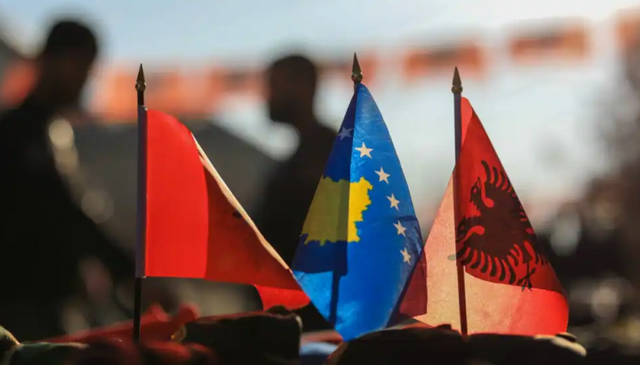
However, the greatest danger for Kosovo does not stem solely from the strength of Serbia or the return of Pan-Slavism. The greatest danger lies in the lack of a Tirana-Pristina national axis and a common Albanian strategic doctrine. As time shows, Albania and Kosovo are entering this era of global change not as a unified national political bloc, but as two fragmented states, with different orientations and, unfortunately, often competing with each other.
The relations between the two Albanian capitals are not built on stable institutional mechanisms, but on personal dynamics and momentary calculations, although institutions are more important than individuals for the long-term stability of a nation. Thus, the lack of a permanent Albanian strategic architecture has transformed national politics into a function of the personal rivalries of Albanian leaders. Tirana has preferred stability and harmonization with the European Union, avoiding clashes. While Pristina in recent years has followed a more sovereignist line and more resistant to compromises. This functional division weakens the Albanian position and gives Serbia a silent advantage.
Governmental cooperation between the two Albanian states, despite its symbolism, has remained sporadic and formal. Joint government meetings and ceremonial agreements have not been accompanied by the building of institutions or a permanent strategic planning structure, with a joint secretariat, synchronized analyses, and a unified doctrine of security and diplomacy. Without these elements, Albania and Kosovo act as two independent actors, without a common political entity in the framework of preserving the interests of the Albanian nation.
This weakness is further exacerbated by an identity and political divide that is consolidating, particularly in Kosovo. The discourse of the “Kosovar nation”, constructed as an identity separate from the Albanian one, seems to serve the consolidation of the new state of Kosovo in formal terms. However, in a national strategic plan, it produces a very dangerous effect: the gradual separation of Kosovo from the Albanian national axis. One of the most important theorists of modern nationalism, Ernest Gellner, emphasizes that nations are political projects that require symbolic and strategic coherence. When state identity is constructed in opposition to national identity, the basis of solidarity is weakened and the capacity for joint action between states of a nation is reduced. One of Gellner’s most radical ideas is that new states often construct artificial state identities, with the aim of consolidating sovereignty. However, this is often done to the detriment of existing national identity.
Even more destabilizing is the normalization of a vernacular hostile to Albania. Accusations of paternalism, the claim that Tirana seeks control over Pristina, and its labeling as a “historical vassal of Belgrade” have gone from episodic polemics to a sustained narrative. It even goes so far as to say that there are Kosovo Albanians who do not see Albania as the motherland of Albanianness. Albin Kurti is called “father of the nation,” while Edi Rama is called “brother of Vuqiqi.”
This language undermines mutual trust among Albanians, paralyzes institutional cooperation, and gives Serbia a valuable propaganda advantage, and is truly the best "gift" that can be given to Serbia.
Unfortunately, the disagreements have also penetrated the academic field, where normally the most stable cohesion should have been produced. The positions of the Academy of Sciences and Arts of Kosovo, accompanied by accusations against the Academy of Sciences of Albania of paternalism or attempts at domination by it, have produced institutional rivalry instead of natural cooperation. The most significant indicator of the depth of this problem is the slowdown, if not the blockage of the major Albanological project “Albanian Encyclopedia”. For more than two years, the two Albanian academies of sciences have still not managed to fully approve the encyclopedic dictionary, the fundamental document of the work. Let alone start the main work, the drafting of encyclopedic articles! And this is not the fault of the Academy of Sciences of Albania, although it also has its shortcomings. Decisions taken together are reopened, closed debates are artificially returned to the table of the Central Editorial Office. The process has been accompanied since its beginning with absurd claims that Tirana will "take everything for itself", using the language of "us and you" etc., as if it is not about a national encyclopedia but about placing pyramids between the Albanian-Albanian border! This structural suspicion towards Tirana's academy transforms a fundamental national initiative into an arena of rivalry and makes it impossible to build a culture of normal academic cooperation.
As mentioned above, academic non-cooperation, the lack of joint long-term government projects, and institutional isolation weaken the formation of a common strategic elite, leaving the Albanian space without a coordinated thought base, let alone consolidation.
However, the responsibility is not one-sided. The prolonged silence of the Albanian government, the systematic avoidance of public debate on relations with Kosovo, and the lack of a clear national policy have deepened the misunderstanding and distancing between Tirana and Pristina. Tirana has often chosen diplomatic conformism instead of seeking dialogue and building a long-term strategic vision. This silence has not produced calm, but a vacuum, which has been filled by radical narratives and accumulated distrust.
The transition from this situation cannot be achieved by tactical corrections, but requires radical strategic intervention, which should aim at transforming the Albanian political, academic and cultural elites themselves. The current elites, formed in the initial conditions and during the long transition, which are compromised by the legacy of old practices, have shown serious limitations in producing a national strategic vision. Only through the arrival of new elites, educated in the West and uncompromised by the logic of the past regime and transitional clientelism, can a new culture of cooperation, trust and long-term planning be built between the two Albanian states.
At this point, a special responsibility falls on the academic elite. In small societies exposed to external pressures, the role of universities and research institutes is not simply descriptive, but orienting. The Academy of Sciences should articulate vital national interests, produce conceptual frameworks for policymaking, and create a minimum strategic consensus beyond electoral cycles. This would make Kosovo more resilient to external pressure and avoid the realization of a particularly dangerous scenario: the “Finlandization” of Kosovo. In the classic sense of Cold War political terminology, “Finlandization” means the formal preservation of sovereignty, but the real limitation of foreign and security policy under the pressure of a larger power, which for Finland was the Soviet Union. For Kosovo, this scenario would mean a formal state, but with conditional sovereignty, asymmetrical autonomy, forced self-restraint, and structural dependence on the will of larger actors (read Serbia). In political theories, this is considered a greater risk than annexation, as it produces false stability and makes the gradual loss of sovereignty irreversible.
Finally, it is worth noting that the fundamental problem for Kosovo is not Serbia. It is not strong enough to change the European security architecture on its own. So, the Ukrainian scenario cannot happen. But Serbia wins if it faces a divided Albanian nation, without a strategic axis and without a long-term defense doctrine. The greatest danger for Kosovo is not military occupation, but the compromise of the great powers and the Albanian disunity. As time is showing, in the new imperialist era, nations do not disappear from war, but from the compromise of the larger ones, when small nations are divided and without a strategy.