Is this police force professional and capable of handling violen...
/ 2026-10-16 18:54:07Focus


A geopolitical analysis of the end of globalization and the rise of the American economic empire
By Henry Chenault
A moment that divided history into two eras
October 26, 2025 will be remembered as a date that changed the course of the 21st century — the day when the United States was no longer part of the international system, but became the system itself.
For more than thirty years, the world had lived under a global order based on economic globalization, where powers were interdependent, markets were open, and supply chains stretched across political borders. This interdependence was seen as a guarantee of peace. But it also created dangerous dependencies, especially on China, which became the world's factory — and more than that: its strategic resource.
In 2025, this architecture began to collapse. But not through spontaneous collapse — it was deliberately toppled. And the conductor of this collapse was America.
China's silent dominance: the era of rare earths
Since the late 1990s, Beijing has systematically built up control over the most strategic sector of the digital age: rare earth materials. These are 17 chemical elements that, while unknown to the public, are the foundation of every modern technology — electric motors, solar panels, wind turbines, rockets, smartphones, satellites and AI servers.
China came to control over 80% of global processing of these elements. And through a sustainable industrial strategy, it not only produced them more cheaply, but also destroyed competition in the US, Australia and Europe, turning itself into the sole global supply center.
This advantage became its most powerful weapon. In any trade or diplomatic clash, China knew it could threaten to cut off supplies of neodymium — an element without which no Tesla drives, no F-35 takes off, no data center functions.
Essentially, China controlled the “neurons” of global technology.
Until the moment when the US decided to divorce itself from this dependence.
Economy as a weapon: Washington's new doctrine
Donald Trump, back in politics after a tumultuous decade, resumed what many called a "trade war," but which in retrospect will be known as the most refined economic warfare strategy ever.
In October 2025, he threatened 100% tariffs on $300 billion in Chinese goods, a move that would have devastated any other economy, but which for the US was calculated blackmail.
The message was clear: either Beijing agrees to restructure its supply chains, or lose access to the world's richest market.
China reacted immediately by threatening to ban exports of rare earth minerals. But for the first time, the US was prepared for this scenario. And the blowback came in spectacular fashion.
The Three Days That Changed the World: “72-Hour Checkmate”
From October 24 to 26, 2025, the US orchestrated a series of agreements that were seemingly technical, but were essentially an overthrow of a global order.
October 24: Malaysia signs pact to develop rare earth mining with US support.
October 25: Thailand signs deal to process these materials, creating alternative infrastructure to Chinese factories.
October 26: New regional framework announced, also including Australia, Cambodia and Japan – with an initial investment of US$350 billion in supply chains.
In just three days, America disconnected its technological system from Chinese dominance and connected it to a new supply chain led by Asian allies.
Beijing "took a step back" – not out of desire, but out of lack of options.
From globalization to "economic imperialism"
In the 1990s and 2000s, the US preached globalization as the way to spread free markets and democracy. But globalization turned against its creator: production moved to Asia, supply chains were concentrated in China, and American dependence deepened.
In 2025, this chapter closed.
The US is not destroying globalization — it is recolonizing it.
Instead of trying to compete on a level playing field, Washington has chosen to control access to the global market itself, making it a tool of political and economic pressure.
In practice, this means:
Countries that cooperate with the US receive trade access, investment and technological support.
Those that remain in the Chinese orbit face tariffs, isolation and a lack of critical access.
This is the new model of economic empire: not through military conquest, but through structured dependence and control of markets.
Figures that speak of the end of the old era
Between 2018 and 2024, US–China bilateral trade fell from $758 billion to $578 billion.
But the money didn't disappear. It was redistributed.
The bulk of this flow – about $180 billion – shifted to ASEAN countries, which accepted the role of “paying partners” in the new American order.
These countries, such as Malaysia, Thailand, Vietnam and Indonesia, saw a 20% increase in trade with the US, making the region the epicenter of global supply after China.
For the first time in 30 years, China's share of the global rare earths market fell, and this decline was symbolic: the end of Beijing's strategic monopoly.
American Strategy: from “Free Trade” to “Controlled Trade”
The United States is applying a strategy that is essentially the inverse of classic globalization.
Instead of pursuing free competition, they are organizing global trade as a hierarchically controlled system, centered in Washington and with branches in Asia, Europe, and Latin America.
In this system:
Monetary policy is tied to the US dollar and rates.
Technological chains pass through US licenses, standards, and companies.
Natural resources are secured through strategic partnerships that are conditioned by politics.
This is imperial capitalism — an order where the economy is an instrument of foreign policy.
"Modern Tribute" and the Return of Controlled Addiction
Essentially, this is not a trading system, but a tribute mechanism.
In ancient Rome, provinces sent gold and resources to the Empire in exchange for protection and trade.
In 2025, the model is the same — except that the tribute is paid in supply chains, technology licenses, and commercial access.
In this new order:
The US provides economic security but requires strategic alignment.
Other states gain stability but lose industrial autonomy.
China remains the sole competitor, but surrounded by an economic wall of satellites dependent on Washington.
Diplomacy of fear: 63% vs. 4%
From 2018 to 2025, the US has implemented a tariff pattern that divides the world into friends and rivals.
63% of Chinese goods have been hit with maximum tariffs, while only 4% of goods from allied countries have been affected.
Every trade crisis has been used as a means of pressure for strategic reorientation:
At every threat, markets crashed, Beijing reacted, while Washington granted exemptions for allies.
The result: global chains avoided China, not out of fear of Beijing, but out of the risk of American sanctions.
Any apparent "chaos" was a deliberate move to displace capital.
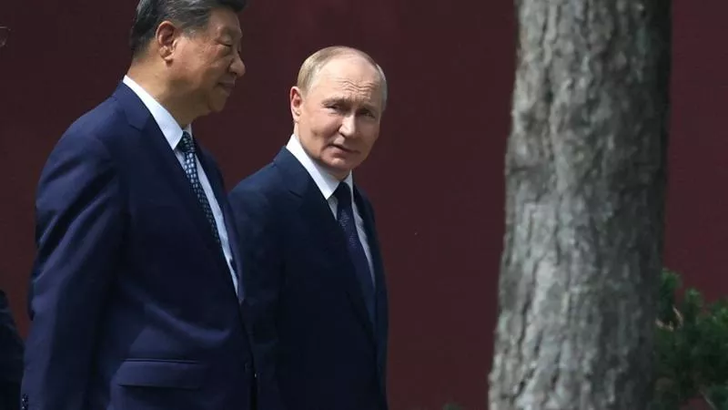
The meeting that will define the era: Xi–Trump at APEC
The November 1 APEC meeting will be symbolic, but essential.
China will seek to save its face by partially accepting the "trade stabilization" agreement.
In reality, this would be Beijing's first diplomatic capitulation to Washington since 1972.
In exchange for tariff relief, China will accept:
American access to Asian rare earth processing capacities,
co-production under American supervision, and
preservation of the status quo in Taiwan in exchange for trade peace.
But beneath the surface, America will have gained control over humanity's technological future.
The post-globalist era: monopoly of values and resources
The emerging era is not multipolar. It is monocentric, centered around an empire that uses not flags or colonies, but standards, markets, and technology.
American AI will dominate the global data infrastructure.
Natural resources will be channeled through dependent partnerships.
Industrial security will be conditioned by politics.
And each country will have to choose:
→ the American market, or
→ Chinese chains.
Not both. Never again.
The empire that won without war
In history, only a few powers have managed to change the world order without burning it down with war.
Rome did it with roads and legions.
Britain with its fleet and trade.
The America of 2025 did it with economics, artificial intelligence, and supply chains.
On October 26, 2025, the US did not declare an empire — it quietly created one.
And while the world still talks about the "end of globalization," the truth is simple:
Globalization didn't die. It was conquered.