Is this police force professional and capable of handling violen...
/ 2026-10-16 18:54:07Focus


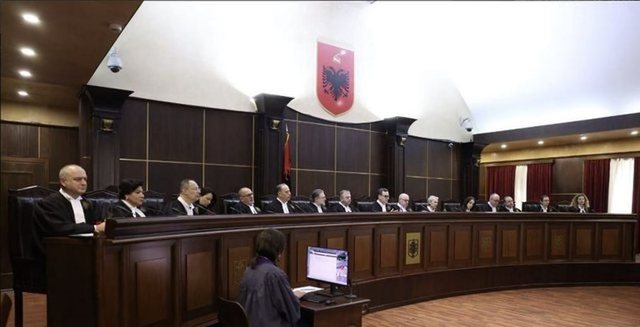
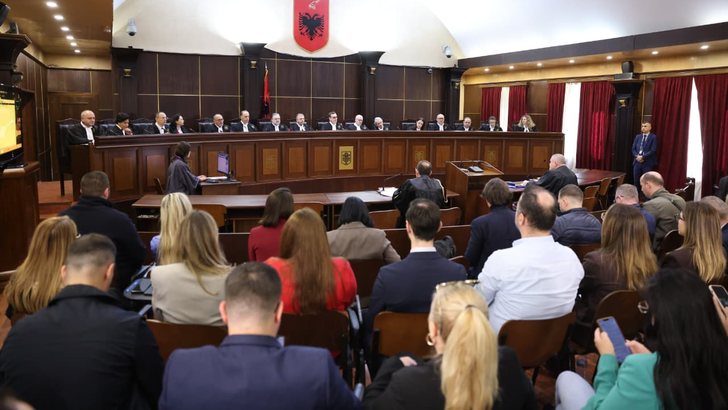
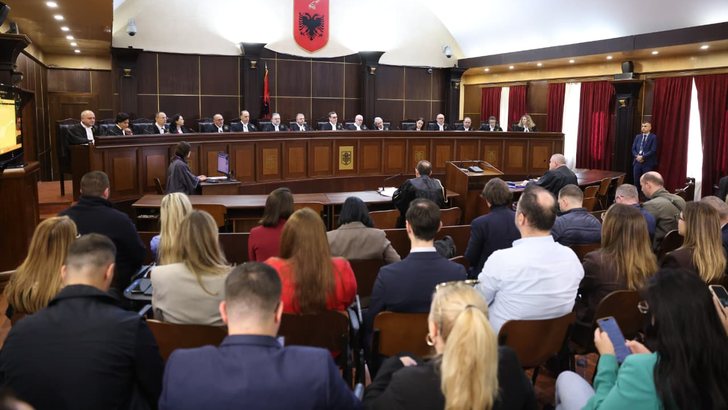
For about 3 hours, the Joint Panels of the Supreme Court discussed the initiative of President Sokol Sadushi to partially change the practice for applying the security measure of arrest in prison.
After the case was reported by Judge Ilir Panda, the representative of the General Prosecutor's Office, Arqile Koça, took the stand and answered questions.

The representative of the central prosecution body told the 16 Supreme Court judges that if they decide to change the practice, they should be careful in two aspects.
First, he said, it must be taken into consideration who is the guarantor that other alternative measures can be implemented in the Albanian reality.
However, according to prosecutor Arqile Koça, the burden of determining the measure of imprisonment lies with the prosecution in every case, and it should not always be based on the dangerousness of the criminal offense but also on other circumstances. Secondly, Koça said, the prosecutor represents and protects the public interest, inviting the high court to take this element into consideration.
The case that brought together the Joint College was initiated by a recourse from the Appellate Prosecutor's Office, which requested the return to prison of a person arrested for the production and sale of narcotics, who was released to house arrest by the second instance of the judiciary.
The defendant's lawyer, Luan Hasneziri, said that the intervention is more than necessary thanks to several decisions of the Strasbourg court, adding that some of the other alternative measures, such as house arrest, mandatory appearance and property guarantees, are not applied by Albanian justice.
The court closed its doors to the media and the public after these statements and moved on to the second phase of reviewing the appeal of the defendant Bektash Zeneli. It is expected that the Joint College of the Supreme Court will issue a decision on whether or not to approve the proposals of Sadushi, who is also the head of this Court, a decision for which there is still no schedule and date for its announcement.
Discussions inside the hall:
Prosecutor Arqile Koça: Today's case carries with it two main points, firstly with the unification of the practice and also with the specific issue, we request that the session be held behind closed doors, due to the problems that the case has. Regarding the unification of the practice, it should be open as much as possible, but regarding the issue, the media should not be present.
Lawyer Luan Hasneziri: I agree with the prosecutor that the discussion on the specific issue should take place behind closed doors.
First rapporteur, Ilir Panda: The report that has been made available to you is related to the fundamental right addressed by the Constitution. In this report, it results that in October 2025, the police in the Lezha area conducted a search in the apartment of this citizen, after a quantity of narcotics was found, and the prosecution requested the security measure of arrest in prison and the lawful arrest of the arrest. The first instance, the Lezha Court, has decided to accept the prosecution's request. Among other things, the court has also decided to implement the unifying decision of 2011 of the High Court, which served for the needs of determining security measures. Through the defense, an appeal was filed by the arrested person on appeal and then the Court of Appeals has imposed the security measure of house arrest.
Regarding the partial change of the unified judicial practice, with the reasoning that some decisions require special review and with this argument the case was transferred to the Supreme Court for review. 1. Justification of the imposition of a coercive security measure. 2. The measure must also be in accordance with the margin of punishment that the offense has. 3. The measure is not applied when the defendant presents positive evidence.
The unifying decision of 2011 has been applied so far by all courts, but in this practice the united panels have concluded that the decision should be reviewed with regard to the security measures and the type of security measure chosen, especially that of imprisonment.
Prosecutor Arqile Koça: Detention is imposed by the court no later than 48 hours. In all cases where liberty is taken away, the citizen may appeal to the court. For the purpose of today's review, the European Convention on Human Rights stipulates that measures are reviewed by the courts. The case of Gëlliç is not the only one that has been reviewed by the ECHR; there are other cases from other countries of the standard. The Code of Criminal Procedure states that detention in prison is imposed when any other measure is inappropriate, while the legal amendments provide other measures, such as a property guarantee. The change that the legislator has made to house arrest is important, which stipulates that when house arrest is imposed, the court also determines the manner of its supervision; this point is important for us. It further states that the court cannot impose a more severe measure than that requested by the prosecutor.
The Supreme Court asks the prosecutor: Why should the practice be changed?
Prosecutor Koça: The most obvious is the appeal of the prosecutor of Appeal. There is a different meaning in relation to what is called the practice of the Supreme Court. As for how the report on judicial practice stands, I do not have the position that needs to be clarified. We take into account the goals of what we want to achieve and the goals are positive, for the purpose of measuring the legislation.
Supreme Court: Then if we accept the principle that the burden of proof lies with the prosecutor in relation to determining the requested measure, why is the court obliged to review the appropriateness of other measures?
Prosecutor: The problem is with the harmonization, we have a problem with not going to the other extreme because we protect the public interest, I am interested in human rights but ultimately we protect the public interest
Lawyer Luan Hasneziri: Arrest in prison can only be imposed when any other measure is inappropriate. This legal clause clearly indicates the conditions when this measure is imposed. The measure of 'arrest in prison' according to the law should be the last alternative.