"We are drowning..." - From Lisbon, Milan to Tirana, "The Guardi...
/ 2026-10-18 23:13:32Focus


Ukrainian media has reported an investigation showing that Albania is allowing Russian oil to enter European markets.
According to them, banned oil products from Russia and Libya continue to enter the European market through Albanian ports.

Ukrainian media cites an investigation by Balkan Insight, which notes that fuel is disguised as construction materials or hidden in specially modified ships, allowing smugglers to evade international sanctions and tax controls.
Experts believe that most of the smuggled fuel is of Russian origin, while another portion comes from Libyan ports controlled by armed groups.
The article notes that smugglers use old ships sailing under the Tanzanian flag and registered to offshore companies to carry out such shipments.
Full Article:
Through Albanian ports, banned oil products from Russia and Libya continue to enter the European market.
According to an investigation, the fuel is disguised as construction materials or hidden in specially modified ships, allowing smugglers to evade international sanctions and tax controls, Balkan Insight reports.
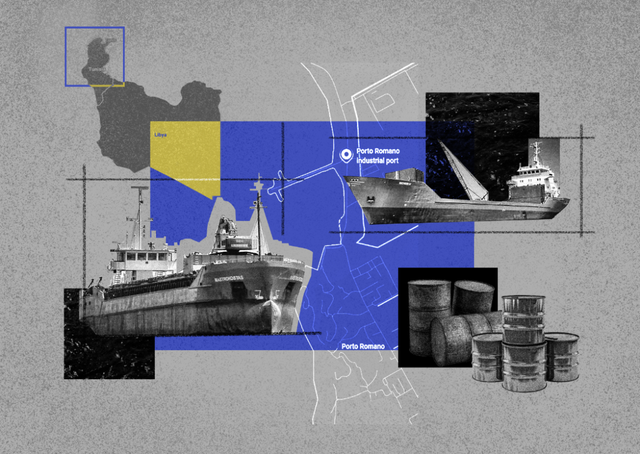
At the beginning of the year, two ships, the Besart and the Aya Zanubya, arrived in Porto Romano, on the Albanian coast, declaring that their cargo was cement.
However, inspections revealed that they were carrying around 600,000 liters of undeclared oil. Investigators found that the port had been repeatedly used to import banned petroleum products from Russia and Libya.
Experts believe that most of the smuggled fuel is of Russian origin, while another portion comes from Libyan ports controlled by armed groups.
Smuggling and bribery network
Albanian police have not commented on the investigation, but sources at the port of Durres say such operations rely on falsified customs declarations and bribes.
Smugglers use old ships that sail under the Tanzanian flag and are registered to offshore companies, one of which is Batimarine Owner Ship, which has carried out several such shipments.
Investigators suspect that smugglers used fake contracts and routes disguised as fishing or towing trips to evade checks.
Montenegrin tracks and new roads
Between 2013 and 2016, about 1.7 million liters of illegal fuel were brought into Albania from Montenegro, according to investigators. Fishing boats were used as cover, taking diesel instead of fish and avoiding taxes.
Prosecutors also uncovered a network of offshore companies that transported hundreds of thousands of liters of oil.
The suspected organizers, Juxhin Koka and Sergio Sula, are currently on the run.
The Libyan connection and international networks
In 2022, another ship, the Queen Majeda, coming from Benghazi, Libya, was seized in Porto Romano. Authorities discovered 2.6 million liters of marine fuel, the import of which is prohibited in Albania.
The investigation showed that in Libya, a country divided between rival administrations, oil smuggling finances armed groups. Experts say Russia uses its ties to the forces of 'Khalifa Haftar' to organize such operations across the Mediterranean.
Fishing boats as cover
Albanian prosecutors are investigating several cases where fishing boats were transporting smuggled fuel from Libya, adapted to hold tens of thousands of liters.
The shipments were disguised as "fish exchanges." According to the Durrës Prosecutor's Office, over 750,000 liters of smuggled oil have been seized since 2022.
The confiscated fuel is of very low quality, suitable only for cargo ships and machinery, not for private vehicles.
Albanian authorities acknowledge that illegal fuel imports continue, despite sanctions, with Porto Romano and Durres remaining the main hubs of the illicit trade.
Investigators link these operations to international criminal networks that use old ships and offshore companies to hide real shipping routes.
Meanwhile, India's refiners have started paying for Russian oil in yuan, with Indian Oil Corp carrying out some transactions in the Chinese currency at the request of traders.
Global oil prices rose after White House statements about possible trade talks with China, which investors saw as a sign of easing tensions between the world's two largest energy consumers./ RBC Ukraine