How Belinda Balluku is fabricating the rumor about Top Channel's...
/ 2026-10-19 16:19:00Focus


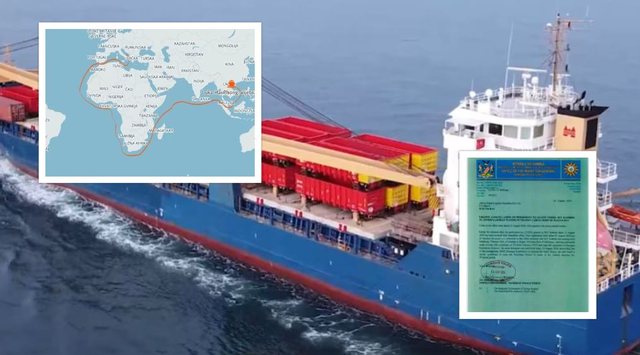
The cargo ship Kathrin, which the international non-governmental organization Amnesty International (AI) believes is, among other things, transporting explosives to Israel, is due to arrive at the port of Koper in Slovenia.
The Office of the Prime Minister of Slovenia, Robert Golob, has confirmed this for Radio Free Europe, but without providing information about the exact date.
This information, although unspecified, is among the rare official data about the vessel MV Kathrin, which since July 21 is sailing from Vietnam to the Port of Koper in the Adriatic, which, as Golob's office said, will serve as a point transit to the countries of the European Union (EU), for the cargo that the ship transports.
"The Port of Kopri is the entry point to the EU. This means that the cargo continues on its way to destinations in the EU", says the Office of the Prime Minister of Slovenia.
From July to October 3, the sailing of the ship Kathrin, which is now three days in a place in the Adriatic Sea, near the coasts of Croatia and Montenegro, caused reactions from the officials of Namibia, Portugal, international organizations and activists, because of the cargo it is carrying and the likely final destination – Israel.
Amnesty International and the United Nations called on countries to prevent the ship from entering their ports "given the clear risk that such cargo would contribute to the commission of potential war crimes in Gaza".
These agencies did not explain why the cargo was not sent directly to Israel or why ports in the Adriatic were chosen for unloading.
On the route of the ship Kathrin, which was sailing under the Portuguese flag, were Namibia, Portugal, Malta, while on the website MarinTraffic for monitoring marine traffic - the destination was also the Port of Tivar in Montenegro.
On October 1, the Port of Tivar told REL that it has not received notification of the vessel's entry.
On Friday, October 4, the ship was in the Adriatic about 75 nautical miles or about 140 km from the Port of Tivar and that for the last two days it was moving in a circle of several kilometers, with no clear indication of which direction it would go.
At the end of August, Namibia stopped anchoring for Kathrin
The first information about the ship Kathrin appeared in the media in August, when the Government of Namibia stopped the ship from anchoring in the port of Walvis Bay.
On August 27, state media New Era published an article about how Namibia “blocked a ship carrying weapons destined for Israel” from docking at a port in the country.
Justice Minister Yvonne Dausab urged the authorities not to allow Kathrin to enter Namibian waters.
According to Minister Dausab, "the decision is in line with Namibia's position on the ongoing Israeli-Palestinian conflict, reflecting the country's support for the Palestinian people and their call to end violence".
Citing a police investigation, the minister said the ship "was indeed carrying explosives destined for Israel, and has therefore been banned from Namibian waters", the BBC reported.
What does Kathrin carry?
The Kathrin, built in 2010 at the Dongfang Shipyard in Yueqing, China, is a cargo ship that can carry cargo up to 7,138 tons.
According to information from the Namibian police, it is currently loaded with 60 containers of trinitrotoluene (TNT) and eight containers of hexogen explosives, one of which is destined for Israel.
REL was unable to independently confirm information on who the Kathrin cargo is destined for, nor how its further distribution is planned.
Trinitrotoluene and hexane are the most commonly used military explosives.
Based on this information, the United Nations requested an arms embargo. In late August, the United Nations special rapporteur on the Palestinian territories, Francesca Albanese, called on countries to deny the ship access to their ports, claiming that these explosives are "key components in the aerial bombs and rockets that Israel uses." against besieged Gaza".
Did the ship remove the flag of Portugal it was sailing with?
The ship Kathrin sailed under the flag of Portugal and is registered in Madeira, while it is owned by the German company Lubeca Marine Germany Gmbh & Co Kg.
In a brief telephone conversation, this company told REL that it does not want to comment on anything related to the Kathrin vessel.
After Portuguese authorities, according to the Lusa news agency, launched an investigation into the case of transporting explosives, the ship Kathrin asked to remove the country's flag, which is an irreversible decision, Portuguese state media reported, citing an official government source.
"On Friday, September 27, the owner of the ship formally and irrevocably requested the cancellation of the registration in Madeira, thus requesting the removal of the Portuguese flag," said the same source.
State media, RTP, reported that the move by the company that owns the ship came after a "clarification request" from the Portuguese government.
The text says the ship is carrying explosives destined for arms manufacturers in Israel, Poland and Slovakia.
Portuguese media reported that a ship without a flag cannot enter any port, which may explain why the Kathrin has been sitting still for days, with minimal movement in the Adriatic Sea.
It was previously announced that it will enter the Port of Tivar on Thursday, October 3, from where it will continue to Koper in Slovenia, the only Slovenian international cargo port, which is of key importance for connecting Central and Eastern Europe. with the Mediterranean.
Unofficial information from the Maritime Administration of Slovenia
The Administration for Maritime Affairs of Slovenia told Radio Free Europe that they had no official notification before the arrival of the ship Kathrin.
"We have unofficial information received from the agent on the ship, about the arrival plan at the Port of Kopri", said this institution, without specifying other details.
The Maritime Affairs Administration shared unofficial data on the removal of the Portuguese flag from the Kathrin with Amnesty International in Slovenia, saying that the transfer from the Portuguese ship register to another country's register has not yet been completed.
It has been said that the ship will be able to sail to the Port of Tivar only after it has a new flag, where it intends to unload part of the cargo, according to the information that Amnesty International in Ljubljana shared with REL.
"After sailing from the Port of Tivar, it is destined for the Port of Kopri, where it will unload the rest of the cargo destined for Poland, the Czech Republic and Slovakia," says the email that the Maritime Affairs Administration sent to Amnesty International.
Meanwhile, some media have written that instead of towards Tivar, the ship will sail towards the Croatian port of Ploča.
From this port they told Radio Free Europe that they currently have no confirmation if the ship will dock in Ploče.
"As port operators, it is our obligation to provide port services in accordance with the applicable laws and regulations of the Republic of Croatia, which we do in accordance with all legal and safety standards and procedures," they said from this port.
The Port of Kopri did not want to comment, saying that the decisions on the entry of ships are made by the Administration for Maritime Affairs.
The organizations called for the respect of international law
On 1 October, Amnesty International called on Montenegro and Slovenia to prevent the ship from docking in their ports.
"The lethal cargo believed to be on board the MV Kathrin should not reach Israel because there is a clear risk that such a cargo will contribute to the commission of war crimes against Palestinian civilians," the organization said.
Taja Premk, from the Slovenian AI, told REL that "international humanitarian law prohibits all states from transferring weapons to parties to an armed conflict when there is a clear risk that this would contribute to the commission of of war crimes or other serious violations of international humanitarian law".
Premk also confirmed that there are many unknowns about the ship Kathrin and the final destinations of the cargo it is transporting and that it is very difficult to get official information.
What do the international laws for the arms trade of countries in conflict determine?
At the global level, the Arms Trade Treaty sets common international standards for regulating trade in conventional arms, ammunition, and parts and components.
Neither this treaty nor international law prohibits arms transfers as such in an ongoing armed conflict.
However, they prohibit such transfers in certain circumstances, while some states refrain from transfers to parties to ongoing armed conflicts as a matter of law or national policy, the official website of the International Committee of the Red Cross (ICRC) said. ).
"States signatory to the Treaty are prohibited from authorizing the export, import, transit, transportation and brokering of weapons, ammunition, as well as parts and components if they know that these weapons or objects will be used to commit war crimes or other international crimes" , says the website of the ICRC.
In addition, the Geneva Convention prohibits signatory states from transferring arms to a party to an armed conflict – regardless of whether it is a state or non-state armed group – when there is a clear risk that this would contribute to a violation of international humanitarian law. / REL