Is this police force professional and capable of handling violen...
/ 2026-10-16 18:54:07Focus


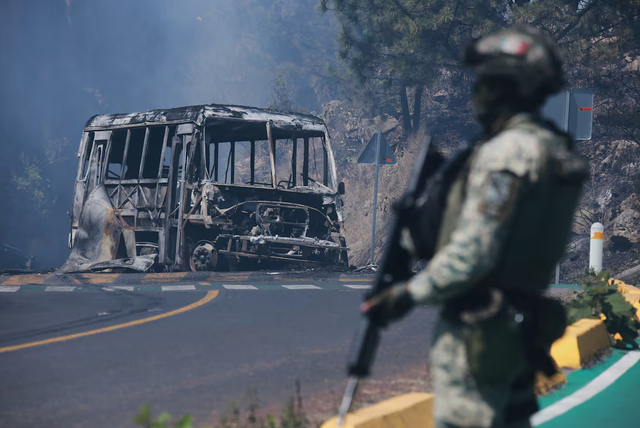
Mexico is facing a new wave of violence from drug cartels, a development that, according to BBC Sport experts, could compromise the organization of World Cup matches this summer.
The outbreak of violence began on Sunday in the western state of Jalisco, following the killing of the leader of the Jalisco New Generation (CJNG) cartel, Nemesio Oseguera Cervantes, known as "El Mencho", during a military operation.
The CJNG, one of the country's most powerful and feared criminal organizations, responded with armed clashes with the Mexican military, roadblocks and burning vehicles. Authorities declared a state of red alert in Jalisco, while the violence spread to at least 12 other regions. Videos posted on social media show armed men patrolling the streets and smoke billowing over cities.
Within 24 hours, at least 25 National Guard members are reported to have lost their lives.
Host cities under pressure
The city of Guadalajara, with a population of over one million, is scheduled to host four matches of the tournament. Five more are scheduled in Mexico City and four in Monterrey.
University of Nottingham criminal law expert Javier Eskauriatza told BBC Sport that crackdowns on cartels often bring strong backlash.
"When you put pressure on the cartels, there is a reaction. The risk lies in the escalation of the security situation and the difficulty of controlling it," he said.
According to him, the power vacuum following the elimination of "El Mencho" could open a new period of instability, as different groups within the cartel try to seize control.
However, Eskauriatza emphasizes that the cartels themselves have an economic interest in the tournament taking place peacefully, as they indirectly benefit from the influx of tourists and investments.
"Moderate" risk to tourists
Dr. Karina Garcia-Reyes, a lecturer in criminology at UWE Bristol, told the BBC that the risk to tourists this summer is expected to be "moderate".
"If no further military operations are undertaken this week, authorities in the most affected areas can address the risks. Overall, tourists should be safe as long as they follow the authorities' instructions," she said.
The US government has advised its citizens in Jalisco to stay indoors, while Canada has canceled flights to Puerto Vallarta airport. Flight-tracking apps have shown planes diverting and returning to their departure points.
Postponement of matches and political pressure
Four football matches in the domestic championship, two in the top flight and two in the second division, were postponed on Sunday due to violence.
Monica Serrano Carreto, professor of international relations at El Colegio de Mexico, warned of the possibility of a new period of instability.
"There is a risk that this will lead to a new phase of insecurity and continued violence," she told the BBC, noting that the cartels have access to heavy weaponry and military-type clashes may be inevitable.
At the same time, the World Cup's hosting has already come under scrutiny due to the security debate in the US. Last month, the organization Football Supporters Europe expressed concern about the militarization of law enforcement in the American host cities.
According to former British Ambassador to Mexico (2021–2024), Jon Benjamin, the American political factor has influenced the current dynamic.
"This is not a unique response, but it is very serious and on a high scale. President Trump has declared the cartels terrorist organizations and Mexico has extradited dozens of their figures," he told the BBC.
The recent events have raised questions about Mexico's capacity to ensure the safety of international fans. BBC Sport has contacted FIFA for comment, but there has been no official response.