Is this police force professional and capable of handling violen...
/ 2026-10-16 18:54:07Focus



Paris, 1970. It's the year of Apollo 13, the failed attempt to reach the Moon again, and the iconic phrase "Houston, we have a problem."
It is also the year that the Soviet probe Venera 7 spent 23 minutes on Venus, becoming the first man-made object to successfully land on another planet and transmit data back to Earth.
A 9-year-old boy goes to the cinema to see the film “2001: A Space Odyssey” with his brother and father, an aerospace engineer. He was already passionate about space, science and engineering, but that film stuck in his mind forever.
"It dealt with three topics that really struck me. The first was space travel. The second was the birth of intelligence in human beings. This question fascinated me a lot. I read books about evolution and wondered how it was possible for evolution to produce something like intelligence. What is intelligence really? This question, in a way, became my profession; at the time it was just a childish fascination. The third topic was artificial intelligence: in the film there is an intelligent computer and the idea seemed extraordinary to me. From then on, I began to think that the best way to understand intelligence was to try to build an intelligent system," are the words of Yann LeCun.
And he did, with great success. Yann LeCun, a French scientist who became an American, is one of the pioneers of AI. In 2018, he won the Turing Award, considered the Nobel Prize of computing, along with Yoshua Bengio and Geoffrey Hinton, for their contributions to the beginning of the era of “deep learning.” This is the basis of modern systems that try to imitate the functioning of the brain through artificial neural networks.
Fate parted ways for this trio: Hinton worked for Google, where he had sold his research startup, and in 2023 resigned to speak out about the dangers of AI; a year later he won the Nobel Prize in Physics. Bengio remained an independent researcher and founded the non-profit organization LawZero for ethical models.
LeCun was hired by Mark Zuckerberg to build Meta’s (then Facebook) artificial intelligence lab. In November 2025, he left after 12 years: “ Mark was upset that I was leaving. I have a great relationship with him and Meta, but we were going our separate ways.”
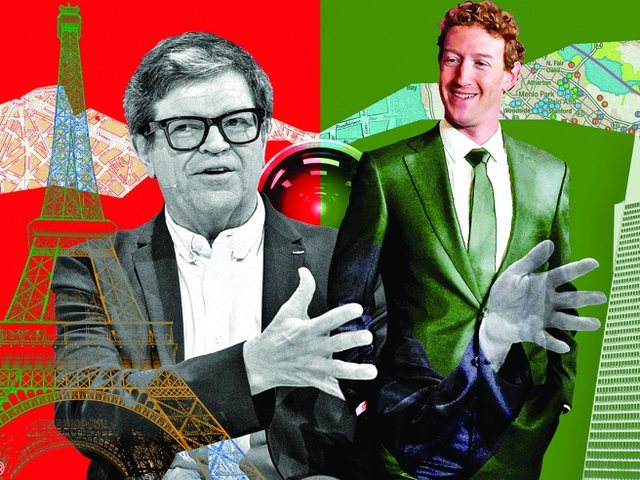
He says his work at the FAIR lab yielded good results, but the technology was moving beyond the company's focus, which is connecting people. "I wanted to turn it into a real product and apply it to many areas."
Although he denies any conflicts, the arrival of Alexandr Wang, founder of Scale AI, a startup that reached a valuation of $29 billion focusing on data labeling, is also in the background. Meta invested billions and hired Wang, creating a contrast between LeCun's scientific approach and the pragmatic business one.
LeCun explains that many companies are focusing on large language models like ChatGPT, so as not to be left behind: “In Silicon Valley there is a herd effect: everyone follows the same path.”
In contrast to this approach, he founded the startup Advanced Machine Intelligence in Paris. “ There is a demand for advanced AI that is neither American nor Chinese.” His project relies on “world models,” which aim to understand the real world beyond the limitations of current models.
According to him, language models have two main limitations: they only work well with symbolic data (like text) and they produce answers through probabilistic predictions, which can lead to errors (“hallucinations”). “ That’s why we have systems that pass legal exams, but we don’t have household robots that are more intelligent than a cat.”
With its new architecture, it aims to build universal intelligent systems for industries such as automotive, aerospace, and biomedicine.
When asked about the use of AI in war, citing figures like Dario Amodei and Sam Altman, he replies: "We should not decide for society. These decisions belong to democratic institutions."
He also gives an example from the war in Ukraine, where AI is being used for autonomous drones: " These are difficult moral choices and society must make them."
As for the impact on work, he remains optimistic: “Every new technology has brought fear. AI is likely to make people smarter and more efficient, but we need to learn to use it well.”
And when will we achieve human-like intelligence? “The real question is: will we have systems that are more intelligent than humans? In the most optimistic scenario, maybe in five years, but it will most likely take longer.”/ Corriere della Sera