Is this police force professional and capable of handling violen...
/ 2026-10-16 18:54:07Focus


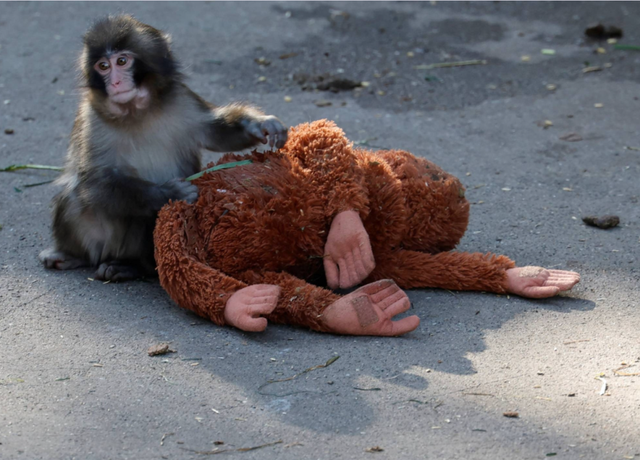
The story of a small monkey in Japan has touched the hearts of many people and brought back to light one of the most controversial experiments in the history of psychology. The macaque monkey, named Punch, became famous after zookeepers discovered the unusual way he sought comfort.
According to zoo staff, the little macaque was abandoned by his mother shortly after birth. To help him calm down, the keepers gave him a teddy bear. Surprisingly, Punch began to keep it close at all times: he would sleep with it, cuddle it and seem to find comfort in the toy, especially at times when the other macaques would not accept him.

His story recalls one of the most famous psychology studies of the 20th century, conducted by American psychologist Harry F. Harlow at the University of Wisconsin during the 1950s and 1960s. Harlow sought to understand how the bond between an infant and its mother is formed.
In his experiments, newborn rhesus monkeys were separated from their mothers and placed in cages with two artificial “mothers.” One was made of wire and had a milk bottle, while the other was a wooden structure covered in soft fabric.
The results were surprising. Even though the food was on the wire structure, the baby monkeys spent most of their time cuddled up to their fabric “mother.” They would approach the wire structure only to feed, and then immediately return to the soft surface.
View this post on Instagram
When an unfamiliar or frightening object was placed in the cage, the monkeys ran towards the soft structure to feel safe and only after they calmed down did they dare to explore the surrounding environment.
In contrast, monkeys that had only a wire “mother” failed to develop the same sense of emotional security. Although they ate normally and developed physically, they displayed anxious behavior, withdrawing into themselves or remaining motionless in stressful situations.
From these experiments, Harlow concluded that physical contact, warmth, and a sense of security are as, if not more, important than food for psychological development. In other words, the bond between mother and infant is not created simply because the mother provides food, but because she offers protection, touch, and emotional comfort.
Later experiments went even further, raising some monkeys in complete isolation. Many of them developed serious behavioral problems, such as fear of other monkeys, aggression, and difficulty forming social relationships.
Although Harlow's studies were criticized for ethical aspects, they profoundly influenced the way psychologists and social workers understand the importance of emotional attachment in child development.
In this context, the image of the little macaque Punch hugging his teddy bear seems to reflect precisely this deep need for security and closeness.
Today, according to zookeepers, Punch has grown up and appears to have become more independent. In recently released videos, he is seen playing and socializing with other macaques, gradually leaving behind the toy that was once the only substitute for the love and care he lacked.