Is this police force professional and capable of handling violen...
/ 2026-10-16 18:54:07Focus


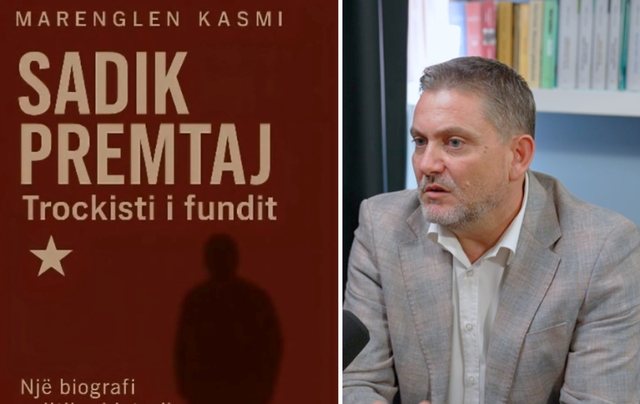
Clashes with the dictator and friendship with the nationalist Hysni Lepenica, the vulgarity of the Yugoslav emissary Dushan Mugosha and his attempt to eliminate the group of young people. Untold details of history, at the moment when the foundations of the dictatorship in Albania were laid
"Sadik Premtja, the Last Trotskyist" is the book by historian Marenglen Kasmi, from the "Naimi" publishing house, a study that brings important details of the early days of the founding of the Communist Party, the youth group, and the inevitable clashes with the dictator Enver Hoxha.
Beyond ideological labels, the story of Sadik Premta is that of a clash between idealism and power, between principles and violence, at a time when communism was shaping the dictatorship in Albania. In the early 1940s, when left-wing youth groups in Albania were trying to create a modern party, there was also a debate about violence, whether or not murder should be used against opponents and "enemies" of the movement. Sadik Premta, who came from an area of great importance like the Vlora River, held positions contrary to the line imposed by the Yugoslav emissaries. When the Serbian factor intervened in every step of the formation of the Communist Party of Albania, the clash was no longer just ideological.
Kasmi’s study sheds light on previously undiscovered facts and documents, including those about Yugoslav emissaries such as Dušan Mugoša, who was identified as the “uneducated wing of the working class.” As contemporary documents describe him, he was known for his vulgar language and hatred of “educated youth” who saw communism as an emancipatory project. On the other side, Miladin Popović, more cultured, spoke French with the young people who founded the Communist Party, but his influence remained politically guiding: Albania had to follow the Belgrade model.
In this clash with the Yugoslav emissaries and the dictator, Sadik Premtja finds strong and significant support in Vlora, where he had created a communist nucleus that also included figures with a nationalist spirit. The documents discovered by the author Kasmi speak of a strong friendship between Sadik Premtja and the nationalist leader Hysni Lepenica, who would become a strong support for Premtja at a time when he was threatened by his communists. Premtja writes that “Hysni Lepenica had been part of the communist cells”.
The study tells us that on the Vlora River, communists and nationalists coexisted for a short time, united by the ideal of liberation and mutual respect. It was perhaps the only period where the Albanian left still had the spirit of debate and not submission.
Sadik Premtaj's first clash with Enver Hoxha came at the moment when Sadik Premtaj spoke out against political assassinations and demanded that the party not become an instrument of eliminations. Enver, now supported by Mugosha and Popovic, declared him a "class enemy", expelling him and later annihilating his group. The study shows that the end of the Albanian Trotskyists was predetermined. But unlike many others, Sadik Premtaj died as a communist, without abandoning the conviction that a different, humane and just left was possible.
Researcher Marenglen Kasmi talks about the figures of the Albanian left in a century, starting from Noli to the "Trotskyists" of our time.
In the post-'90s transition, the word "Trotskyist" returns as a metaphor for those who refuse to compromise with power. But unlike Sadik Premta's time, today the new Trotskyists are not persecuted with rifles, but with marginalization, exclusion and silence.
History, in an ironic way, seems to be repeating itself.
Follow the interview of historian Marenglen Kasmi for TemA.