Is this police force professional and capable of handling violen...
/ 2026-10-16 18:54:07Focus


By Ardit Rada
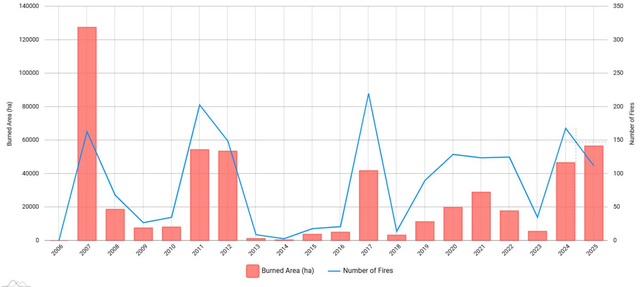
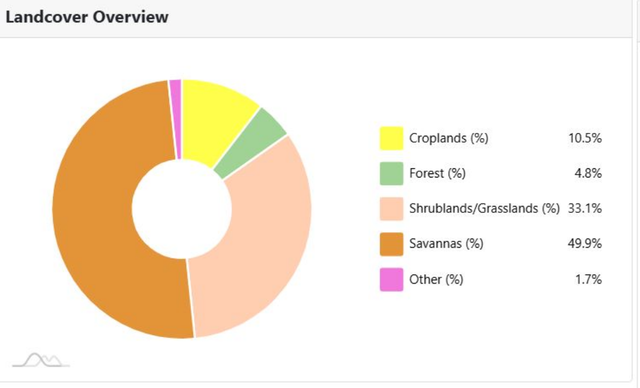
Albania is going through a summer that will be remembered for a long time, due to the fires that swept the country, leaving irreparable consequences in most cases. In addition to hundreds of evacuations and two deaths as a result of the flames, our country has lost over 56 thousand hectares of green land from the beginning of the year to the end of August. But a similar situation seems to have been experienced by all of Europe, although in our case the damage is more significant due to the ratio of the total area to the burned area. In most cases, the blame has been placed on the extreme climate, but suspicions also remain of deliberate arson that later got out of control.
Europe on fire!
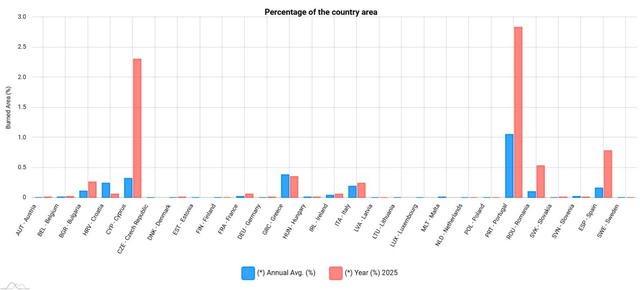
A Copernicus EFFIS graph shows that over 1 million hectares have burned within the European Union since the beginning of the year until 27 August, significantly above the annual average of 278 thousand hectares. This also marks a historical record that exceeds the alarm signal for the heat that the continent has experienced. According to Copernicus, Spain ranks as the most affected country with around 403 thousand hectares burned, followed by Portugal with 275 thousand hectares. The two countries thus account for 2/3 of the burned area in the EU.
The case of Italy remains interesting, where the area burned as of July 31 is almost equal to that consumed by the flames in Albania. Italy has reported 56,263 hectares burned, while tiny Albania has a full 55,154 hectares.
Albania burned 2% of its total area
The case of Albania has surprised not only the locals, but also international reports. The fact that in our country we are dealing with evacuations or two lives lost due to fires, shows that the latter have affected important landscapes. Often threatening entire cities, as in the case of Gramsh or Delvina. According to official data, Albania has reported that this year there have been 2 deaths, 2 thousand evacuated and 11 injured from the flames. The area reported as burned this summer constitutes 2% of the total area of Albania, which is 2.8 million hectares. This is a worrying report for a relatively small country.
Compared to some countries, Albania is considered severely damaged by the fires. From a comparison with EFFIS data, Bulgaria has burned about 0.26% of its surface and Italy 0.19%. While in the case of other countries, the data is negligible.
Meanwhile, compared to Spain, Albania is again more damaged in terms of burnt nature. Spain currently records only 0.08% of its surface as burnt by 2025.
A deep contract with neighbors and not only
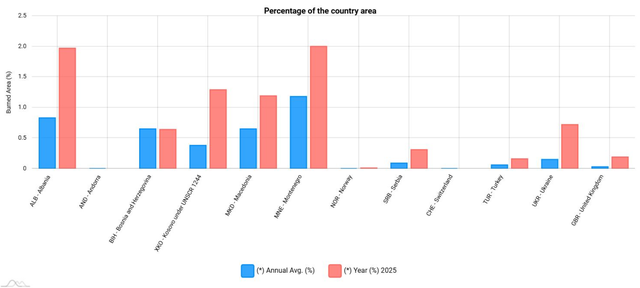
From EFFIS data, we see that Albania's fire damage has almost tripled compared to the annual average. This year, 11 fires have been recorded, burning about 2% of the territory, making our country the most affected in the region.
In relation to its neighbors, Albania leads the list of countries with burned areas. Montenegro also remains affected, where 26,719 hectares of a total area of 1.3 million hectares have been burned, or 2% of the territory. While Bosnia and Herzegovina and Serbia remain with negligible damage from the fires. Respectively with 0.6% and 0.3% of the total burned area. Kosovo is reported to have suffered damage to 1.2% of its territory with a total of 14 thousand hectares engulfed by flames.
But Albania has been damaged more than its larger neighbors. The comparison with Greece shows frightening data. Our southern neighbor has burned in 2025 about 46 thousand hectares out of 13.2 million hectares, which is the total area. So 10 thousand hectares less than Albania. In other words, Greece has burned only 0.36% of its territory, unlike our case where a full 2% have been burned.
Of the other European countries that are not part of the European Union, Turkey appears to be the most damaged, but far from being compared to Albania. In Turkey, only 0.16% of the total territory has been burned, while countries like Andorra, Norway and Switzerland are almost untouched by this year's fires.
Albania, the only one without air defense in the region
Albania remains a country without air defense against fires, despite promises from the Government that purchases of aircraft have been authorized. Compared to neighboring countries, Greece has a full 44 aircraft and 20 helicopters to extinguish fires. North Macedonia has 3 aircraft and 4 helicopters. Montenegro has one aircraft and 3 helicopters and Serbia has 12 helicopters to extinguish fires.
It should be noted that although Kosovo does not have aircraft, it has two firefighting helicopters, while Albania does not have any specialized aircraft in this field. The government's justification in recent years has been based on the rhetoric that a small country like ours does not need an air fleet to fight fires. This refers to the statements of former Defense Minister Niko Peleshi three years ago when Albania faced a similar situation with fires, but also of other officials thereafter.
Today, our country is assisted by air through foreign forces. For example, Canadair aircraft from Italy and Greece, sent through the European Civil Protection Mechanism, have been used in areas such as Borsh, Piqeras, Dropull, Finiq and beyond. However, the fires of 2025 that burned 2% of the territory showed that emergencies do not wait until agreements are made or until the assistance requested by other countries is approved.
In the test of fire
If in Spain and Portugal fires are seen as major national disasters, in Albania they are more than that: they are wounds that go to the heart of a small country and cause incalculable financial damage. Every hectare lost is an irreplaceable piece of our mountainous landscape and or a damage to the agricultural economy and citizens' properties.
This year is an alarm bell. If today Albania burns over 2% of its territory, what will happen if tomorrow temperatures rise even higher and the rains are absent for longer? The challenge for the authorities remains the same: Will we remain mere witnesses to the flames, or will we build a protection system that prevents such tragedies? The fires of 2025 are not just the news of the day. They are the warning of whether our country will choose between preparation and destruction.
Albania, small on the map but big in its wounds, can no longer afford the luxury of delay. The battle with fire begins today, not tomorrow. Otherwise, next summer will be even more devastating than this one.