Is this police force professional and capable of handling violen...
/ 2026-10-16 18:54:07Focus


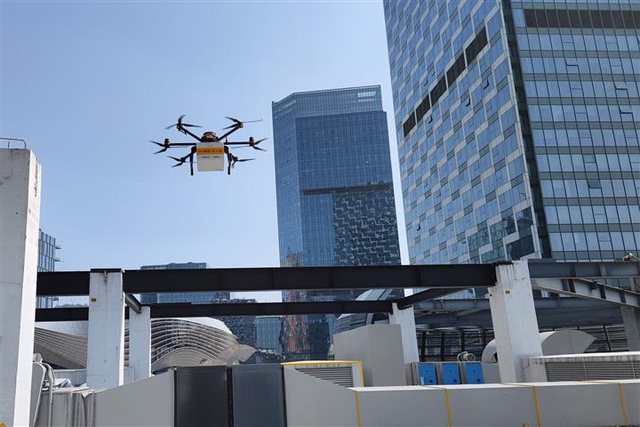
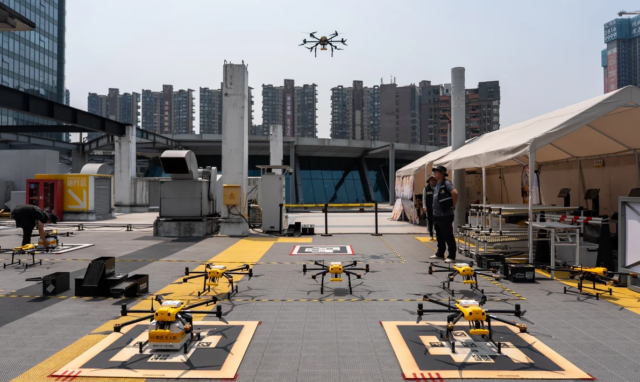
Shenzhen – On the roof of a skyscraper in Dongguan, a district north of Shenzhen, dozens of five-rotor drones wait their turn to take flight. They look like the “new delivery workers,” much like the motorbike couriers seen in European cities waiting in front of restaurants.
When an order arrives, a box of iced tea or a plate of noodles is placed on the drone and it immediately takes off. There is no pilot. The route is determined by a computer program.
Within a few seconds, it rises to about 100 meters and heads towards the customer's address. The drone can reach speeds of up to 90 km/h, but when transporting a drink or food that can spill, it slows down to about 36 km/h.
This is just one part of China's grand project: automating everything from food delivery to urban logistics, using artificial intelligence and new technologies.
The experiment began in Shenzhen, the southern city where modern China began its economic transformation in 1980. At the time, it was a small fishing town of about 100,000 people across from Hong Kong, until Chinese leader Deng Xiaoping declared it the first special economic zone. It was the beginning of the opening of the market economy in a country with a one-party system.
Today Shenzhen has about 18 million inhabitants, is the headquarters of the technology giant Tencent and offers large funding programs to attract foreign experts in technology and the biomedical industry.
At first glance, delivering food within 15 minutes seems like a simple task. But behind it lies a much bigger battle: China is trying to create new industries before the rest of the world, funding companies experimenting with future technologies with huge sums of money.
If these technologies manage to spread, many countries could face the risk of Chinese companies taking control of new strategic sectors.
In the case of drones, the project is not led by a small startup, but by Chinese giant Meituan, a company listed on the Hong Kong stock exchange with a turnover and market value of tens of billions of dollars. It is one of the largest delivery platforms in China, comparable to Glovo or Deliveroo in Europe.
But the difference is big: Meituan doesn't just use couriers. It builds its own technology, develops software, manufactures autonomous systems, and invests billions in research.
Since 2021, Meituan has made almost 1 million drone deliveries in Shenzhen. The city has created dozens of air corridors for their movement and special points where drones drop off orders.
In addition to flying drones, the company is also testing small autonomous vehicles on the ground that transport packages to the drones or from a drop-off point to the customer's door. In some areas, special towers are also being set up where drones can take off and land. Inside them, an automated system picks up the package and places it in a locked box, which the customer can open only with a personal code.
In the future, the idea is for drones not to land at all, but to hover near the ground and deliver orders directly.
But there is a big problem: the technology works, but the business is still not profitable.
Drone deliveries cut delivery times by about 10-15% and reduce traffic, but the cost is much higher. An air delivery costs Meituan about five times more than a human delivery, mainly due to batteries and maintenance.
Meanwhile, the profit per order is very low, usually a few dozen euro cents.
So how does this work?
The answer is: state subsidies.
The Shenzhen local government facilitates airspace permits, while the Dongguan district finances the company. For every drone delivery that a customer pays about 65 cents, the local administration gives the company a subsidy of about 6.5 euros, which is used for research and development.
In addition, Meituan also benefits from low office rents and other economic support.
Such a model would be almost impossible in most Western countries: a company that receives many times more public support than it earns from the service it provides. But China is using this strategy in other areas as well: robotics, artificial intelligence, batteries, electric cars, solar panels, renewable energy, and advanced industries.
Larger transport drones are also being developed in Shenzhen. Some fly in groups and can carry loads of up to 50 kilograms. These vehicles could become competition for a share of the civilian helicopter market, where Italian companies such as Leonardo have been successful so far.
But faced with the pace of Chinese development, European industry risks losing ground. From the rooftops of Shenzhen's skyscrapers, the characteristic drone noise is constantly heard. It is the sound of a country that is accelerating at an extraordinary pace towards the technological future.
A race that China is pursuing at all costs, while the rest of the world tries to understand if it will be able to follow it./ Corriere della Sera