Protests, violence, curfews: From France to Albania, why Europe'...
/ 2026-10-20 23:47:20Focus


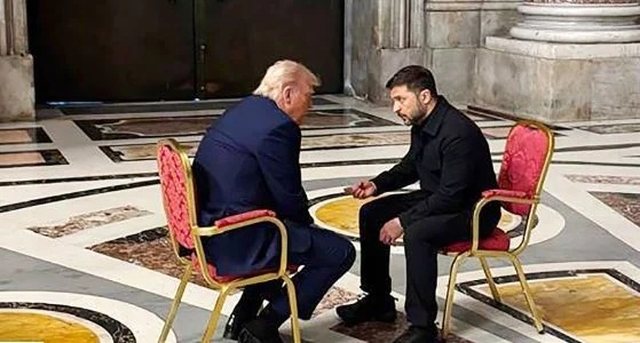
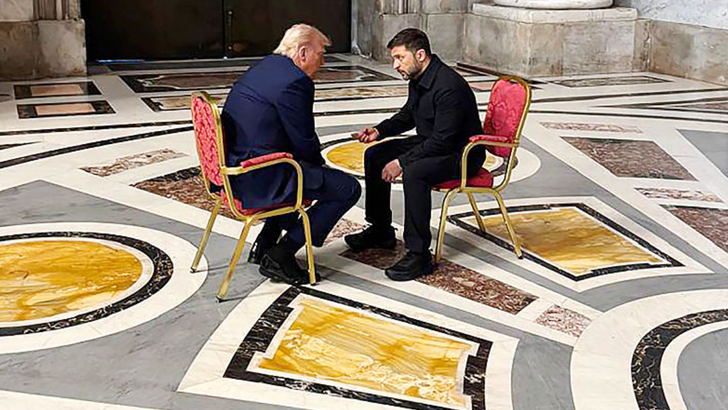
President Trump held an extraordinary one-on-one meeting with President Zelensky on the sidelines of the Pope's funeral, before accusing President Putin of dragging his feet in efforts to end the war in Ukraine, The Times reports.
A peace deal between Ukraine and Russia appeared to be nearing after intense exchanges in St. Peter's Basilica. Zelensky said their 15-minute conversation had "the potential to be historic," while the White House described it as "a very productive discussion."
In a sign that the US president had shown more understanding of the Ukrainian message than during the last tense meeting in the Oval Office in February, Trump then publicly criticized Putin.
After boarding Air Force One, he posted on his Truth Social platform that the recent missile barrages and drone strikes on civilian areas in Ukraine by Moscow “makes me think maybe he doesn’t want to stop the war, is just fooling me, and should be dealt with differently, through ‘banks’ or ‘secondary sanctions’? Too many people are dying!!!”
Earlier, Trump had threatened to impose secondary tariffs on "all oil coming from Russia."
However, in the same post, he also criticized Zelensky, claiming that his insistence on returning Crimea to Ukraine was one of his "other senseless demands."
The meeting between Trump and Zelensky during the Pope's funeral, in chairs placed very close to each other and just a few steps from the coffin, took place hours after the US president declared that a deal was "very close" and that Ukraine and Russia should meet at a "very high level" for talks.
The US has been pressuring Ukraine to accept a peace deal that would require Kiev to accept Russian control over large parts of occupied territory.
Zelensky has insisted he will never recognize Russian sovereignty over Crimea, the region occupied by Moscow’s forces since 2014, nor its continued control of southern and eastern Ukraine. He has demanded that Putin accept an unconditional end to the fighting.
In a post on X (formerly Twitter), he appeared to highlight the possibility of reaching a deal after a “good meeting” with Trump, writing:
“We discussed a lot face to face. We hope for results in everything we covered. The protection of the lives of our people. A complete and unconditional ceasefire. A credible and lasting peace that will prevent the outbreak of another war. A very symbolic meeting that has the potential to become historic, if we achieve common results.”
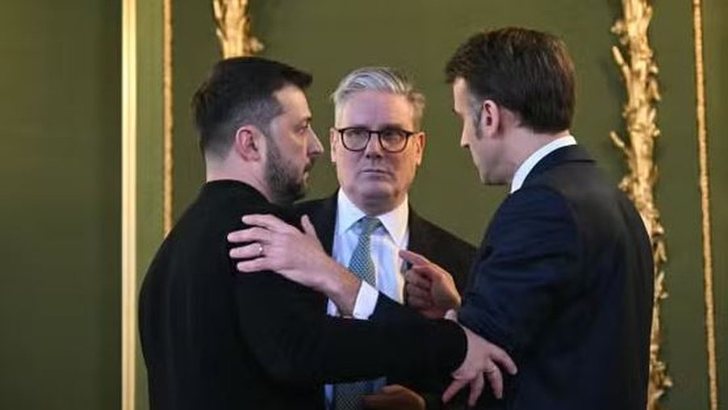
He and Sir Keir Starmer also held a 15-minute one-on-one meeting after the funeral in the gardens of the British ambassador's residence in Rome, where they were photographed chatting with Trump and French President Emmanuel Macron.
A 25-minute meeting with officials followed. Both sides agreed to “maintain the momentum and continue to work intensively” in efforts to secure peace.
Ceasefire talks between European, Ukrainian and American officials took place in Paris earlier this month, the first time Europe has been given an official seat at the negotiating table. A second round of talks was held in London earlier this week.
The ministerial-level meeting turned into official-level discussions after Marco Rubio, the US secretary of state, pulled out at the last minute amid speculation that Russia might be willing to change its position.
Speaking about the state of the peace talks, a senior British government figure said: “As with any negotiation, the process is very fluid, and sometimes what is said publicly is not what actually happens behind closed doors. The meeting in Paris and the one in London last week gave the Americans enough from the Ukrainian side to draw the Russians into a negotiating process. Whether, of course, the Russians will deliver results and not simply engage in tactics to blame the Ukrainians for the failure remains to be seen.”
It is understood the US presented a "constructive" document at the London meeting on Tuesday, where Ukraine, France, Germany and Britain were invited to propose amendments.
This weekend, The New York Times reported that Ukraine's counterproposals include demanding that there be no limits on the size of its military; that a "European security contingent" supported by the United States be deployed on Ukrainian territory to ensure security; and that frozen Russian assets be used to repair damage caused in Ukraine during the war.
While these conditions may be unacceptable to the Kremlin, other parts of the Ukrainian plan suggest an attempt to find common ground. There is no mention, for example, of the full return of all territory occupied by Russia, or an insistence that Ukraine be allowed to join NATO, two issues that Zelensky has previously declared were not up for discussion.
A source familiar with the discussions said there was “some level of positivity” about the proposals.
It is understood that David Lammy, the British foreign secretary, has spoken to Rubio twice in the past week, while Putin’s meeting with Steve Witkoff, Trump’s special envoy, was described by the Kremlin as “constructive and very useful”.
A senior government source said: “What’s interesting now is how much Putin wanted to meet Witkoff, he kept insisting that he come back.”