How Belinda Balluku is fabricating the rumor about Top Channel's...
/ 2026-10-19 16:19:00Focus


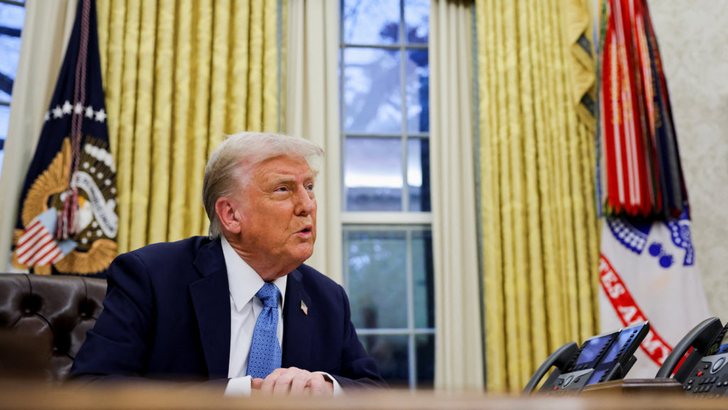
Three days after taking office, President Donald Trump signed an executive order to declassify documents related to the assassinations of President John F. Kennedy, his younger brother, Senator Robert Kennedy, and civil rights activist Martin Luther King, Jr.
These three men were among the most influential individuals of the 1960s, and their murders, allegedly carried out by lone attackers, have given rise to several conspiracy theories that still grip the country six decades later.
Perhaps no assassination in the history of the United States has been more analyzed and discussed than the assassination of President Kennedy, who was shot dead on November 22, 1963, while he was traveling through Dallas sitting in the back seat of the presidential limousine accompanied by his wife and Texas Governor John Connally, who was sitting in the front.
Lee Harvey Oswald, a former soldier who had briefly lived in the Soviet Union, was accused of shooting Kennedy from the sixth floor of a Texas school library. Before he could stand trial, Oswald was assassinated by Jack Ruby, a Dallas nightclub owner, during a live television broadcast of his transfer to another prison.
A government commission in 1964 concluded that Oswald acted alone when he killed Kennedy. However, many questioned the commission’s finding—which they derisively called the “magic bullet theory”—that a single bullet had struck Kennedy from behind, exited his neck, struck Connally in the back, passed through his chest and struck his hand, and then ended up in his thigh.
Many of those who dispute the single-bullet theory claim that another attacker was positioned at street level along the road the limousine was traveling on, at a spot known as the "Grassy Knoll."
Various conspiracy theories have been put forward about who was behind Kennedy's assassination, including CIA officials, Cuban exiles, the Soviet government, and the American mafia. The government's decision to keep certain materials secret over the years has only fueled belief in a conspiracy.
In announcing the decision to declassify the remaining documents, Trump said he wanted to clarify the details surrounding the assassinations of President Kennedy, his brother and Martin Luther King. Senator Kennedy was shot dead in a Los Angeles hotel in 1968, while King was killed by a sniper while standing on the balcony of his motel room in Memphis.
"Their families and the American people deserve transparency and the truth. It is in the national interest that every document related to these murders be finally released without delay," Trump's executive order states.
The 1991 film JFK, directed by Oliver Stone, revived national interest in the Kennedy assassination and added more doubt to the public about the official version of events.
The film depicts the 1969 investigation into the assassination of President Kennedy by New Orleans District Attorney Jim Garrison, who believed that Oswald was merely a "victim" of a wider conspiracy to kill the president.
The national outrage sparked by the film partly prompted Congress to pass the John F. Kennedy Assassination Evidence Collection Act in October 1992. This law required that all documents related to President Kennedy's assassination be released in full by October 26, 2017. Exceptions were made for documents that could harm the military, intelligence agencies, or foreign relations.
The law also ordered that all materials related to the assassination be preserved in a single collection at the National Archives in Washington. The collection today has over 5 million pages of documents, photographs, videos, audio recordings and artifacts.
Trump was in his first term as president when the deadline for releasing all the materials expired. However, he and his successor, Joe Biden, delayed the declassification of tens of thousands of documents pending further review, as recommended by the FBI, CIA and other US national security agencies. While those reviews were taking place, the presidents approved the release of more documents.
In June 2023, Biden announced the completion of the final phase of the declassification program, after his administration released over 15,000 documents.
The Biden administration said 99 percent of all materials had been released, but called on agencies to continue declassifying the remaining documents - estimated to be about 4,000 - as needed.
Trump's executive order could potentially speed up that process. The order directs the director of national intelligence and the attorney general to submit a plan within 15 days for the "full release" of documents related to the Kennedy assassination. It also calls for a plan to release all documents related to the assassinations of Robert Kennedy and Martin Luther King.
Most of the documents that have not yet been released are from the CIA. The agency may have kept these documents secret because they may contain the names of sources who are still alive, reveal methods for gathering information, or point to questionable assessments.
In an interview with the FOX television channel, James Robenalt, who has written about the assassination and does not believe Oswald acted alone, said that the remaining documents could contain "a lot of interesting things" about how the CIA had been tracking Oswald in the months before the assassination of President Kennedy.
"It's like putting all the pieces together, it's the connection of things," he said, adding that there could be something "that we don't even know about that will come to light" if all the documents are released.
However, Gerald Posner, author of a book on the assassination who believes Oswald was a lone gunman, said he does not expect any major surprises from the materials.
"I don't think what most Americans are expecting is a document that would turn the whole case upside down and we would say 'here's who killed Kennedy, that it was really part of the secret government and here are the people involved', that's not going to happen," he said.
Some analysts have suggested that Trump's signing of the executive order on the issue is a way for him to show his supporters that he is acting quickly on campaign promises. It was one of dozens of executive orders signed in the first days after he was sworn in as president./ REL