Is this police force professional and capable of handling violen...
/ 2026-10-16 18:54:07Focus


By Roland Lami
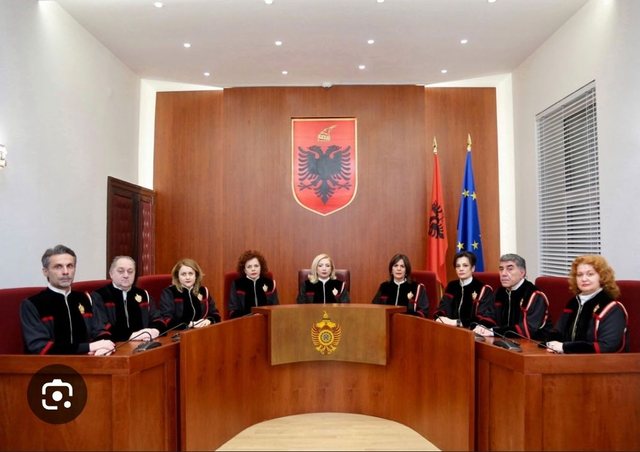
In legal terms, the decision of the Constitutional Court, by not making a decision, despite the public outcry and high expectations from all political parties, returns the case to where it was before it reached the Constitutional Court, Ms. Balluku remains suspended from duty according to the decision of the Constitutional Court. In other words, legally there is no innovation, politically, there is a lot of confusion and a lot of room for political interpretations.
This is problematic in a country with a fragile democracy as the Constitutional Court had a sui generis case in the Albanian context to clarify the separation of powers and to establish the boundaries between the judiciary, the legislature and the executive. A decision that would constitute a "casus" for scholars and law students. However, instead of rising to the level dictated by the constitution, it chose not to express itself in substance.
It is not without reason that Hans Kelsen saw the constitutional court as the “guardian of the Constitution”, but a guardian who is silent in the face of the conflict between powers leaves the Constitution without protection. Silence here is not neutrality, but an avoidance of constitutional responsibility. As Lon Fuller warned, the law fails not only when it is unjust, but also when it does not provide an answer where the conflicts are real and acute. By pushing the parties towards the Venice Commission, an advisory body that suggests but does not oblige, the Constitutional Court did not solve the problem, but exported it.
The result is predictable, each political party will find in the Venice opinion that part that suits its next interest, and the Constitutional Court lost the opportunity to set a precedent that would serve not only the present but also the future.
This pattern of behavior, not clarifying but prolonging or deepening the ambiguities between the three branches of government, is not new. Even in the Xhaçka and Berisha case, the Constitutional Court avoided clear decision-making, leaving the conflict to degrade into the gray space between law and politics. Giovanni Sartori would call this an illusion of neutrality since institutions that avoid decision-making do not stay outside politics, but produce politics through inaction. All the more so in a fragile system like ours where such behavior, does not contribute to stability; on the contrary, it feeds public cynicism and delegitimizes constitutional authority.
In the end, the question that remains is not simply legal, but deeply political: do we have a Constitutional Court that fulfills its function as the supreme arbiter of the constitutional order, or a body of judges that, with decisions cautious to the point of paralysis, reflect political balances, fears, and bargains? If the answer leans toward the latter, then the most dangerous precedent is not the suspension of a minister, but the normalization of a justice system that speaks only when it does not risk anything.