The inspection revealed products with salmonella at the sausage factory, why were the dangerous products released on the market before the tests were out?
2025-10-01 22:16:59AktualitetSHKRUAR NGA REDAKSIA VOX
Photo illustration
According to Article 25 of the Food Law, it is clearly stated that every food business operator must have a data system, not just a food safety invoice.
According to this legal obligation, every business operator must have a technological card. That is, it must show the origin of the product, where it came from, if it is a producer, what it has put into the product, how many additives it has, how much meat it has.
All of these criteria are the obligation of the NFA to require and their absence makes traceability impossible.
"To prevent and minimize the risk, you must trace even the last gram of the product that poses a risk. If there is no traceability system, from the first moment you receive the material, you must show where it went. So in many cases, in the case of meat with salmonella, it took authorities 10 days to find out where the product is, and during this time the product was sold," said Ana Vuksana, a food safety expert.
To increase food safety, AkU inspectors are located at every customs point and are responsible for carrying out checks. According to the BIP manual, Inspection at Border Points, there are two options for taking samples. Taking samples based on risk, when there is a signal that there may be problems. In this case, the load is blocked and does not go on the market until the answers are available. The second case is the routine one, when the sample is taken based on annual plans. In this case, the product is allowed to go on the market.
Although the product may arrive infected with salmonella, at the time of analysis it is possible to prevent it from reaching the consumer, but this is not implemented.
"To be honest, inspections are very rare. 3-4 times a year for high-risk operators, meat shops are only once a year, think where we are," said Ana Vuksana, a food safety expert.
The law requires that all imports entering Albania must undergo analytical control. Experts say that this procedure is currently not implemented, being reduced to only a few entities that may have had previous negative histories.
"All imported products entering our country must be subject to control. What currently happens is that not all batches that enter are subject to official analytical control. This means that the NFA carries out a control based on the risk of inspection, tracking in time and space, seeing that if there has been a history of exposure to salmonella, they increase the controls," said Kapllan Sulaj, Dean of Biotechnology and Food, UBT.
But according to experts, this procedure should be changed. They refer to specific cases published earlier and those that we are discovering. When the analyses came out, the product had been sold. If the sample is taken on an alert basis, then the product remains blocked in the import warehouses until the analysis comes out.
"As long as you take a sample, the product should not be released to the market, even if this is based on the annual plan. The analysis came out 11 days late in the case of chicken fillet, the option of releasing the product to the market was implemented and when the ISUV analysis with salmonella came out, almost all of the product had been sold.." said Granit Sokolaj, a food safety expert.
In this chain of procedures, an important link that is not functioning properly are the analysis laboratories. The NFA has 7 laboratories, but none of them is accredited and faces various shortages, starting with reagents and kits.
"Although ISUV is a reference laboratory, although AKU has 7 laboratories, there is maintenance, kits are purchased, but the analyses are carried out privately, because there are no laboratory capacities and there are no accredited analyses," said Ana Vuksana, a food safety expert.
"The fact is that the AKU and the entire chain of subordinate laboratories do not have the analytical capacity to carry out and cope with such a load, despite the improvements at customs points, it has not been possible at this analytical control point to monitor all batches of goods entering the Republic of Albania," said Kapllan Sulaj, Dean of Biotechnology and Food, UBT.
The lack of capacity to conduct tests, coupled with delays in providing results, causes infected products to enter the market, directly endangering the health of citizens.
What has failed throughout the history of salmonella outbreaks is the fact that notification has often been delayed, health service structures have been notified late, and surveillance measures have not been taken in time. As a result, a portion of the population has been exposed to a contaminated product.
"It seems like we manage to control the product from farm to table, but there are uncovered links, there are dark links in the information that the product carries from field to table."
"You can do measurements on a load, and it doesn't work, but that doesn't mean that the entire load is clean. That's why it's always required to be accompanied by different analyses. This means that even after each test performed, we should never think that the risk has been eliminated 100%," said Kapllan Sulaj, Dean of Biotechnology and Food, UBT.
Ervin Resuli, an expert and president of the Order of Veterinarians, admits that the process is also lagging when it comes to inspectors.
"Veterinary structures are not up to par in terms of the legal basis, the institutions they depend on and are directed by, and in terms of in-depth scientific research," said Ervin Resuli, a food safety expert.
He blames this situation on the anemic support that governments have given to the national food authority and inspectors in particular. As a result, inspectors feel powerless to take punitive measures against multi-million euro businesses.
"Inspectors are not up to the task of performing the functions assigned to them by law, both due to lack of logistics and lack of salary. It is not possible for an inspector with a salary of 800 thousand lek to revoke the license of an operator with a turnover of 20 million euros per year," said Ervin Resuli, a food safety expert.
According to him, the removal of the status has also weakened the inspector by reducing his legal guarantee for the job.
"Let's not forget that before 2023 they were protected by status, while now they are on contract. So depending on the appetite of the political director, the inspector leaves, is promoted or is denigrated. This makes them try to protect their job, not clash with subjects and some things," said Ervin Resuli, a food safety expert.
Inspection revealed salmonella-contaminated products at the sausage factory, did they end up on our tables?!
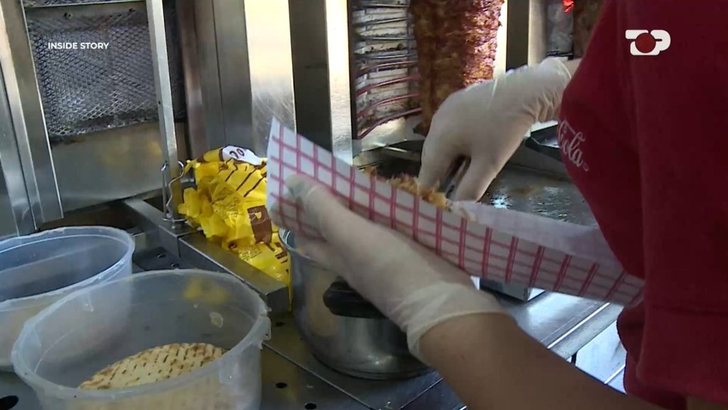
At the beginning of 2024, during an inspection of a meat processing facility called “AL Çeki” in Korca, a meat processing factory, the presence of salmonella was found. Referring to the practice followed by the National Food Authority, from the analysis of 7 products, 2 resulted in the presence of Salmonella. It was about 38 kg of minced meat and 92 kg of grilled pork.
The company was fined 100 thousand lek and the entire production line was also blocked, on the condition that the entity find the source of the infection.
The findings of the AKU inspectors were not accepted by the company's administrator. He refused to sign the report, claiming that he did not believe in the results of the analyses conducted at ISUV.
The exact amount of infected meat that ended up on consumers' tables is unknown. We contacted the company in question with a request for information, asking a series of questions about the amount of meat that was traded, the measures taken to avoid the risk, and the company's own stance, but we received no response by the time the documentary aired.
The lack of transparency not only constitutes an avoidance of responsibility, but also the risk that the phenomenon will be repeated.
Inside Story's research shows that in addition to the Al-Çeki company, other entities accused of salmonella have not accepted the results of the analyses conducted within the country. In some cases, they have privately sent them to laboratories outside Albania.