"We are drowning..." - From Lisbon, Milan to Tirana, "The Guardi...
/ 2026-10-18 23:13:32Focus


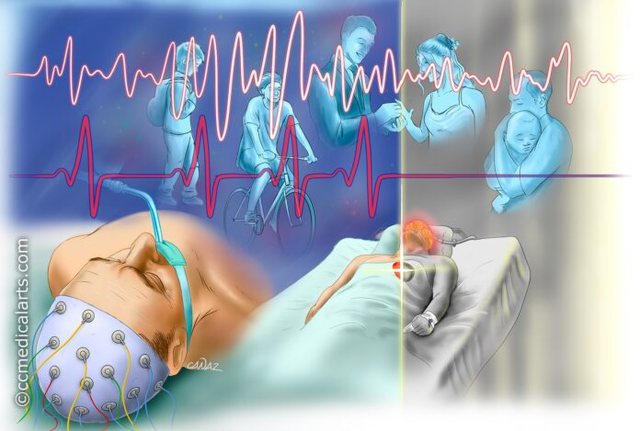
Scientists have long sought the answer to what happens in our brains in the moments before death.
Now, a team of neuroscientists have recorded the brain activity of a person on the verge of death for the first time.
According to the data, it seems that during those moments we see a “life summary”. These have been reported by many people who have experienced clinical death or have been very close to death and have said that they saw their entire life as a very fast autobiographical film. This is similar to the everyday expression “life flashed before my eyes”.
The recording in question was made on an 87-year-old patient who went into cardiac arrest while being treated for epilepsy. Doctors had placed a device on his head to monitor brain activity, but the elderly man died.
They recorded 900 seconds of brain activity around the time of death, which allowed them to see what happened in the 30 seconds before and after his heart stopped beating.
Brain wave measurements showed that the areas that control memories were still active.
"Just before and after the heart stopped, we saw changes in a specific range of neural oscillations called gamma oscillations, but also in delta, theta, alpha and beta ones," explains Dr. Ajmal Zemmar from the University of Louisville in Kentucky.
Brain waves are repetitive patterns of electrical impulses that are present in the brain of a living person. Their various types reflect different brain functions and consciousness. Gamma waves are involved in higher cognitive functions such as memory.
"By producing brain waves that include memories, the brain may be playing a summary of life's most important events shortly before death, similar to near-death experiences."
The researchers said the brain may be biologically programmed to cope with the transition to death, perhaps by orchestrating physiological and neurological episodes rather than simply ceasing to function.
They are not entirely sure how and why this phenomenon occurs, but they have some theories.
One is that reduced oxygen can release neurotransmitters, or chemical messengers that relay signals between neurons. These neurons are quickly activated, and increased activity can lead to the perception of vivid memories and images.
Another possible explanation could be the storage of memories. Scientists believe that highly emotional memories are stored in the amygdala, the area of the brain that is also responsible for quick reactions. Its activation during a life-threatening episode can release vivid memories, causing them to appear before our eyes.
Neuroscientists say the discovery raises new questions, particularly around organ donation. It changes the discussion about death, and it's unclear when organ donation can resume.
However, they are very aware that they cannot rely solely on this case, as this patient's brain had suffered hemorrhage, seizures, and swelling, so other patients will be considered in the future.