Protests, violence, curfews: From France to Albania, why Europe'...
/ 2026-10-20 23:47:20Focus


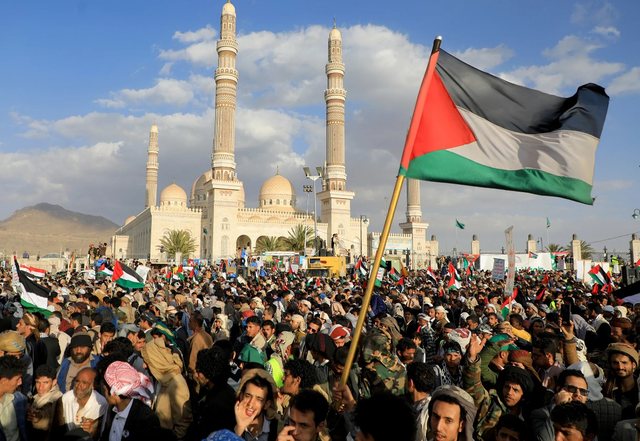
Some Arab countries behind the scenes maintain close relations with Israel. The others are the hearth of Iranian-backed groups and consider themselves part of the "axis of resistance" against the U.S. and Israel.
Jordania: Akt balancues
Jordan, a constitutional monarchy constantly needs to balance. One in five people in Jordan, including the queen, are of Palestinian origin. Support for Palestinian statehood and equal rights are the desire of many locals, and the country's leaders often speak out about it. But Jordan is also close to Israel and the US, perhaps more than many locals want, experts say. In 1994, Jordan signed a peace agreement with Israel. The two nations work together on security-related issues, such as security at the Al-Aqsa mosque compound.
In 2021, the U.S. and Jordan signed a defense cooperation agreement that allows American forces, vehicles and aircraft to enter and move freely across Jordan. In April this year, when Jordan presumably helped shoot down Iranian missiles crossing its airspace towards Israel, many locals saw this as a betrayal. Jordan maintains diplomatic relations with Iran as well, but they tend to be cold. Jordanian Foreign Minister Ayman Safadi's recent visit to Iran to discuss escalating tensions in the region was one of the rare ones.
Egypt: Self-interest and diplomacy
Neighboring Egypt, under the authoritarian governance of Abdel Fatah el-Sisi, must also carefully balance its relations with Israel. Since signing a peace treaty with Israel in 1979, "Egypt has tried to balance its national interests, particularly those regarding insecurities in Sinai with support for the Palestinian cause," a May report by the International Crisis Group said. "Concretely, this effort has meant the refusal of any direct responsibility for the plight of the people in Gaza, supporting efforts to reach a diplomatic solution based on the two-state solution."
The topic of security and economic cooperation with Israel have a common part of relations, and until the start of the Gaza conflict, Egypt was responsible for the Gaza-Egypt border crossing at Rafah. Israeli demands to be allowed to control the area are problematic for Egypt, as is the potential for the increasingly deteriorating humanitarian situation in Gaza to flow into refugee flows into Egyptian territory. The Egyptian government previously opposed Hamas, seeing it as an Islamist organization and a threat to it. But recently, that position has changed somewhat and Egypt has played an important role in the ceasefire negotiations. Egypt's relations with Iran have also improved since 2023, but they also tend to be chilly.
Liban: Hizbollahu
Lebanon, a parliamentary democracy, has itself been saddled with a grave political and economic crisis these years. The country has had no elected government since 2020 and is facing one of the worst crises in the world. Before that, the Lebanese government was always made up of representatives of the country's many different religious and ethnic groups.
Hezbollah's political wing represents the interests of Shia Muslims and plays an important role in governing Lebanon. It must balance its interests with those of other powerful groups, including Lebanese Christians, Sunni Muslims and Druze. Hezbollah's military wing is something else. It is categorised as a terrorist organisation by the US and some European countries and is thought to be better equipped and organised than Lebanon's army itself. Many Lebanese and local politicians don't necessarily want Hezbollah to start a larger war with Israel. But Lebanese politicians also know they have little control over Hezbollah, which is the powerful player in the so-called "axis of resistance," a free coalition of militant groups backed by Iran and in opposition to Israel and the US.
Iran-backed Syria
Since the creation of the state of Israel in 1948, Syria has considered itself at war with its neighbor. There are often exchanges of fire between the two sides, though they are considered largely symbolic. Syrian dictator Bashar Assad is in power today thanks to Iran, which supported him militarily during the country's 13-year civil war. This also explains the growing presence of pro-Iran militias in Syria, including hezbollah members and others from Iraq. This has led to intensifying Israeli attacks from 2017 and further escalation since the October 7 hamas terror attack against Israel. An April attack by Israel on the Iranian diplomatic compound in Damascus, Syria's capital, where a senior Iranian commander was killed led to Iranian retaliation.
Iraq: Against outside interference
Iraq does not recognize Israel, and although the Iraqi government — currently dominated by Shia Muslim politicians — has grown closer to Iran over the past decade, the Palestinian issue crosses religious dividing lines, experts say. Within Iraq there are a range of militant groups that also belong to Iran's "axis of resistance." These groups have previously hit U.S. bases inside Iraq with rockets and have also tried, but largely failed, to hit Israel. The UNITED States has responded to them. The Iraqi government and its security forces tend either to tolerate these groups or have little contact with them. "Iraq has always been forced to balance its relationship between the U.S. and Iran," Marsin al-Shamary, a research fellow at the Brookings Institution, a Washington-based political institute, said recently.
"This is not new to Iraqi leaders. Baghdad's relationship with Washington has had the clear lines, especially with regard to Iraq's position on Israel. Iraq has consistently supported the Palestinian cause, and its position on this current conflict has not been shaped by Iran's support for Hamas."
Gemein: Gajithka Lidhet Me Huthit
Due to a civil war, Yemen is divided between the internationally recognized government in Aden, southern Yemen, and the Huthi rebel group in northern Yemen. Neither side recognizes Israel. Yemen's neighboring country, Saudi Arabia, previously led a coalition against the Huth, but since a ceasefire was signed in early 2022 there has been a relative calm. The Huths are also considered part of the "axis of resistance.". They support Hamas, claim Israel is a destabilizing force in the Middle East and oppose the U.S. presence in the region. In November last year, they began launching rockets in the direction of Israel and blocking maritime traffic in support of Hamas.
Saudi Arabia, uae and Qatar: Pragmatic and rich
The autocratic monarchies of the Gulf Arab states meanwhile take a more pragmatic approach to the current conflict. They see Iran as the enemy and have long been working to normalize relations with Israel. In 2020, the United Arab Emirates and Bahrain signed the so-called Abraham Agreements, with which they established diplomatic contacts with Israel. Saudi Arabia seemed to be the next country to take this step.
And Qatar was more of a place of intermediaries. He avoids normalizing relations with Israel, but in fact established economic ties with it as early as the 1990s. Because Hamas' political wing is also expected in Qatar, the country has played an important role in the ceasefire negotiations.