Peqin, a new '5D'? The Municipality Secretary creates a company ...
2026-11-19 14:17:00Focus


The meeting between Xi Jinping, Donald Trump and Vladimir Putin in Shenzhen, on the sidelines of the APEC (Asia-Pacific Economic Cooperation) summit, was not simply a protocol meeting or a joint photo opportunity.
It could mark a significant moment in international relations, as the three leaders of the major nuclear powers presented a new vision for world order.
The four-point joint statement, published after the meeting, contains principles that could change the way the international system functions, calling into question some of the rules established after World War II and the end of the Cold War.
Although not directly mentioned, the declaration's messages are clear: Ukraine remains outside the agreements of the great powers, Europe's position is weakened, and the role of international institutions is called into question.
Essentially, the document suggests that the world could be moving towards an order where the most powerful states set the rules, while smaller countries have little opportunity to challenge them.
Energy and Ukraine, out of the spotlight of the agreement
One of the most important points of the declaration is related to energy supply. The three leaders state that they will increase the supply of refined petroleum products, in function of the needs of all countries. They also emphasize the importance of maintaining the stability of energy supplies.
According to the analysis of Corriere della Sera, these formulations can be interpreted as support for the continuation of trade in Russian energy products and as a weakening of the effect of Western sanctions against Moscow. At the same time, the statement does not directly address the Ukrainian attacks on Russian refineries.
It remains unclear whether Xi Jinping's emphasis on the stability of energy supplies also constitutes a distancing of China from Iranian military actions that could impede the transport of oil through the Strait of Hormuz.
Following the announcement, prices of some refined products also fell, such as diesel by 0.9% and crude oil for processing, known as industrial oil (naphtha), by 2.2%. Corriere della Sera links this development to expectations of increased supplies from China, which has significant refining capacity.
A blow to international institutions and the role of Europe
Another point of the statement directly affects the International Criminal Court and other similar institutions. The three leaders emphasize that the immunity of state representatives is essential and that international courts should not exceed their jurisdiction.
According to Corriere della Sera, this stance weakens the role of international justice and creates space for political leaders to evade responsibility for their actions.
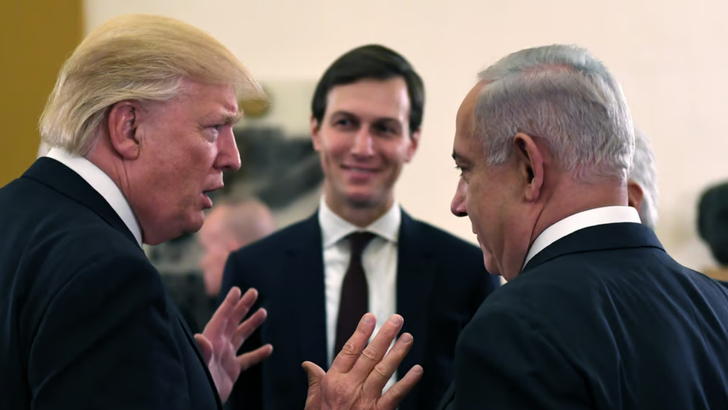
In this context, Vladimir Putin and Israeli Prime Minister Benjamin Netanyahu are mentioned, who have faced proceedings at the International Criminal Court. Putin is the subject of an arrest warrant from this court, while Netanyahu is also the subject of an arrest warrant related to the war in Gaza.
Corriere della Sera argues that such an approach weakens one of the main instruments through which Europe has sought to exert influence on international politics: respect for international law and responsibility for its violations.
This constitutes, according to the analysis, a step back in relation to the principles established after World War II, when the Nuremberg trials and subsequent trials for war crimes in the former Yugoslavia strengthened the foundations of international justice.
A new world order, where might rules, not right?
For Europe, respect for international law, universal human rights and multilateral institutions constitutes one of the foundations of its foreign policy.
But the vision pursued by Trump, Putin, and Xi seems to center on the power of states and the right of their leaders to act in the name of national interests, without necessarily being subject to international accountability mechanisms.
According to Corriere della Sera, this approach moves the world away from the principles of the international order built during the 20th century and brings it closer to the logic of the 19th century, when great powers determined the fate of weaker states through their influence and strength.
The statement also mentions the need to reform the United Nations. However, the analysis raises concerns that this idea could aim to create a forum where key decisions are made by the great powers, without equal representation for other states.
In such a scenario, European countries would risk losing their influence, as none of them, taken individually, has the same weight as the powers that dominated the Shenzhen meeting.